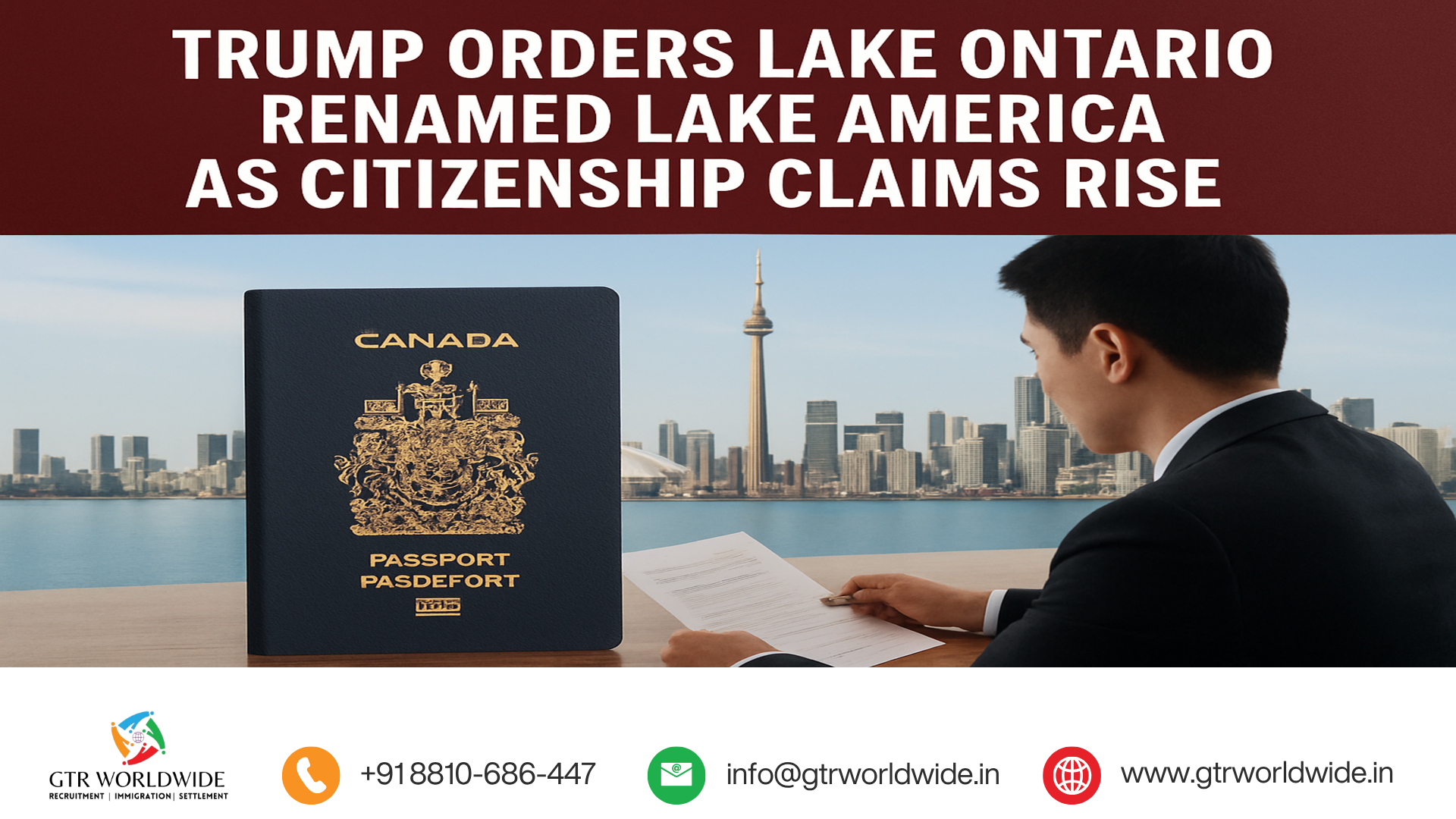
Renaming Lake Ontario and the surge in U.S. applications for Canadian citizenship: what immigrants and applicants need to know
Why this matters for immigration and cross‑border ties
On August 27, U.S. President Donald Trump signed an executive order directing federal agencies to call Lake Ontario “Lake America.” Within hours, Canadian political leaders pushed back — Prime Minister Mark Carney noted the lake’s name predates both countries by more than 400 years, and Ontario Premier Doug Ford said, “No one is going to call it Lake America.” The dispute is a symbolic flashpoint in a wider rupture that also includes tariffs and trade measures introduced in 2025. For people exploring Canadian citizenship or cross‑border moves, these political developments sit alongside concrete legal changes — notably Bill C‑3 — that are already affecting who can claim Canadian citizenship by descent and how long proof‑of‑citizenship applications take to process.
How the diplomatic spat ties to rising citizenship demand
The naming incident came amid an escalating trade conflict that began when the U.S. imposed tariffs on Canadian goods in February 2025. Canadian leaders described some U.S. proposals as “uneconomic” and “unfair,” and provinces reported concrete responses such as limits on the sale of certain U.S. products. Those economic pressures, together with the December 15, 2025 change to Canada’s citizenship law (Bill C‑3), have coincided with a marked increase in U.S. applications for proof of Canadian citizenship.
What Bill C‑3 does in practice
Bill C‑3 removed the “first‑generation limit” on citizenship by descent. Practically, that means people born abroad who can document a direct line to a Canadian ancestor — parent, grandparent, great‑grandparent or earlier — may now be Canadian citizens. Eligible people apply for a citizenship certificate (proof of citizenship) rather than going through naturalization; this confirmation does not require a citizenship test or taking the Oath of Citizenship. A certificate allows the holder to obtain a Canadian passport and access the rights tied to citizenship.
Who is showing up in the numbers
Since the law change, U.S. applications have surged. Reported figures show that in January 2026 U.S. applications for citizenship certificates outnumbered the combined total from the next nine source countries. Backlogs grew quickly: pending proof‑of‑citizenship files rose from 70,400 in May 2026 to 121,800 in August 2026. Archives and registries that issue historical records report unusually high demand, with some seeing years’ worth of requests in a few months.
Why many Americans qualify now
Two main reasons explain the spike:
– Historical migration: large flows of Canadians to the U.S. over the past two centuries — for example, an estimated 900,000 French Canadians who moved to New England between 1840 and 1930 — have left many Americans with Canadian ancestors now covered under Bill C‑3.
– Political and personal contingency: increased political uncertainty in the U.S. has led some Americans to pursue dual citizenship as a backup. Investor‑oriented and other dual‑citizenship applications rose in this period, and polls cited in coverage show growing interest in dual nationality, especially among younger cohorts.
What proof of Canadian citizenship provides — and what it does not
– A citizenship certificate is legal proof of status and allows the holder to obtain a Canadian passport.
– It does not require renouncing U.S. citizenship; both countries permit dual nationality.
– Simply receiving a citizenship certificate does not create Canadian income‑tax obligations; Canada taxes on the basis of residency. Only if someone moves to Canada and becomes a tax resident would they need to address Canadian income tax, subject to the U.S.–Canada tax relationship.
– Practical benefits include children being able to study in Canada without a study permit, eligibility for International Experience Canada for those under the referenced age limit (“under the age of 30 or 35”), and, if residency is later established, access to provincial public healthcare and social supports.
Who is most directly affected
– Applicants with Canadian ancestry who can document lineage.
– Families seeking easier education or mobility for children.
– Young adults who may qualify for work‑holiday programs.
– Workers and businesses in sectors hit by trade measures (agriculture, construction) and in provinces identified as more exposed.
– Archives and document services facing heavy demand for records.
Practical impacts for prospective applicants
– Expect longer waits: processing backlogs and strained archives mean applications and record retrieval can take much longer.
– Documentation is essential: you must prove a direct descent line, generation by generation, following IRCC criteria. Missing or incorrect documents cause delays.
– No test or oath for confirmation applicants: this route is a documentary confirmation, not a naturalization process.
– Tax and residency: acquiring a certificate alone doesn’t trigger Canadian income tax; tax obligations depend on establishing Canadian residency later.
– Benefits for children and young adults are immediate once citizenship is documented.
Documentation and steps to prioritise
– Identify your anchor ancestor by speaking with oldest relatives and tracing the family line carefully.
– Request primary documents early: birth, marriage, death and immigration records are commonly required. Archives may be slow, so start now.
– Follow IRCC’s documentary requirements precisely for each generation.
– Plan for delays and consider professional help for complex cases (adoptions, name changes, missing records).
– Balance urgency with completeness: incomplete files can be returned for clarification and add time to processing.
Administrative pressures and what to watch
IRCC capacity and archival services are under strain, which affects timelines and record availability. Continued trade and political tensions may keep demand elevated. Applicants should monitor official IRCC guidance for procedural updates and information about acceptable alternative documents if record retrieval is delayed.
Questions to ask before applying
– Can I identify an anchor ancestor and obtain required documents for every generation?
– Am I prepared for extended waits for archival records and processing?
– Do I understand what a citizenship certificate provides and what it does not (tax, residency implications)?
– Will dual citizenship help my family’s education, healthcare or mobility plans if cross‑border life becomes less predictable?
– Should I consult a licensed immigration lawyer for complicated family histories?
For personalised support with your Canadian immigration pathway, contact GTR Immigration. Call us: +91-8810-686-447
#CanadianCitizenship #BillC3 #ProofOfCitizenship #DualCitizenship #IRCC #CanadaImmigration #CrossBorderPolitics
Leave a Reply