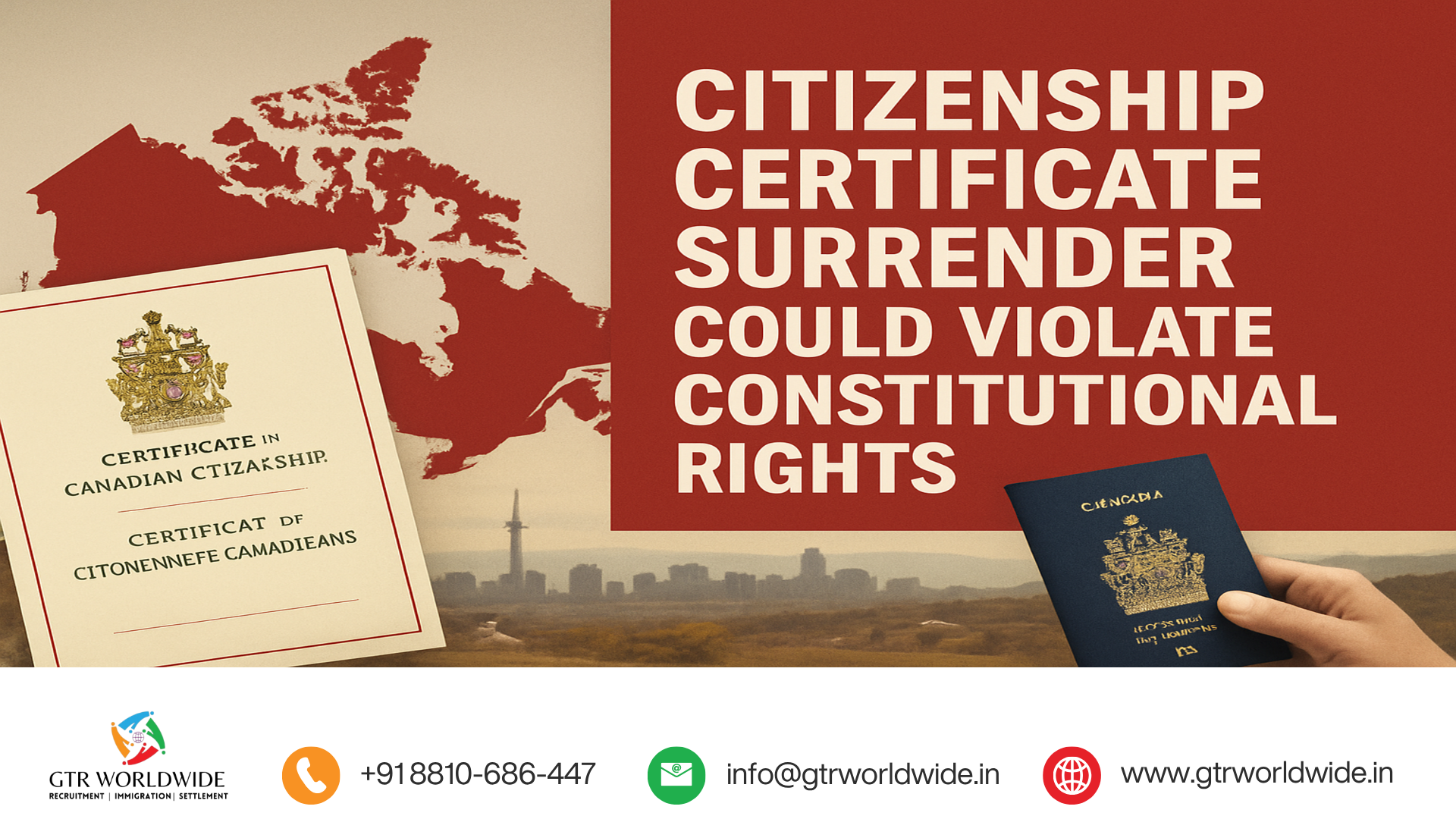
Surrender Orders under Citizenship Regulations 26(1): What the June 13, 2026 Registrar Letters Mean for Proof of Canadian Citizenship
Immediate summary
On June 13, 2026 the Registrar of Citizenship sent mass letters asking people born outside Canada to immediately surrender their Canadian citizenship certificates while investigations proceed. The Registrar relied on Citizenship Regulations 26(1), which lets the office require surrender of citizenship certificates when there is reason to doubt entitlement or compliance with the Act. Immigration lawyer Ala Bujac told CIC News on June 17, 2026 that this broad use of the regulation may discriminate against citizens by descent and could raise an equality challenge under section 15(1) of the Canadian Charter of Rights and Freedoms. The practical concern: many overseas-born Canadians use the certificate as their primary proof of citizenship, and surrendering it can limit their ability to show they are citizens even though their legal status remains unchanged.
How the regulation was applied
Regulation 26(1) permits the Registrar to require surrender of various citizenship certificates when there is reason to believe a person is not entitled to the document or has breached the Act. On June 13 the Registrar applied this authority to a group of people born outside Canada by issuing mass surrender letters, removing possession of the physical certificate while inquiries continue. In effect, this is a preventive administrative step that temporarily takes away the documentary proof of citizenship.
Why this raises a constitutional issue
Section 15(1) of the Charter protects equality and prohibits discrimination on grounds including national or ethnic origin. The letters were directed at people born outside Canada—typically citizens by descent—while people born in Canada normally rely on provincial birth certificates to prove citizenship. Birth certificates are not covered by Regulation 26(1) and therefore are not subject to surrender. That difference in practical ability to prove citizenship is the core of the possible Charter claim identified by Bujac: citizens by descent may be disadvantaged in practice because they can be forced to give up the document many institutions require as proof.
If a court finds s.15(1) engaged, the next step would be a s.1 analysis to decide whether any infringement can be justified as a reasonable limit. Any Charter litigation would likely take years to resolve, leaving affected people uncertain in the interim.
Practical effect on proof of citizenship
A citizenship certificate is often the primary documentary proof for Canadians born abroad. Surrendering it does not revoke citizenship, but it can create a gap between legal status and the ability to demonstrate that status to officials or institutions that ask for documentary evidence. Citizens born in Canada usually rely on birth certificates, which are not included in the surrender power, so the practical difference between groups is the basis of the equality concern.
Who is directly implicated
The letters targeted persons born outside Canada—those who obtained citizenship by descent. The source does not specify how many people were affected, the precise selection criteria, the expected length of investigations, or any interim solutions for those who need to prove citizenship urgently.
Practical advice based on the source
– Preserve copies of any Registrar communications and any documents you are asked to surrender.
– Keep a record of dates and all correspondence. The letters were issued June 13, 2026; public commentary from Ala Bujac appeared June 17, 2026.
– Note that, according to the source, provincial birth certificates are not subject to surrender under Regulation 26(1).
– Expect uncertainty: a legal challenge could take years, so plan for an interim period without the physical certificate.
– Seek individualized legal advice for your situation; the source does not describe administrative remedies or interim proof solutions.
What the source does not answer
The article does not provide numbers, selection criteria, timelines for investigations, procedures for urgent proof needs, or how and when surrendered certificates might be returned. These gaps contribute to practical uncertainty for affected Canadians.
Why the legal distinction matters
The key point from the source is that surrendering a certificate does not remove citizenship in law but can remove the documentary proof people need in practice. That distinction—legal status versus ability to demonstrate it—drives both the lived impact and the potential Charter challenge.
For personalized support with your Canadian immigration pathway, contact GTR Immigration. Call us: +91-8810-686-447
#CanadianCitizenship #CitizenshipRegulations #CharterRights #ProofOfCitizenship #CitizensByDescent #ImmigrationLaw #AdministrativeLaw #GTRImmigration
Leave a Reply