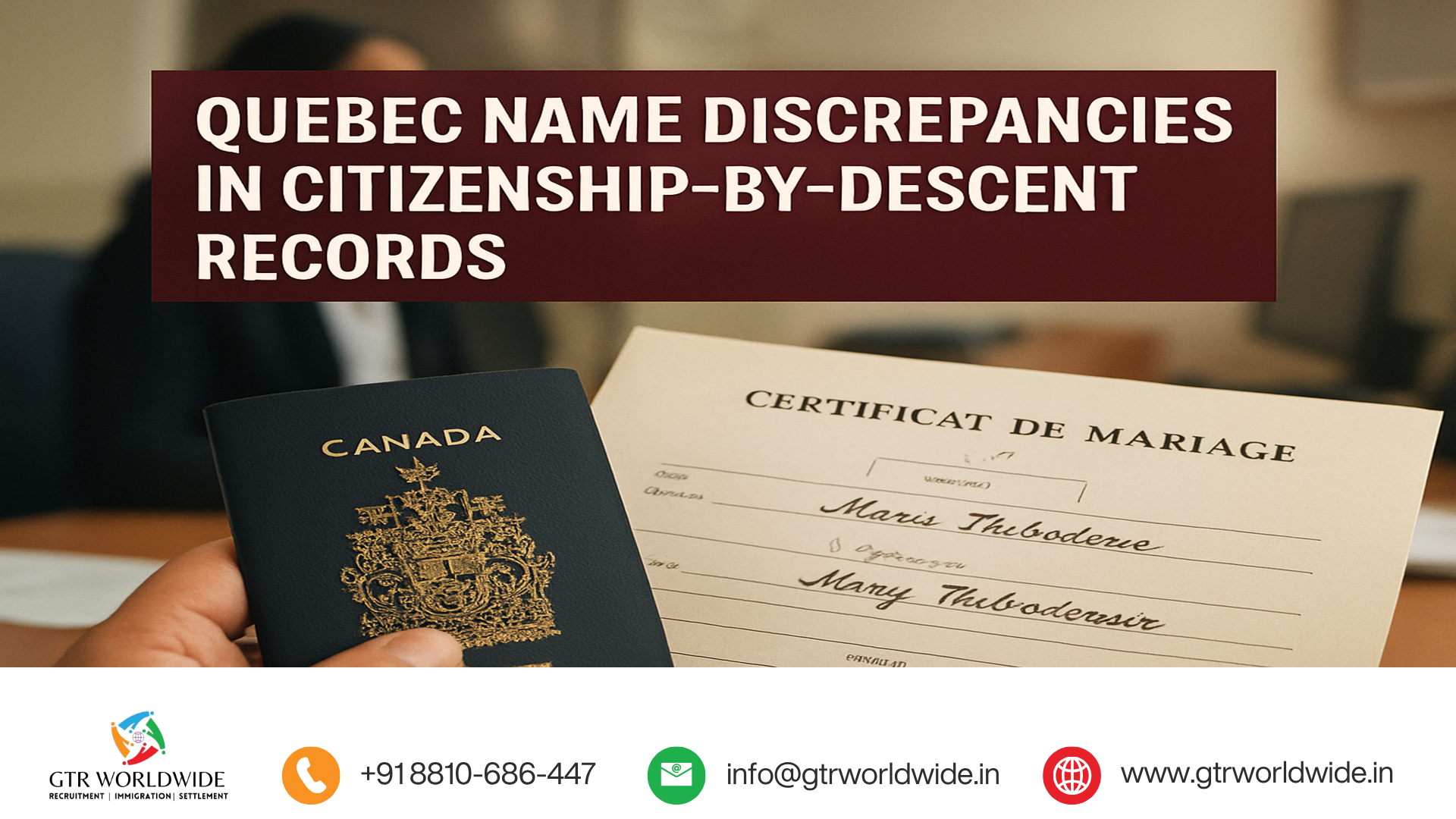
Quebec registrar’s new name-correction powers and what it means for citizenship by descent claims
Why the June 11, 2026 update matters
On June 11, 2026 the Directeur de l’état civil (DEC) gained expanded authority to correct a person’s name on provincial civil-status acts so the name matches the name on their act of birth. For applicants building a chain of descent for Canadian citizenship by descent, this administrative power can resolve common spelling or anglicization gaps and reduce IRCC resubmission requests. If your chain includes Quebec records, this change should shape how you search for, order, and — when needed — correct documents.
How Quebec’s records are split — why two offices matter
Quebec’s records sit in two places:
– DEC holds civil-status acts less than 100 years old. These are the records the DEC can correct under the new authority.
– Bibliothèque et Archives nationales du Québec (BAnQ) keeps older parish registers, some dating back to the 1600s. The DEC transfers another year of registers to BAnQ each year.
The DEC has not confirmed that its new power covers BAnQ holdings for pre‑1926 records; assume it does not until told otherwise. Also note that IRCC rejects Quebec birth and marriage certificates issued before January 1, 1994 — an important constraint when deciding which documents to order.
What the DEC can do — scope, examples and limits
The DEC can align the name on a provincial act with the name shown on the birth act, and can correct clerical errors (misspellings, wrong place or date) when supported by valid evidence.
Examples the registrar cites include a person whose foreign birth act uses “Maria” while a Quebec marriage act shows “Marie” — presenting the birth act (with translation if needed) may allow the Quebec act to be changed to “Maria.” The power is intended to reduce discrepancies such as anglicized Franco-American variants like “Marie” vs. “Mary,” where evidence supports it.
Important limits and consequences:
– The DEC cannot change records issued by other provinces, U.S. states, or foreign authorities.
– Corrections themselves are free, but any certificate already issued for an act that is corrected will be cancelled; you must reorder and pay for replacement certificates.
– The registrar may also correct acts on its own initiative while processing a file.
– Deliberately false declarations at the time (for example, falsified ages) can only be changed by a court.
Who can request a correction — consent and practical limits
The DEC sets who may file correction requests:
– Birth acts: the adult whose act is concerned; one parent of a minor; or one parent of an adult (but an adult must still consent to corrections to their own act).
– Death acts: the person who declared the death, the funeral director, the spouse or civil union spouse, the deceased’s parents, or the deceased’s children.
Grandchildren and great‑grandchildren are not listed for death-act requests. The DEC’s published list applies to clerical errors; there is no separate published list for the new name-standardization power. For applicants tracing multiple generations (for example a great-grandchild seeking correction of a great-grandmother’s act), these limits affect who can apply and what supporting documents you may need.
Suggested workflow to avoid wasted time and cost
Many applicants spend money on certificates before checking what the original register shows. Follow this sequence:
1. View the free BAnQ image where available. BAnQ has digitized many parish registers.
2. Transcribe the entry exactly — letter for letter — including date, parish, and parents’ names.
3. Decide whether you need a correction or just a certified copy. If a DEC certificate already matches the birth act, a correction may be unnecessary.
4. Order only the records each generation requires and proceed generation by generation. Skipping steps often leads to paying for a certificate that later gets cancelled and must be reordered.
How multi-jurisdictional chains play out — an example
Example: you, a U.S.-born parent and grandparent, and a great-grandmother born in Quebec in 1905.
– The 1905 baptism is with BAnQ (pre‑1926) and is not automatically subject to DEC’s new power.
– A 1928 Quebec marriage act (98 years old) still sits with the DEC; as a great-grandchild you fall outside the DEC’s softened list of relatives and may need to justify your interest and provide supporting documents.
– Other records (U.S. births, marriages, deaths) follow each issuing state’s rules.
Cost and timing contrast:
– BAnQ charges non-residents $350 for the first certified copy and $100 for each additional; Quebec residents pay $55 for the first copy. Processing times vary by archive centre and volume.
– DEC fees (at the time of the source material) are lower: a birth act was $46.75 online or $64.25 by mail; accelerated online processing cost $75.00 and ships by Xpresspost to Canadian addresses only. The DEC publishes 10 business days for normal processing (excluding delivery).
The takeaway: the oldest record (usually with BAnQ) often sets cost and timing. File BAnQ requests first and treat them as the schedule driver.
IRCC document standards and proving a missing record
IRCC requires authentic, reliable and verifiable documents issued by the original authority. If an official record is unavailable, IRCC asks applicants to explain why and to show proof of attempts to obtain it.
Quebec tools that help, but don’t fully replace certificates:
– DEC attestation: a letter confirming whether an act sits in the Quebec register. It is not a certificate or a copy of the act and many organizations will not accept it as proof the event occurred; its main value is to document your search. The DEC charges a fee for the attestation and a separate search fee.
– BAnQ: it will not issue a signed letter certifying absence. If nothing is found, BAnQ emails you; that email and your search records are what you file with IRCC for pre‑1926 ancestors.
Administrative caveats applicants must know
– Ordering many certificates or repeated requests may prompt the registrar to ask for more justification.
– The DEC issues documents only to people named in the act or to those who establish their interest. If your name is not on the act, you must explain why and attach supporting documentation (examples the registrar gives include a power of attorney or a will). For deceased persons, closer relatives (spouse, child, sibling) can establish relationship through acts already in the Quebec register.
– If the DEC corrects an act after you obtained a certificate, the earlier certificate is cancelled and you must pay for a replacement.
Practical checklist — what to do next
– Start with BAnQ: search and view the parish register image and transcribe the entry exactly.
– Only order a DEC certificate after confirming what the original register shows and whether a correction will be needed.
– If you find a discrepancy, check who is eligible to request a correction under DEC rules and whether an adult’s consent or supporting documents are required.
– Request a DEC attestation to document searches of the DEC register; keep BAnQ email confirmations and your search notes for pre‑1926 records.
– Plan timing around BAnQ’s variable delivery times; treat DEC processing as relatively quick but remember delivery and accelerated shipping limits.
– Budget for the possibility that a DEC correction will cancel a certificate you purchased and that you may need to reorder.
Final observations
The DEC’s new power to align names with a birth act is a useful administrative tool for applicants with name variations in Quebec records. It can reduce IRCC resubmissions and alter document-gathering strategy, but it does not solve all evidence gaps. Limits on who may request corrections, DEC’s inability to alter records from other jurisdictions, and BAnQ’s different procedures mean this change requires planning rather than being a complete fix.
For personalized support with your Canadian immigration pathway, contact GTR Immigration. Call us: +91-8810-686-447
#citizenshipbydescent #QuebecRecords #DirecteurDeLEtatCivil #BAnQ #CanadianImmigration #DocumentGathering #NameCorrection #IRCC
Leave a Reply