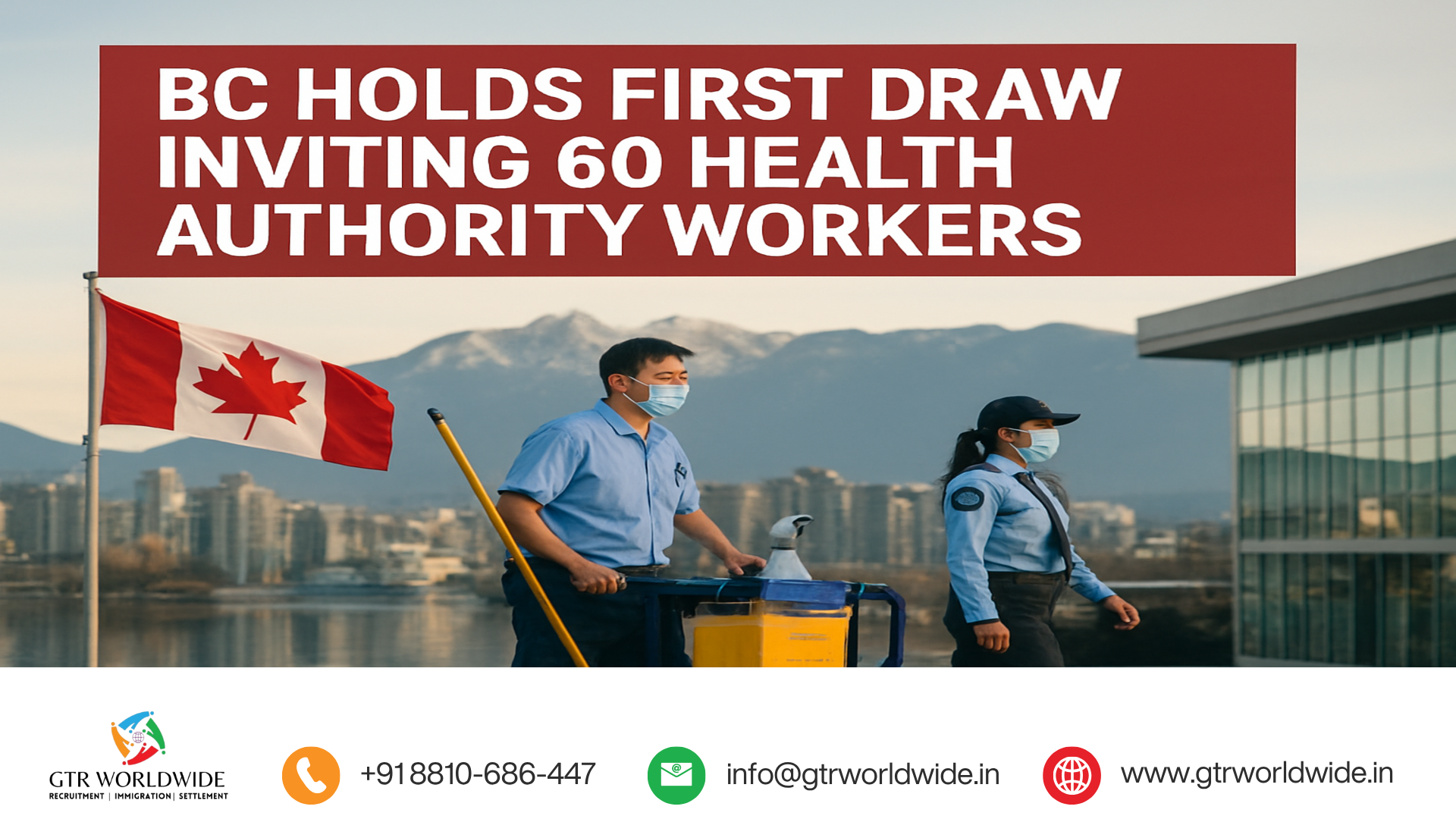
British Columbia Temporary Rural / Remote Health Support initiative (TRHSI): July 23 draw and what applicants need to know
On July 23, B.C. ran the first selection round under its new TRHSI, inviting 60 cleaning and security workers employed by a B.C. health authority to apply for provincial nomination. The initiative is a one-time, time-limited pathway that can nominate up to 250 health authority cleaners and security staff for permanent residence. Registrations opened June 15 and will be accepted through August 31, 2026. The draw used the province’s lowest cut-off score of the year — 50 points — which suggests relative accessibility within the targeted pool, but the pathway remains narrowly focused and subject to strict rules.
Why TRHSI was created
TRHSI is part of a broader restructuring of the British Columbia Provincial Nominee Program that refocuses priorities on three pillars: Care (health and care-related services), Build (infrastructure and major projects), and Innovate (long-term economic growth). The shift follows a reduction in B.C.’s federal nomination allocation: the province’s annual quota fell from 8,000 in 2024 to 5,254 in 2026, despite B.C. having requested 9,000 slots for 2026.
Key eligibility and operational rules
– Eligible occupations (exact NOC codes): Janitors, caretakers, and heavy-duty cleaners (NOC 65312); Light-duty cleaners (NOC 65310); Security guards and related security service occupations (NOC 64410).
– Location: the job must be in a qualifying rural or remote area. Certain regional districts are excluded: Central Okanagan, Metro Vancouver and the Capital Regional District — with exceptions for Galiano Island, Mayne Island, Pender Island, Salt Spring Island and Saturna Island.
– Employment and continuity: candidates need a “regular, indeterminate, full-time” job in an eligible occupation with the same employer. They must have completed at least nine months of full-time employment in that occupation with the same employer before registration, and must keep the valid job offer and continue working full-time through the application process.
– What does not count toward the nine months: work done while in Canada on a study permit (including co-op placements) and any leave longer than two weeks during the qualifying period.
– Health authority support: B.C. names eight public health authorities; each has its own internal selection process. Applications require confirmed support from an authorized representative of the relevant health authority. B.C. did not disclose which occupations were represented among the 60 invited candidates in the first draw.
– Education and income: candidates must hold a high school diploma, meet the minimum income requirement for the full nine-month qualifying period, and satisfy the general Skills Immigration requirements.
Who is likely helped — and who is excluded
TRHSI mainly benefits front-line cleaners and security staff employed by one of the eight public health authorities in qualifying rural/remote areas who meet the nine-month continuous, full-time requirement and have health authority support. Workers in excluded urban regional districts, those whose qualifying employment includes study-permit or co-op time, anyone with leaves over two weeks during the qualifying period, or applicants lacking a high school diploma or the required income do not meet the criteria. Employment by a health authority does not guarantee nomination — the authority must provide documented support.
Operational realities for employers and applicants
Health authorities control which employees they will back. The eight authorities are: First Nations Health Authority; Fraser Health; Interior Health; Island Health; Northern Health; Providence Health Care; Provincial Health Services Authority; and Vancouver Coastal Health. Each authority’s internal process, priorities and timelines will affect who can register and apply. Candidates must coordinate with both their employer and the health authority to secure the required support and documentation.
Practical impacts and next steps
– Up to 250 nominations are available; the program is important but limited in scale.
– Strict continuity and documentation requirements mean interruptions or employer changes can disqualify otherwise eligible workers.
– Gather nine months of continuous full-time employment records, proof of income for that period, your high school credential, an indeterminate full-time job offer, and confirmed support from the relevant health authority’s authorized representative.
– Confirm your exact NOC code and that your job location is not in an excluded regional district.
– Register with the BCPNP during the open window (registrations accepted through August 31, 2026), but act early: selection rounds have started and nominations are capped.
Important numbers and limits
– First selection round: July 23 (60 workers invited).
– Registration window: opened June 15 and accepted through August 31, 2026.
– Minimum work experience: nine months of full-time employment with the same employer in an eligible occupation.
– Cut-off score in this selection round: 50 points.
– Maximum nominations via TRHSI: up to 250.
– BCPNP annual nomination quota: declined from 8,000 in 2024 to 5,254 in 2026; B.C. requested 9,000 for 2026.
Final note
The July 23 draw and the 50-point cut-off indicate this stream can be accessible for eligible workers, but health authority support and the overall cap mean nomination is not automatic. Early coordination with your employer and health authority and careful documentation are essential.
For personalized support with your Canadian immigration pathway, contact GTR Immigration. Call us: +91-8810-686-447
#BCPNP #TRHSI #BritishColumbia #CanadianImmigration #HealthcareWorkers #PNP #PermanentResidence
Leave a Reply