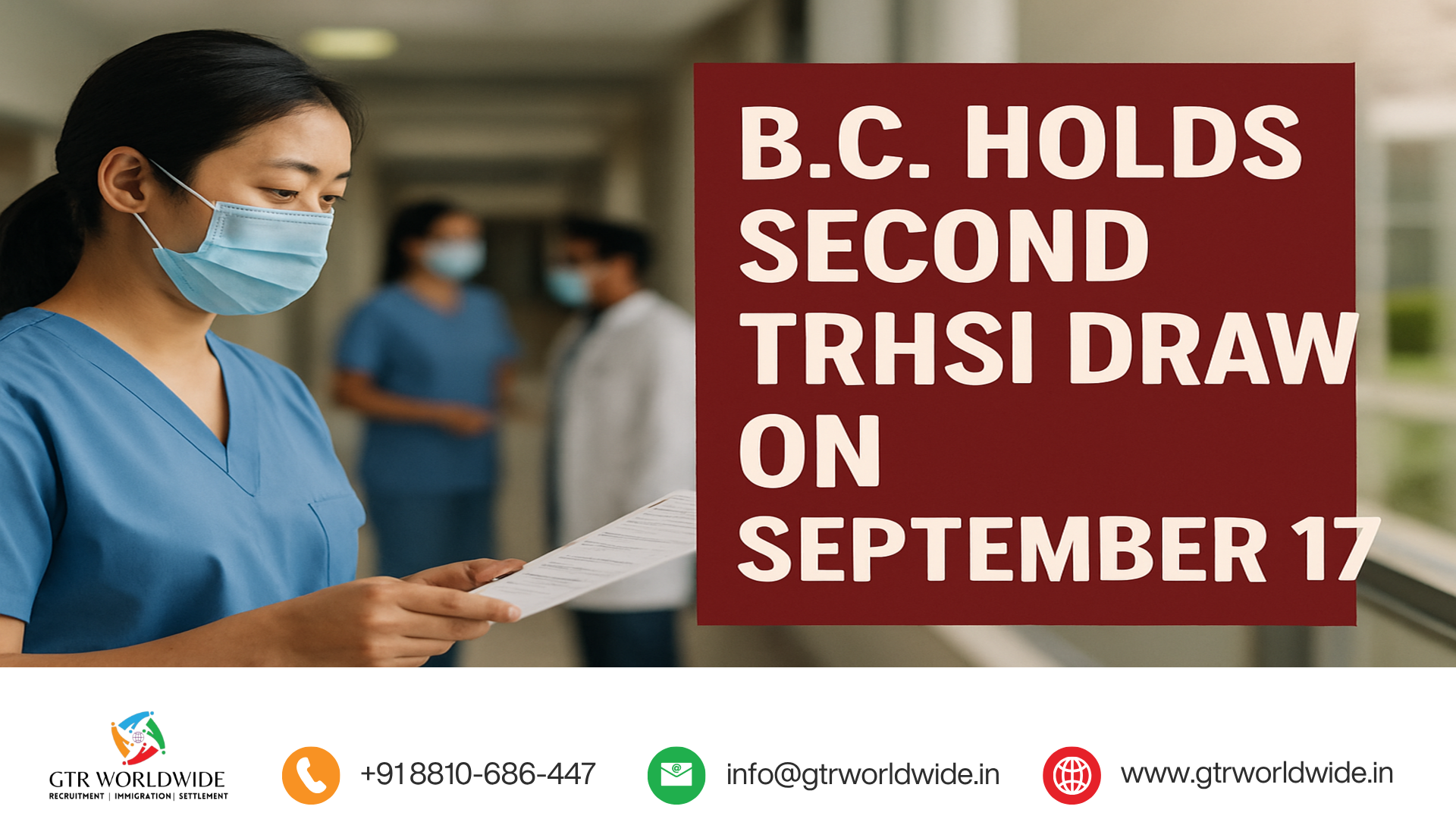
BC PNP TRHSI September 17 Draw: 33 Cleaners and Security Staff Invited — What This Means for Rural Health Workers
Why the September 17 draw matters now
On September 17, 2026, B.C. held its second selection under the Temporary Rural/Remote Health Support Initiative (TRHSI), issuing 33 invitations to cleaners and security staff working for a public health authority in a remote area. The TRHSI is a time-limited provincial pathway aimed at stabilizing staffing in rural and remote health settings. A provincial nomination through the BCPNP lets candidates apply to IRCC for permanent residence (PR) and can help in-Canada nominees access a Bridging Open Work Permit (BOWP) more quickly under a recent federal temporary measure.
How TRHSI fits into B.C.’s broader immigration priorities
TRHSI sits under the BCPNP’s “Care” pillar in the province’s 2026 program restructuring, focused on supporting healthcare and related services. The initiative targets frontline support roles—janitorial, cleaning, and security positions—in eligible rural or remote public health facilities, providing a more direct pathway to nomination for these essential workers.
What happened in the September 17 draw and the trend so far
– September 17, 2026: cutoff score 60, 33 invitations issued.
– July 23, 2026: cutoff score 50, 60 invitations issued.
To date, the BCPNP has issued 93 invitations under TRHSI. The province plans to nominate up to 250 workers through the initiative. Registration remains open until 11:59 p.m. on October 7, 2026 (extended from Aug. 31 due to wildfire-related impacts). The BCPNP has not disclosed which occupations were invited in either round.
Who the TRHSI is designed for — roles and employer types
The TRHSI is open to foreign nationals with a regular, indeterminate, full-time job for a B.C. public health authority in a qualifying rural or remote region. Eligible occupations (NOC references used by the BCPNP):
– Janitors, caretakers, and heavy-duty cleaners (NOC 65312)
– Light-duty cleaners (NOC 65310)
– Security guards and related security service occupations (NOC 64410)
Only workers employed by one of these eight public health authorities qualify: First Nations Health Authority; Fraser Health; Interior Health; Island Health; Northern Health; Providence Health Care; Provincial Health Services Authority; Vancouver Coastal Health. Each authority has its own process to decide which applications it will support; a BCPNP application must be supported by an authorized representative of the relevant health authority.
Key eligibility rules that shape who can register
– Employment must be full‑time, regular, indeterminate, with the same employer in the same region.
– Candidates need at least nine months of continuous full‑time employment in the eligible occupation, with the same employer and in the same region before registering.
– Some periods do NOT count toward the nine-month requirement: work on a study permit, study-related placements (e.g., co-op), and any leave longer than two weeks.
– The job offer must remain valid through registration and application stages, and the worker must continue full‑time employment for the duration of the process.
– Candidates must have at least a high school diploma and demonstrate they met the minimum income requirement for the full nine‑month period, plus meet broader Skills Immigration eligibility rules.
– Certain regional districts are excluded from TRHSI: Central Okanagan, Metro Vancouver, and the Capital Regional District — with island exceptions for Galiano, Mayne, Pender, Salt Spring, and Saturna Islands.
For full job offer requirements, see sections 3.5 and 6.6 of the BCPNP Skills Immigration guide.
What the raised cutoff score and invitation counts indicate
With the cutoff rising from 50 in July to 60 in September while invitations fell from 60 to 33, the published rounds suggest increasing competition or changes in the candidate pool. Possible explanations include a more competitive registry, a phased nomination strategy, or concentration of eligible applicants in earlier rounds. Because the BCPNP has not explained selection rationale or disclosed which occupations were invited, applicants should treat each round as independent and expect variability.
Practical implications for workers, employers and families
– A provincial nomination lets candidates apply for PR, and in‑Canada nominees who apply for PR can seek a BOWP to maintain work authorization.
– As of June 9, 2026, a federal temporary measure waives the requirement to already have an Acknowledgement of Receipt (AOR) before applying for a BOWP for base PNP nominees, effectively shortening the time to BOWP eligibility.
– Health authorities must support applications, so employers play a gatekeeping role; candidates should confirm their authority’s willingness to endorse their application.
– The initiative targets rural and remote needs; workers in excluded regional districts (e.g., Metro Vancouver) are not eligible even if employed by a public health authority.
Numbers, quotas, deadlines and program limits to note
– TRHSI PR pathway launch: June 15, 2026.
– Draws: July 23, 2026 (cutoff 50, 60 invitations); September 17, 2026 (cutoff 60, 33 invitations).
– Total TRHSI invitations issued to date: 93.
– Province’s intended TRHSI nomination ceiling: up to 250 workers.
– BCPNP registration deadline for TRHSI: October 7, 2026 (extended from Aug. 31).
– B.C.’s 2026 overall nomination allocation: 6,254 spaces (after receiving an extra 1,000 spaces from the federal government).
How applicants should prepare and what to monitor next
– Confirm nine months of continuous full‑time employment with the same employer in the same region and document it carefully.
– Keep the job offer valid and remain employed full‑time throughout registration and application processing.
– Engage your health authority’s authorized representative early to understand their internal support process.
– Gather proof of high school education and documentation showing you met the minimum income requirement for the nine‑month period.
– Expect cutoff scores and invitation counts to change; prepare a strong registration profile.
– Monitor the federal BOWP temporary measure and how it may affect your work authorization while your PR application is processed.
– Note the TRHSI registration deadline: October 7, 2026.
Limitations and uncertainties applicants should be aware of
– The BCPNP has not published detailed selection criteria for TRHSI rounds or disclosed which occupations received invitations.
– Health authorities control endorsement decisions, and their internal processes vary.
– The timing and breakdown of the province’s intended 250 TRHSI nominations have not been specified.
– The BCPNP has not updated the public on how many workers have actually been nominated under TRHSI since the pathway launched.
Final practical checklist before you register
– Confirm your job matches an eligible NOC (65312, 65310, 64410).
– Verify nine months of continuous, full‑time employment in the same region with the same employer (excluding study work and extended leaves).
– Obtain a commitment from an employer/health authority representative to support your BCPNP application.
– Gather proof of high school education and income evidence for the nine‑month period.
– Prepare for variable cutoff scores and act before the October 7, 2026 registration deadline.
For personalized support with your Canadian immigration pathway, contact GTR Immigration. Call us: +91-8810-686-447
#BCPNP #TRHSI #BritishColumbia #PNP #BridgingOpenWorkPermit #RuralHealthJobs #CanadaImmigration #TemporaryRuralRemoteHealthSupport
Leave a Reply