Author: gtrIndia

  • Canada Express Entry Update: CRS Score Drops Below 400 in Major Category-Based Draw

    Canada Express Entry Update: CRS Score Drops Below 400 in Major Category-Based Draw

    Canada’s Express Entry system delivered one of the most unexpected outcomes of 2025, with the latest draw recording a Comprehensive Ranking System (CRS) cut-off below 400. This uncommon result underscores Immigration, Refugees and Citizenship Canada’s (IRCC) growing use of category-based selection, particularly to attract candidates with strong French-language proficiency.

    Below is a breakdown of the draw, the reasons behind the sharp drop in CRS, and what this development signals for Express Entry applicants heading into 2026.

    Highlights of the Latest Express Entry Draw

    In the most recent invitation round, IRCC issued 6,000 Invitations to Apply (ITAs) under the French-language proficiency category. The minimum CRS score required was 399—one of the lowest thresholds seen in Express Entry in recent years.

    Key details:

    • Draw category: French-language proficiency (category-based)
    • ITAs issued: 6,000
    • CRS cut-off: 399
    • Tie-break rule: Profiles submitted before late August 2025

    In comparison, general and Canadian Experience Class (CEC) draws typically demand CRS scores well above 450, highlighting the continued advantage of targeted category-based invitations.

    Why Did the CRS Score Fall Below 400?

    Several factors combined to produce this unusually low cut-off:

    1. Focused French-language immigration strategy
    IRCC has identified Francophone immigration outside Quebec as a key national priority. Category-based French-language draws are designed to favor bilingual and French-speaking candidates, even when their overall CRS scores are comparatively lower.

    2. High-volume invitation round
    By issuing 6,000 ITAs in a single draw, IRCC significantly expanded the selection pool, naturally pushing the CRS cut-off downward.

    3. Shifts in Express Entry pool composition
    A series of recent large draws—including CEC and other category-based rounds—has already removed many high-scoring profiles from the pool, reducing competition at the top and allowing lower-ranked candidates to be invited.

    4. Policy changes affecting CRS distribution
    Earlier adjustments, such as the removal of additional CRS points for arranged employment, have altered score patterns across the pool, indirectly contributing to lower cut-offs in targeted draws.

    Express Entry Pool Trends in Late 2025

    By late 2025, Express Entry data shows a clear decline in candidates scoring above 500 CRS points. At the same time, competition has intensified in mid-range and lower score brackets, particularly for category-specific draws.

    This trend indicates that IRCC is actively managing application volumes—balancing backlog reduction with economic and demographic objectives through targeted selection rather than relying solely on general draws.

    What This Means for Express Entry Candidates

    A CRS cut-off below 400 has important implications:

    • French-speaking candidates now enjoy a significant advantage, even without exceptionally high CRS scores.
    • Candidates once viewed as non-competitive may now have viable PR pathways through category-based draws.
    • General and CEC draws are still likely to remain competitive, but targeted draws are expected to continue offering lower thresholds.

    For applicants looking to strengthen their profiles, improving French language skills, gaining Canadian work experience, or qualifying under priority occupations could be key factors.

    Express Entry Outlook for 2026

    As Canada continues to address labour shortages, demographic challenges, and application backlogs, category-based Express Entry draws are expected to play an even more prominent role in 2026.

    While CRS scores below 400 will likely remain uncommon overall, this draw clearly demonstrates how targeted selection can dramatically improve outcomes for specific candidate groups.

    Applicants are encouraged to stay informed, keep their Express Entry profiles active, and align their strategies with IRCC’s evolving immigration priorities.

  • Canada Reviews Post-Graduation Work Permit Program as Immigration Policies Evolve in 2025–2026

    Canada Reviews Post-Graduation Work Permit Program as Immigration Policies Evolve in 2025–2026

    Canada is reassessing its post-study work permit framework for international students as part of broader immigration reforms. Although the federal government has not formally eliminated the Post-Graduation Work Permit (PGWP) program, discussions with provincial governments indicate that major adjustments may be forthcoming. Alongside recently introduced eligibility updates, these proposed changes could significantly alter study-to-work and long-term immigration pathways for international graduates.

    What Is the Post-Graduation Work Permit (PGWP)?

    The PGWP allows international students who graduate from eligible Canadian institutions to receive an open work permit, enabling them to remain in Canada and gain work experience after completing their studies. The program has long been a cornerstone of Canada’s approach to attracting international talent and meeting labour-market needs.

    Why Canada Is Reconsidering the PGWP

    According to recent reports, the federal government is exploring revisions to the PGWP program to better align post-study work permits with actual labour-market demand. These discussions are also driven by mounting pressures on housing, employment, and immigration systems. Consultations with provinces and territories reportedly include options to reduce the overall number of PGWPs issued and tighten eligibility requirements—marking an important shift in immigration policy planning.

    Changes Already Implemented

    Several official policy updates affecting international students and PGWP eligibility are already in place:

    Broader Reforms Affecting International Students

    The review of the PGWP is part of wider reforms to Canada’s International Student Program, including:

    • Study Permit Caps – Limits on new study permits have been introduced to control growth.
    • Off-Campus Work Restrictions – New limits have been placed on the number of hours students may work off campus.
    • Spousal Work Permit Changes – Eligibility for open work permits for spouses of international students has been tightened.

    What This Means for International Students

    While the PGWP remains available, international students and prospective applicants should consider the following:

    • Choice of Program Is Critical – Graduating from a PGWP-eligible program is now essential for post-study work opportunities.
    • Focus on Labour-Market Demand – Future reforms are likely to favor fields experiencing workforce shortages.
    • Ongoing Policy Uncertainty – With consultations still underway, students should closely follow updates from Immigration, Refugees and Citizenship Canada (IRCC).

    Conclusion

    Canada’s review of post-study work permits reflects a broader shift toward balancing international student intake with labour-market realities and socio-economic capacity. While several policy changes are already in effect, further reforms to the PGWP program remain under consideration. International students planning to study or work in Canada are strongly advised to stay informed through official government announcements and reliable immigration news sources.

  • Canada Introduces New Immigration Pathways to Strengthen Its Healthcare Workforce

    Canada Introduces New Immigration Pathways to Strengthen Its Healthcare Workforce

    On December 8, 2025, the Government of Canada announced one of its most impactful healthcare-focused immigration reforms in recent years. These new measures aim to tackle long-standing physician shortages, reinforce Canada’s public healthcare system, and offer internationally trained doctors faster and more reliable pathways to permanent residence (PR).

    The announcement, made by Immigration, Refugees and Citizenship Canada (IRCC) in collaboration with provincial and territorial governments, reflects Canada’s growing shift toward occupation-specific immigration selection—particularly for professions essential to the country’s economic and social well-being.

    1. Dedicated Express Entry Category for Physicians

    Canada will launch a new Express Entry category exclusively for doctors with Canadian work experience. To qualify, candidates must have completed at least 12 months of full-time Canadian clinical work (or an equivalent amount of part-time work) within the past three years in one of the following eligible occupations:

    • General practitioners and family physicians
    • Specialist physicians in surgery
    • Specialist physicians in clinical and laboratory medicine

    This physician-specific Express Entry category is expected to begin issuing Invitations to Apply (ITAs) in early 2026. The new stream will simplify and accelerate the PR process for doctors already contributing to Canada’s healthcare system by reducing competition with the general skilled worker pool and directly addressing urgent workforce shortages.

    2. 5,000 Dedicated Permanent Residence Spaces for Doctors

    In a landmark initiative, the federal government has allocated an additional 5,000 permanent residence admission spaces exclusively for licensed physicians who hold valid job offers and receive provincial or territorial nominations.

    These spaces are separate from regular Provincial Nominee Program (PNP) quotas, giving provinces and territories greater flexibility to recruit and retain doctors according to regional healthcare demands. This move highlights Canada’s commitment to both retaining internationally trained doctors currently working in the country and attracting new medical professionals to underserved regions.

    3. Faster Work Permit Processing for Physicians

    To ensure quicker integration into the workforce, doctors who receive provincial nominations will be eligible for expedited work permit processing, with decisions issued in as little as 14 days.

    This allows physicians to begin or continue working in Canada while their PR applications are being processed, minimizing disruptions to healthcare services and supporting immediate patient care needs.

    How These Measures Work Together

    The December 8 reforms are designed as an integrated framework rather than isolated policy changes:

    • Express Entry physician category: Accelerates federal PR selection and lowers CRS competition for doctors
    • 5,000 reserved PR spaces: Supports predictable provincial recruitment and retention
    • 14-day work permits: Provides immediate workforce continuity and reduces service gaps

    Together, these initiatives significantly shorten the transition from temporary work status to permanent residence—a process that previously took many doctors several years.

    Why These Changes Are Important

    Canada continues to face a critical shortage of physicians, with many communities experiencing long wait times for both primary and specialist care. These reforms are intended to:

    • Strengthen Canada’s healthcare workforce through skilled international doctors
    • Simplify and streamline immigration pathways for qualified physicians
    • Support provinces in attracting and retaining medical professionals
    • Reduce delays in work authorization and permanent residence processing

    By embedding these changes within Express Entry and provincial nomination systems, Canada is signaling a decisive shift toward strategic, occupation-focused immigration that prioritizes essential public services.

    Outlook for 2026 and Beyond

    With physician-specific Express Entry draws anticipated in 2026 and provinces preparing targeted nomination streams, Canada is positioning itself as a leading global destination for internationally trained doctors.

    Experts anticipate:

    • Regular Express Entry draws focused on physicians
    • Potential expansion to other healthcare professions
    • Increased international recruitment efforts by provinces

    For doctors seeking long-term stability, permanent status, and meaningful professional opportunities, Canada’s December 8, 2025 announcement marks a major turning point in healthcare immigration policy.

  • Canada’s Labour Market Shifts as Foreign Worker Arrivals Drop Below 2025 Targets

    Canada’s Labour Market Shifts as Foreign Worker Arrivals Drop Below 2025 Targets

    Canada’s latest immigration data shows a sharp decline in foreign worker arrivals for 2025—placing the country ahead of schedule for the major reductions planned for 2026. Government statistics confirm that more than 100,000 fewer temporary foreign workers have been admitted compared to the 2025 target.
    The decrease is largely driven by new policies affecting both the Temporary Foreign Worker Program (TFWP) and the International Mobility Program (IMP).
    This marks one of the most significant slowdowns in temporary worker admissions in the past decade.

    1. Canada Is Already Moving Toward 2026 Reduction Goals

    In 2024, the federal government announced major cuts to temporary resident levels by 2026.
    Data from late 2025 shows that these reductions are happening faster than expected due to:

    • Stricter labour market and employer requirements
    • Lower LMIA approval rates
    • Reduced access to low-wage foreign workers
    • Fewer open work permit pathways

    Foreign worker admissions are already more than 100,000 below the projected 2025 numbers—indicating Canada may reach, or even surpass, its 2026 reduction targets early.

    2. Key Numbers at a Glance

    Foreign Worker Admissions: Projected vs. Actual (2024–2026)

    YearProjectedActual/EstimatedChangeTrend
    2024605,000580,000-25,000Mild decline
    2025550,000440,000-110,000Major drop
    2026 Target430,000TBDOn trackExpected stabilization

    Program-Level Reductions

    Category / Program20242025 Est.Change% ChangeNotes
    IMP Total360,000260,000-100,000-28%Largest drop
    – Open Work Permits (Spouses)140,00090,000-50,000-36%Stricter rules
    – PGWP65,00045,000-20,000-30%Public-private college limits
    – Employer-Specific IMP155,000125,000-30,000-19%More audits
    TFWP Total220,000180,000-40,000-18%LMIA tightening

    3. Why the IMP Saw the Sharpest Decline

    The International Mobility Program experienced the greatest reductions due to several major policy changes:

    a. Fewer open work permits

    Canada is moving away from broad open work permit streams, especially:

    • PGWP restrictions introduced in 2024
    • Tighter rules for spousal open work permits
    • Reduced humanitarian/open-permit exemptions

    b. Stricter employer-specific programs

    Employer-linked IMP categories faced:

    • Higher refusal rates
    • More compliance audits
    • Additional documentation requirements

    c. Shift to permanent immigration

    The goal is to reduce temporary residents to 5% of Canada’s population by 2026, making IMP reductions essential.

    4. What This Means for Employers & Foreign Workers

    For Employers

    • Longer LMIA and IMP processing times
    • Increased compliance checks
    • Need to explore PR-focused recruitment strategies
    • Potential pressure to raise wages or improve job conditions

    For Foreign Workers

    • Fewer open work permit options
    • More rigorous eligibility standards
    • Stronger evidence of skills, ties, or job offers required
    • PR pathways remain available but are more selective

    5. What to Expect in Late 2025 and 2026

    Canada is expected to continue tightening temporary worker rules through:

    • Stricter LMIA processes
    • Reduced study permit issuance
    • Additional PGWP limitations
    • Caps on sectors relying heavily on temporary labour

    This signals a long-term shift toward a more controlled temporary labour system.

    6. Conclusion

    Foreign worker arrivals in 2025 show that Canada is already aligned with its planned 2026 reductions—admitting over 100,000 fewer workers than expected.
    The most significant declines are within the IMP, driven by tighter open work permit rules and increased employer scrutiny.
    Both employers and workers should prepare for a more selective and regulated system that prioritizes permanent, stable immigration over short-term labour dependency.

  • Canada PR Admissions 2025: What the Latest Numbers Reveal

    Canada PR Admissions 2025: What the Latest Numbers Reveal

    Canada is on track to miss its 2025 permanent resident (PR) admissions target, according to newly available data from IRCC and independent analyses. Although 2025 began with strong momentum, reduced provincial nomination allocations, fewer Express Entry invitations, and evolving immigration priorities have collectively slowed PR intake.

    PR Admissions: Trends from 2023 to 2025

    Below is a summary of real PR admissions based on IRCC releases and public data:

    YearTotal PR AdmissionsNotes
    2023471,550Exceeded target of 465,000
    2024~483,395Higher than 2023 intake
    2025 (Jan–Aug)276,870Current admissions pace is below target

    Key Insights:

    • 2023: Canada welcomed 471,550 PRs — surpassing its target.
    • 2024: PR intake remained strong at roughly 483,000.
    • 2025: With 276,870 admissions by August, the country may not meet its goal of 395,000 PRs for the year.

    Why Canada May Not Reach Its 2025 PR Target

    1. Reduced Provincial Nominee Program (PNP) Allocations

    • PNP targets dropped dramatically from ~110,000 in 2024 to 55,000 in 2025.
    • Several provinces responded by pausing or limiting certain PNP streams, shrinking their capacity to nominate PR applicants.

    2. Fewer Express Entry Invitations

    • From January to October 2025, IRCC issued 9,350 fewer ITAs than during the same period in 2024.
    • Notably, no STEM category-based draws occurred in 2025, compared to ~4,500 STEM ITAs in 2024.

    3. New Focus on Temporary Residents in Canada

    • The 2025–2027 Immigration Levels Plan prioritizes transitioning temporary residents already in Canada to PR.
    • Over 40% of 2025 PRs are expected to come from students, workers, and other temporary residents transitioning to permanent status.

    Not a Failure—A Strategic Adjustment

    The slower intake in 2025 reflects a deliberate policy recalibration rather than a system shortfall. The government appears to be:

    • Moderating immigration levels to better match housing, healthcare, and infrastructure capacity
    • Limiting PNP quotas and overseas entries to rebalance long-term settlement patterns
    • Moving away from rapid growth seen in 2023–2024 toward a more controlled, sustainable immigration model

    What This Means for Stakeholders

    • Labour Market

    A slower PR inflow may narrow the talent pool, though prioritizing in-Canada applicants helps retain skilled workers already established in the country.

    • Provinces

    Those heavily dependent on PNP nominations may face challenges meeting labour and demographic goals.

    • Social Systems

    Lower arrivals could temporarily ease strain on housing, healthcare, and public services.

    • Long-Term Immigration Strategy

    These trends signal a shift toward steady, predictable immigration, rather than the accelerated growth trajectory of previous years.

    Conclusion

    While Canada exceeded its PR targets in both 2023 (471,550) and 2024 (~483,000), early 2025 data indicates the country may not meet the 395,000 PR admission target this year. The shortfall is driven by reduced PNP quotas, fewer Express Entry ITAs, and a policy shift favouring temporary residents already living in Canada. This marks a move toward a more balanced and sustainable long-term immigration strategy.

  • Foreign Work Experience & Express Entry: Rules, CRS Points, and PR Success Tips

    Foreign Work Experience & Express Entry: Rules, CRS Points, and PR Success Tips

    Foreign skilled work experience is one of the strongest factors that can increase your Comprehensive Ranking System (CRS) score and boost your chances of qualifying for Canadian Permanent Residence (PR) through Express Entry.

    While many applicants focus on improving language results or gaining Canadian work experience, foreign work experience alone can contribute up to 50 CRS points under the Skill Transferability category — often becoming the deciding factor in competitive draws.

    This guide breaks down what IRCC considers valid foreign work experience, how it affects CRS scoring, and how you can use your overseas experience to maximize your PR potential.

    How Foreign Work Experience Impacts Your CRS Score

    Foreign work experience does not give core human capital points by itself, but it plays a major role in the Skill Transferability section when paired with:

    • High English or French scores (CLB 7 or CLB 9+), or
    • Canadian work experience.

    You can earn:

    • Up to 50 points for foreign work experience + strong language scores
    • Up to 50 points for foreign work experience + Canadian work experience

    Your past skilled work abroad can significantly shape how competitive you are in the Express Entry pool.

    What IRCC Considers Valid Foreign Work Experience

    To be counted by IRCC, your foreign work must meet several criteria.

    Eligibility Requirements

    RequirementDescription
    Paid work onlyMust be paid, full-time, or equivalent part-time
    Skilled occupationMust fall under NOC TEER 0, 1, 2, or 3
    Within the last 10 yearsOlder experience is not eligible
    Minimum 1 continuous year30 hrs/week or equivalent
    Strong documentationReference letters with duties, hours, salary, dates
    Matching job dutiesMust align with the NOC description

    If duties do not match or documents are incomplete, IRCC may exclude the work from your CRS calculation.

    CRS Points for Foreign Work Experience

    Foreign experience becomes most valuable when paired with strong language proficiency.

    Human Capital Points (Foreign Experience Only)

    Years of Foreign Skilled ExperienceCRS Points
    0 years0
    1 year13
    2 years25
    3+ years50

    Skill Transferability Points: The Real Advantage

    Foreign Experience + Language Ability

    Foreign ExperienceWith CLB 7With CLB 9+Maximum
    1 year1325Up to 25
    2 years1325Up to 25
    3+ years255050

    Foreign + Canadian Work Experience

    Experience CombinationCRS Points
    1–2 years foreign + 1 year Canadian25
    3+ years foreign + 2+ years Canadian50

    Does Work Experience While Studying Count?

    Yes.
    Foreign work completed while being a full-time student can count, as long as it meets all IRCC requirements.

    Can Remote Work for a Foreign Employer Count?

    In some cases, yes.
    If you lived in Canada but worked remotely for an overseas employer, IRCC may treat it as foreign work experience — but only with strong proof such as:

    • Foreign employment contract
    • Payslips
    • Job duties and work hours
    • A clear explanation letter

    With proper documentation, some applicants can benefit from both foreign and Canadian work experience points.

    Strategic Tip: Combine Canadian + Foreign Experience

    Applicants who achieve:

    • 3+ years of foreign skilled experience
    • 1–2 years of Canadian experience, and
    • CLB 9+ language score

    can reach the maximum 100 Skill Transferability points, creating a highly competitive CRS profile.

    Why Foreign Experience Is Becoming More Valuable (2024–2025 Trends)

    IRCC is placing increased focus on:

    • Skilled global professionals
    • STEM, healthcare, tech, and trades occupations
    • Skill transferability criteria
    • Category-based selection draws

    Foreign work experience has therefore become a critical differentiator for applicants trying to stand out in the Express Entry pool.

    Final Thoughts

    Foreign work experience is not just a background detail — it is a powerful strategic asset that can significantly boost your CRS score. Whether your experience is recent or several years old, ensuring it aligns with IRCC rules and is fully documented can be the key difference between remaining in the pool and receiving your Invitation to Apply (ITA).

  • New Alberta Rural Renewal Stream Rules 2026 – Updated AAIP Requirements for Canada PR

    New Alberta Rural Renewal Stream Rules 2026 – Updated AAIP Requirements for Canada PR

    The Alberta Advantage Immigration Program (AAIP) has announced major updates to the Rural Renewal Stream (RRS), effective January 1, 2026. These changes are designed to improve alignment with Alberta’s labour-market needs, manage program oversubscription, and ensure rural communities use their endorsement spaces more strategically.

    Below is a clear breakdown of the key updates, their impact, and how applicants, employers, and communities should prepare.

    Key Updates to the RRS (Effective January 1, 2026)

    1. Valid Work Permit Required for In-Canada Applicants

    • Applicants already living in Canada must hold a valid work permit at the time of AAIP submission and during assessment.
    • Previously accepted forms of status—such as maintained (implied) status or restoration status—will no longer be eligible.
    • This ensures applicants maintain continuous legal status throughout the process.

    2. Transition to a TEER-Based Endorsement System

    • Alberta is adopting a TEER-based model (Training, Education, Experience & Responsibilities) for community endorsements.
    • Designated communities are expected to favour TEER 0–3 occupations, which represent mid- to high-skilled jobs that are in strong demand in rural Alberta.
    • TEER 4 and 5 positions, especially for applicants outside Alberta, will face stricter scrutiny and may be harder to secure endorsements for.

    3. Annual Endorsement Caps for Each Community

    • From 2026, every designated community will receive a fixed yearly cap on how many Endorsement of Candidate letters they can issue.
    • This change prevents communities from endorsing more candidates than AAIP can nominate, a problem seen in previous years.
    • Communities will need to be more selective and target endorsements where they will have the greatest impact.

    4. 12-Month Validity for Endorsement Letters

    • Endorsement letters will now expire 12 months from the date of issue.
    • If applicants fail to submit their AAIP application within this window, they must obtain a new endorsement—provided the community still has allocation.
    • This promotes timely action and prevents unused endorsements from clogging the system.

    Why Alberta Is Making These Changes

    • Oversubscription: Communities were issuing far more endorsements than Alberta had nomination spots, causing backlogs.
    • Labour Market Efficiency: Alberta aims to focus nomination spaces on the most needed occupations in rural areas.
    • Long-Term Sustainability: The updated system encourages strategic recruitment rather than a first-come, first-served approach.

    Impact on Applicants, Employers & Communities

    For Applicants

    • Keep your work permit valid—don’t rely on implied or restoration status.
    • Know your TEER classification and understand whether your role falls into the preferred 0–3 range.
    • Submit your AAIP application within 12 months of receiving your endorsement.

    For Employers

    • Begin recruitment early to secure an endorsement before community allocations run out.
    • Focus hiring efforts on high-demand TEER jobs that fit community priorities.
    • Work closely with candidates to ensure they apply within the endorsement validity period.

    For Designated Rural Communities

    • Develop clear endorsement strategies based on local labour needs and TEER priorities.
    • Establish systems to manage endorsement caps, track allocations, and monitor expiry dates.
    • Communicate the new rules to employers and prospective applicants.

    How to Prepare for January 1, 2026

    Applicants

    • Renew or secure your work permit early.
    • Confirm your TEER code and job classification.
    • Stay in contact with your community’s economic development office.

    Employers

    • Align recruitment with community labour needs and TEER priorities.
    • Plan hiring cycles in advance.
    • Coordinate with designated communities to secure endorsements early.

    Communities

    • Set endorsement caps and priorities for 2026.
    • Inform local employers and workers about the new system.
    • Track endorsement issuance and expiry dates closely.

    Conclusion

    Alberta’s updated Rural Renewal Stream represents a shift toward a more targeted, data-driven immigration strategy. With limited nomination spaces and new TEER-based priorities, the program will become more competitive and time-sensitive. However, applicants in high-demand occupations who prepare early and follow the new guidelines will still have strong opportunities for success.

  • Canada Announces 2026 Study Permit Cap – 7% Reduction & Complete Breakdown for International Students

    Canada Announces 2026 Study Permit Cap – 7% Reduction & Complete Breakdown for International Students

    Canada has officially released its 2026 study permit cap, confirming a 7% decrease in the total number of permits that will be issued. As the government continues efforts to reduce temporary resident levels and ease pressure on housing and public services, these new limits will significantly impact international students planning to study in Canada.

    This update continues the trend seen in 2024 and 2025, reinforcing Canada’s move toward a more regulated and sustainable international student system.

    Study Permit Targets 2024–2026: Consistent Decline

    Canada’s international student intake has been adjusted downward for three consecutive years:

    YearNational Study Permit TargetChange From Previous Year
    2024485,000
    2025437,000–10%
    2026408,000–7%

    Overall, Canada will issue 77,000 fewer study permits in 2026 compared to 2024, signaling a shift toward stabilization after years of record growth.


    2026 Study Permit Allocation Breakdown

    IRCC has released a category-specific distribution for 2026:

    A. New Students vs. Returning Students

    • 155,000 permits — new international students entering Canada for the first time
    • 253,000 permits — returning/continuing students, including permit extensions

    New students represent only 38% of the total 2026 allocation.

    B. Allocation by Program Level / Student Category

    1. Master’s & PhD Students — 49,000 permits

    • Exempt from PAL/TAL starting January 1, 2026
    • Faster processing times
    • Recognized for long-term economic and labour-market contributions

    2. K–12 Students — 115,000 permits

    • Fully exempt from attestation letter requirements
    • Make up the largest exempt category

    3. Other Exempt Applicants — 64,000 permits

    Includes:

    • Exchange students
    • Certain public-policy exempt groups
    • Temporary residents transitioning to student status

    4. PAL/TAL-Required Applicants — 180,000 permits

    Applies to:

    • Majority of undergraduate programs
    • Colleges (public and private)
    • Non-exempt post-secondary programs

    This will be the most competitive category due to high demand.

    Why Canada Is Reducing Study Permits

    The federal government aims to bring the temporary resident share of Canada’s population below 5% by the end of 2027.
    The study permit cap helps control population growth and reduce strain on:

    • Housing
    • Healthcare systems
    • Provincial education capacities
    • Urban infrastructure

    Canada emphasizes that, despite the cuts, it remains committed to welcoming qualified students—particularly those in high-value graduate programs.

    What This Means for 2026 Students

    1. Increased Competition for Undergraduate Applicants

    With only 180,000 PAL/TAL-required spots, competition will be significantly tougher.

    2. Graduate Students Benefit

    Master’s and PhD applicants gain a notable advantage:

    • No PAL/TAL requirement
    • Dedicated quota of 49,000 permits

    3. Early, Complete Applications Will Be Critical

    With tighter caps, incomplete or delayed submissions may face higher chances of refusal.

    4. Provincial Allocations Will Play a Big Role

    Larger provinces such as Ontario, British Columbia, and Alberta may have stricter seat limits, influencing admissions to popular schools.

    Conclusion

    Canada’s 2026 study permit cap marks a major turning point in the international education landscape. Although overall numbers are declining, Canada continues to prioritize graduate-level programs and maintain opportunities for well-prepared students. Those targeting undergraduate or college pathways should apply early, stay updated on provincial attestation rules, and ensure strong, complete applications.

  • Nova Scotia Immigration Update 2026 – New EOI System, Priority Occupations & PR Rules

    Nova Scotia Immigration Update 2026 – New EOI System, Priority Occupations & PR Rules

    Nova Scotia has announced major reforms to its permanent residency selection process. On November 28, 2025, the Nova Scotia Provincial Nominee Program (NSPNP) confirmed that it is shifting to a full Expression of Interest (EOI) model — bringing its system in line with most other Canadian provinces.

    What’s New

    • All submissions — new or existing — under both the NSPNP and Atlantic Immigration Program (AIP) will now be handled as EOIs.
    • Simply having a case ID or meeting eligibility standards no longer guarantees that your file will be processed.
    • Applications will only move forward after being selected from the EOI pool during a provincial draw.
    • This replaces the previous “refused or nominated” approach. Now, all complete applications go into a central pool, and candidates are invited based on labour-market needs.

    Nova Scotia’s Current Priority Sectors

    The province will conduct regular draws to select candidates whose profiles match its economic needs. Priority areas currently include:

    • Healthcare
    • Construction
    • Skilled trades
    • STEM occupations
    • Natural resources
    • Manufacturing

    These focus areas may change as provincial requirements shift.

    Why the System Has Changed

    The update is driven by a widening gap between:

    • The growing number of applicants, and
    • The sharply reduced number of nomination spots allocated by the federal government.

    IRCC’s 2025–2026 immigration plan cut provincial allocations by half.
    For 2025, Nova Scotia received only 3,150 spots for NSNP + AIP, down from 6,300 in 2024.

    By August 2025:

    • 1,838 spots were already used
    • 1,312 spots remained
    • Approximately 9,774 EOIs were in the pool — almost 3× more applicants than available spaces

    With demand far exceeding supply, the EOI system allows Nova Scotia to select candidates strategically, rather than processing applications in the order received.

    What Applicants & Employers Need to Know

    • Submitting a complete application now places you into the EOI pool, not directly into processing.
    • Only those selected in draw rounds will move forward.
    • If your EOI isn’t chosen, it remains in the pool for possible future draws.
    • For AIP employers, endorsement applications are also treated as EOIs. Full packages must still be submitted, but will only be assessed if selected.
    • Because nomination spots are limited, submitting a complete, accurate, and priority-aligned profile — especially in healthcare, trades, or STEM — can improve selection chances.

    Important Note

    Even if you submitted under the previous system and already received a case ID, your application has now been placed in the EOI pool. Processing will only occur if you are selected in a draw.

  • Express Entry Update 2025: CEC CRS Score Drops to 531 in Latest Draw

    Express Entry Update 2025: CEC CRS Score Drops to 531 in Latest Draw

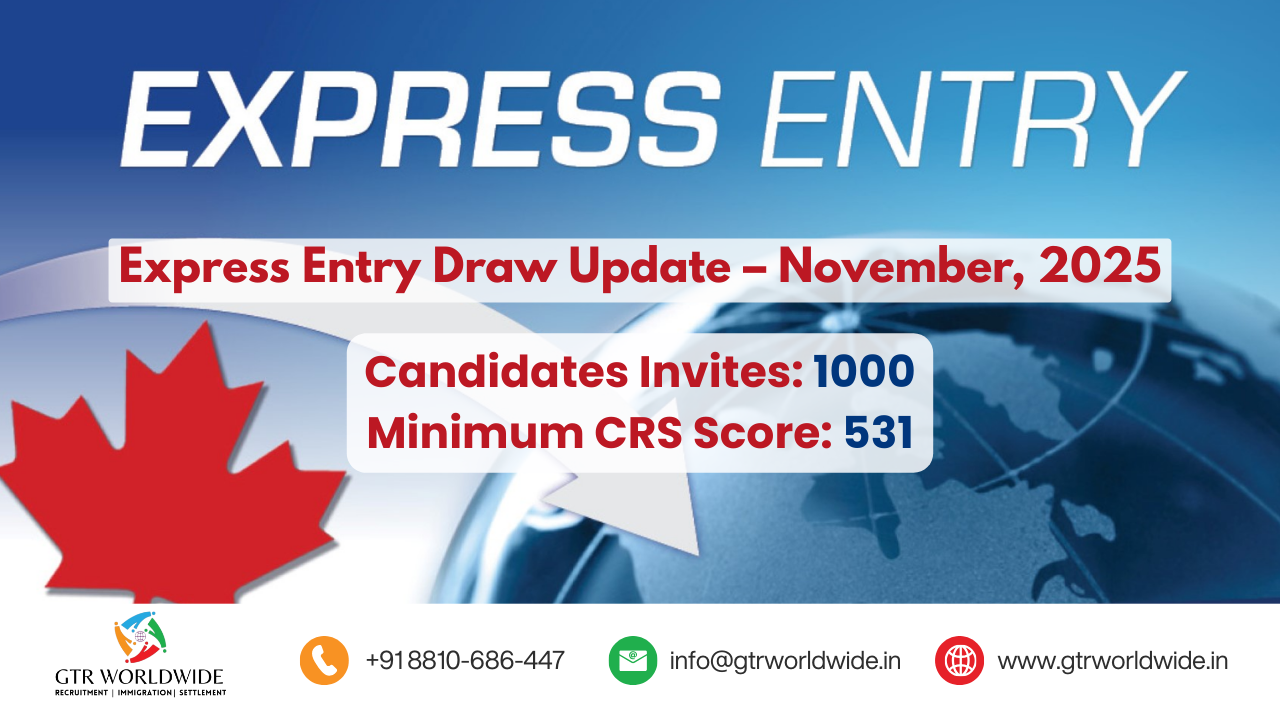
    Canada has released another positive update for Canadian Experience Class (CEC) candidates following the second CEC-focused Express Entry draw of November 2025. In this round, Immigration, Refugees and Citizenship Canada (IRCC) invited 1,000 applicants and lowered the Comprehensive Ranking System (CRS) cut-off to 531, the lowest CEC threshold since July 2025.

    A Meaningful Drop After Months of Stability

    CEC draws had been holding steady with cut-off scores between 533 and 534 for several months, reflecting steady competition within the pool.
    The new cut-off of 531, while only slightly lower, marks a shift and opens the door for candidates with CRS scores in the low 530s.

    Key Details of the November 26, 2025 Draw

    • Draw Date: November 26, 2025
    • Program: Canadian Experience Class (CEC)
    • Invitations to Apply (ITAs): 1,000
    • Minimum CRS Score: 531
    • Lowest CEC Score Since: July 2025

    This also marks the second CEC-only draw in the same month, hinting at renewed attention on candidates with Canadian work experience.

    2025 Summary of Major Express Entry Draws & CRS Patterns

    DateDraw TypeITAsCRS Cut-off
    Nov 26, 2025CEC1,000531
    Nov 25, 2025PNP777699
    Nov 14, 2025Healthcare & Social Services3,500462
    Nov 12, 2025CEC1,000533
    Nov 10, 2025PNP714738
    Oct 29, 2025French-language proficiency6,000416
    Oct 28, 2025CEC1,000533
    Oct 1, 2025CEC1,000534
    Sep 3, 2025CEC1,000534
    Aug 7, 2025CEC1,000534
    Jul 8, 2025CEC3,000518
    Jun 26, 2025CEC3,000521
    Jun 12, 2025CEC3,000529
    May 13, 2025General500547
    Feb 5, 2025CEC4,000521
    Jan 23, 2025CEC4,000527
    Jan 8, 2025CEC1,350542

    Why This CRS Reduction Matters

    1. More candidates reach competitive range

    Candidates scoring between 530 and 532 now have a real chance of receiving an ITA in upcoming draws.

    2. CEC continues to be a reliable pathway

    Despite the diversity of draw types in 2025, CEC rounds remain consistent, confirming Canada’s ongoing preference for workers with Canadian experience.

    3. Signs of easing competition

    If this trend continues, candidates in the mid-520s could start seeing more opportunities.

    4. Additional pathways beyond CEC

    Category-based draws in 2025 have been substantial, including:

    • French-language proficiency (up to 6,000 ITAs, CRS around 416)
    • Healthcare & social services (3,500 ITAs, CRS around 462)
    • Provincial Nominee Program (PNP)

    These offer alternative routes for those who qualify.

    What Candidates Should Do Next

    • Keep Express Entry profiles updated with the latest language scores, work history, and education.
    • Explore CRS-boosting strategies, including retaking language tests, gaining additional experience, or pursuing provincial nominations.
    • Watch upcoming draws closely, especially if IRCC continues prioritizing CEC applicants.