Author: gtrIndia

  • Canada Expands Low-Wage LMIA Processing Freeze – Six Additional Regions Affected from October 10, 2025

    Canada Expands Low-Wage LMIA Processing Freeze – Six Additional Regions Affected from October 10, 2025

    Starting October 10, 2025, Employment and Social Development Canada (ESDC) will expand its Low-Wage Labour Market Impact Assessment (LMIA) processing freeze. This measure is designed to safeguard job opportunities for Canadians and permanent residents in regions with unemployment rates of 6% or higher.

    This update adds six new Census Metropolitan Areas (CMAs) to the list where low-wage LMIA applications will not be processed, while one CMA has been removed due to improved labour market conditions.

    Regional Updates Effective October 10, 2025

    CategoryRegion (CMA)ProvinceChange
    AddedHalifaxNova ScotiaAdded to freeze list
    AddedBarrieOntarioAdded to freeze list
    AddedKingstonOntarioAdded to freeze list
    AddedPeterboroughOntarioAdded to freeze list
    AddedWindsorOntarioAdded to freeze list
    AddedKelownaBritish ColumbiaAdded to freeze list
    RemovedMonctonNew BrunswickRemoved due to lower unemployment

    Purpose of the Freeze

    The Low-Wage LMIA Processing Freeze prevents employers in high-unemployment regions from submitting LMIA applications for low-wage positions. This is part of the federal government’s labour market stabilization strategy, which prioritizes the hiring of Canadian citizens and permanent residents before turning to the Temporary Foreign Worker Program (TFWP). The freeze list is reviewed quarterly based on regional unemployment data.

    Impact on Employers and Foreign Workers

    • Employers in the frozen regions cannot submit new low-wage LMIA applications.
    • Applications for high-wage, agriculture, or Global Talent Stream positions are still allowed.
    • Foreign workers with pending offers in affected areas may experience delays or cancellations.
    • Employers are encouraged to consider alternative pathways, such as:
      • Provincial Nominee Program (PNP)
      • Express Entry
      • In-Canada recruitment and training incentives

    Next Review
    The freeze will remain in effect until the next quarterly review in January 2026, when ESDC will reassess unemployment trends and update the eligible CMAs accordingly.

    Conclusion
    This expansion highlights the government’s data-driven approach to labour policy. Employers in the newly frozen CMAs should review staffing strategies and seek guidance from authorized immigration experts to explore alternative work permit or visa options.


  • Victoria Skilled Migration Program 2025–26 Is Now Open: Here’s What You Need to Know

    Victoria Skilled Migration Program 2025–26 Is Now Open: Here’s What You Need to Know

    The Australian state of Victoria has officially opened its Skilled Migration Program for the 2025–26 program year, with limited allocations and an efficient nomination process for eligible skilled professionals both inside and outside Australia.

    Whether you’re a recent graduate, a skilled worker in tech, healthcare, trades, or business—this could be your gateway to permanent residency in Australia.

    What Visa Categories Are Available?

    Victoria will nominate candidates under two key skilled migration visas:

    Visa TypeDescription
    Subclass 190 – Skilled Nominated VisaA permanent residency visa for skilled workers nominated by a state government
    Subclass 491 – Skilled Work Regional (Provisional) VisaA 5-year provisional visa leading to PR after 3 years in regional Australia

    Initial 2025–26 Allocation

    • Subclass 190: 200 places
    • Subclass 491: 180 places

    These are interim allocations and may increase once the Australian Government finalizes the full state-by-state allocation.

    Application Process for Victoria Nomination

    1. Submit Your Expression of Interest (EOI)

    Use the SkillSelect system to register your profile and select Victoria as your preferred state.

    2. Register Your Interest (ROI) with Victoria

    After your EOI is submitted, you must register your interest with the Victorian Government through their website.

    3. Wait for an Invitation

    If your ROI is selected, you’ll receive an invitation to apply for nomination and proceed to apply for your visa.

    What If You Already Submitted an ROI in 2024–25?

    • If your previous ROI is still valid, it will carry over into the 2025–26 program year.
    • No need to re-submit unless your circumstances have changed (e.g., job, location, partner details).

     Who Should Apply?

    Victoria is especially looking for candidates in:

    • Healthcare – nurses, aged care workers, allied health
    • Tech – software developers, cybersecurity, data specialists
    • Construction & Engineering
    • Education & Childcare
    • Trade Occupations

    If you have skills and experience in these sectors, your chances are higher.

    Why Act Now?

    • Low initial allocations = high competition
    • The faster you apply, the better your chances
    • Delays may reduce eligibility if your age, English score, or work experience changes

    How GTR Worldwide Can Support You

    Navigating state nominations, SkillSelect EOIs, and ROI systems can be tricky—especially with limited slots. With GTR Worldwide, you get:

    • Free profile eligibility check
    • Expert advice on improving your CRS & occupation score
    • ROI submission with optimized statement
    • Full visa application support after nomination
    • Priority updates from VIC and other state programs
  • Canada Steps Up for Tech Talent as U.S. Raises H-1B Visa Costs

    Canada Steps Up for Tech Talent as U.S. Raises H-1B Visa Costs

    September 2025 – Global Immigration Update by GTR Worldwide
    The U.S. has announced a major policy shift that could reshape global tech mobility. A new $100,000 fee for first-time H-1B visa applications is now in effect, making it significantly harder — and costlier — for international tech professionals to pursue opportunities in America.

    As the U.S. door narrows, Canada is opening its arms wider to global talent.

    Canada’s Competitive Edge

    Canadian Prime Minister Mark Carney confirmed that new measures will expand immigration pathways for technology and STEM workers. Programs designed to support global talent mobility include:

    • Global Talent Stream – two-week processing for high-demand tech occupations.
    • Innovation Stream Work Permits – LMIA exemptions for high-growth employers.
    • H-1B Open Work Permit Pathway – a fast-track for professionals already holding U.S. visas.
    • Express Entry Tech Draws – targeting candidates with IT, AI, and engineering experience.

    These programs give skilled professionals not just career opportunities, but also a direct route to Canadian Permanent Residence and eventually citizenship.

    Why This is a Game-Changer

    The sharp increase in U.S. H-1B costs is expected to discourage startups, multinational firms, and individuals from pursuing U.S.-based opportunities. Industry analysts say this could trigger a shift of top tech talent toward Canada, which offers affordability, stability, and growth in sectors like AI, fintech, clean tech, and advanced software development.

    How GTR Worldwide Supports Global Professionals

    At GTR Worldwide, we help individuals and businesses navigate immigration challenges and unlock opportunities across Canada, Europe, the U.S., and Asia.

    For tech professionals, we provide:

    • Work permit and PR strategies tailored to your skills.
    • Employer connections through our recruitment and HR networks.
    • Guidance on Express Entry, PNPs, Start-Up Visa, and LMIA pathways.

    For businesses, our team offers international mobility solutions to help you recruit, relocate, and retain top talent worldwide.

    Final Word

    With U.S. policy changes creating barriers, Canada is emerging as the new global hub for skilled professionals. For tech workers looking to build long-term careers and families seeking stability, Canada’s immigration programs offer clarity and opportunity.

    🌍 Connect with GTR Worldwide to explore pathways that fit your goals — from tech worker permits to permanent residency and beyond.

  • AAIP September 2025 Draws – Alberta Invites 1,376 Skilled Workers

    AAIP September 2025 Draws – Alberta Invites 1,376 Skilled Workers

    The Alberta Advantage Immigration Program (AAIP) conducted seven targeted provincial draws in September 2025, issuing a total of 1,376 Invitations to Apply (ITAs) to candidates in priority occupations.

    Focus on High-Demand Sectors

    Between September 2 and September 10, 2025, Alberta invited candidates through its Express Entry stream to address pressing labor shortages in key industries, including:

    • Healthcare
    • Construction
    • Agriculture
    • Aviation

    For instance, the draw held on September 10, 2025 targeted aviation professionals, issuing 30 invitations with a minimum Comprehensive Ranking System (CRS) score of 50. Healthcare talent remained the central focus, with multiple draws throughout the month. CRS cut-offs for healthcare professionals ranged between 44 and 64 points, highlighting Alberta’s urgent need for workers in this sector.

    Alberta AAIP – September 2025 Draw Results

    Draw dateStreamInvitations issuedCRS cut-off
    September 10, 2025Alberta Express Entry – Aviation3050
    September 9, 2025Alberta Express Entry – Healthcare7064
    September 8, 2025Alberta Express Entry – Construction12161
    September 5, 2025Alberta Express Entry – Agriculture7148
    September 4, 2025Alberta Opportunity Stream89156
    September 3, 2025Health Care Pathway (non-Express Entry)6744
    September 2, 2025Health Care Pathway (Express Entry)12649

    CRS Scores and Program Priorities

    The AAIP continues to prioritize candidates with Alberta job offers, in-demand work experience, or strong ties to the province. Compared to federal Express Entry draws, Alberta’s CRS requirements remain relatively low, creating additional opportunities for qualified workers and international graduates.

    Nomination Quota Update 2025

    As of September, Alberta has issued 3,749 nominations under its annual allocation of 4,875 from Immigration, Refugees and Citizenship Canada (IRCC). This leaves 1,126 nominations still available for the remainder of 2025.

    Why Choose Alberta?

    Alberta’s growing economy and strong demand for skilled labor make it a leading destination for newcomers to Canada. With ongoing recruitment in healthcare, construction, and agriculture, the province is strategically aligning immigration with labor market needs—helping newcomers integrate quickly and contribute to its workforce.

    In September alone, over 1,300 skilled workers received invitations to apply for permanent residency through AAIP. Moving forward, candidates with relevant experience and ties to Alberta are encouraged to maintain an active Express Entry profile and stay updated on future AAIP draws.

  • NLPNP & AIP Draw Results – 202 Invitations Issued on August 29

    NLPNP & AIP Draw Results – 202 Invitations Issued on August 29

    On August 29, 2025, Newfoundland and Labrador held its latest immigration draw, inviting 202 skilled candidates to apply for permanent residency. Invitations were issued under both the Newfoundland and Labrador Provincial Nominee Program (NLPNP) and the Atlantic Immigration Program (AIP), reinforcing the province’s strategy to support long-term labor force and population growth.

    Invitation Breakdown

    • NLPNP (Provincial Nominee Program): 125 ITAs
    • AIP (Atlantic Immigration Program): 77 ITAs

    This was the province’s eighth Expression of Interest (EOI) draw since the launch of its new immigration selection system in early 2025.

    Comparison With Recent Draws

    Draw DateNLPNP ITAsAIP ITAsTotal ITAs
    July 29, 202510050150
    August 13, 202518051231
    August 29, 202512577202

    Year-to-Date Invitations (as of August 29, 2025)

    • NLPNP: 1,800 ITAs
    • AIP: 451 ITAs
    • Total: 2,251 ITAs

    These numbers show the province is on track to meet its 2025 immigration targets of 2,050 PNP spots and 475 AIP spots.

    Focus on Provincial Priorities

    Newfoundland and Labrador continues to prioritize candidates in key sectors, including:

    • Healthcare
    • Technology
    • Skilled Trades
    • Resource Industries

    Through its EOI system and the Immigration Accelerator platform, the province is streamlining recruitment to attract highly skilled professionals who can contribute to economic growth and community development.

  • IRCC Issues 4,500 Invitations in Latest French-Language Express Entry Draw

    IRCC Issues 4,500 Invitations in Latest French-Language Express Entry Draw

    Immigration, Refugees and Citizenship Canada (IRCC) has conducted another Express Entry draw, inviting 4,500 candidates with strong French language skills to apply for permanent residence.

    September 2025 French-Proficiency Draw

    This category-based draw required a minimum Comprehensive Ranking System (CRS) score of 446. To qualify, candidates needed to have submitted their Express Entry profile before 7:21 a.m. UTC on June 16, 2025.

    This result reflects Canada’s ongoing commitment to welcoming French-speaking immigrants to strengthen bilingual communities and address labor market needs.

    Express Entry Draws in 2025 – Overview

    Throughout 2025, IRCC has held a variety of draws under different categories, including the Provincial Nominee Program (PNP), Canadian Experience Class (CEC), and targeted draws for healthcare, social services, education, and French proficiency.

    Summary of Express Entry Draws in 2025

    DateDraw TypeITAs IssuedCRS Cut-off
    Sept. 3Canadian Experience Class1,000534
    Sept. 2Provincial Nominee Program249772
    Aug. 19Healthcare & Social Services2,500470
    Aug. 18Provincial Nominee Program192800
    Aug. 8French Language Proficiency2,500481
    Aug. 7Canadian Experience Class1,000534
    Aug. 6Provincial Nominee Program225739
    July 22Healthcare & Social Services4,000475
    July 21Provincial Nominee Program202788
    July 8Canadian Experience Class3,000518
    July 7Provincial Nominee Program356750
    June 26Canadian Experience Class3,000521
    June 23Provincial Nominee Program503742
    June 12Canadian Experience Class3,000529
    June 10Provincial Nominee Program125784
    June 4Healthcare & Social Services500504
    June 2Provincial Nominee Program277726
    May 13Canadian Experience Class500547
    May 12Provincial Nominee Program511706
    May 2Healthcare & Social Services500510
    May 1Education1,000479
    April 28Provincial Nominee Program421727
    April 14Provincial Nominee Program825764
    Mar. 21French Language Proficiency7,500379
    Mar. 17Provincial Nominee Program536736
    Mar. 6French Language Proficiency4,500410
    Mar. 3Provincial Nominee Program725667
    Feb. 19French Language Proficiency6,500428
    Feb. 17Provincial Nominee Program646750
    Feb. 5Canadian Experience Class4,000521
    Feb. 4Provincial Nominee Program455802
    Jan. 23Canadian Experience Class4,000527
    Jan. 8Canadian Experience Class1,350542
    Jan. 7Provincial Nominee Program471793

    Express Entry Trends in 2025

    • Total ITAs issued to date: 62,109
    • Most frequent draw type: Provincial Nominee Program (16 draws)
    • Other categories:
      • Canadian Experience Class – 9 draws
      • French language proficiency – 5 draws
      • Healthcare & social services – 4 draws
      • Education – 1 draw

    IRCC’s 2025 strategy shows a strong focus on PNP and category-based draws, with continued opportunities for French-speaking candidates and those with Canadian work experience.

    What This Means for Applicants

    French-speaking candidates continue to enjoy comparatively lower CRS cut-offs, making this an attractive immigration pathway in 2025. Applicants are encouraged to maintain up-to-date Express Entry profiles and closely follow IRCC’s evolving draw schedule to enhance their chances of receiving an Invitation to Apply (ITA).

  • Canada Immigration Update: Ontario Issues 2,643 Invitations in September 2025 PNP Draw

    Canada Immigration Update: Ontario Issues 2,643 Invitations in September 2025 PNP Draw

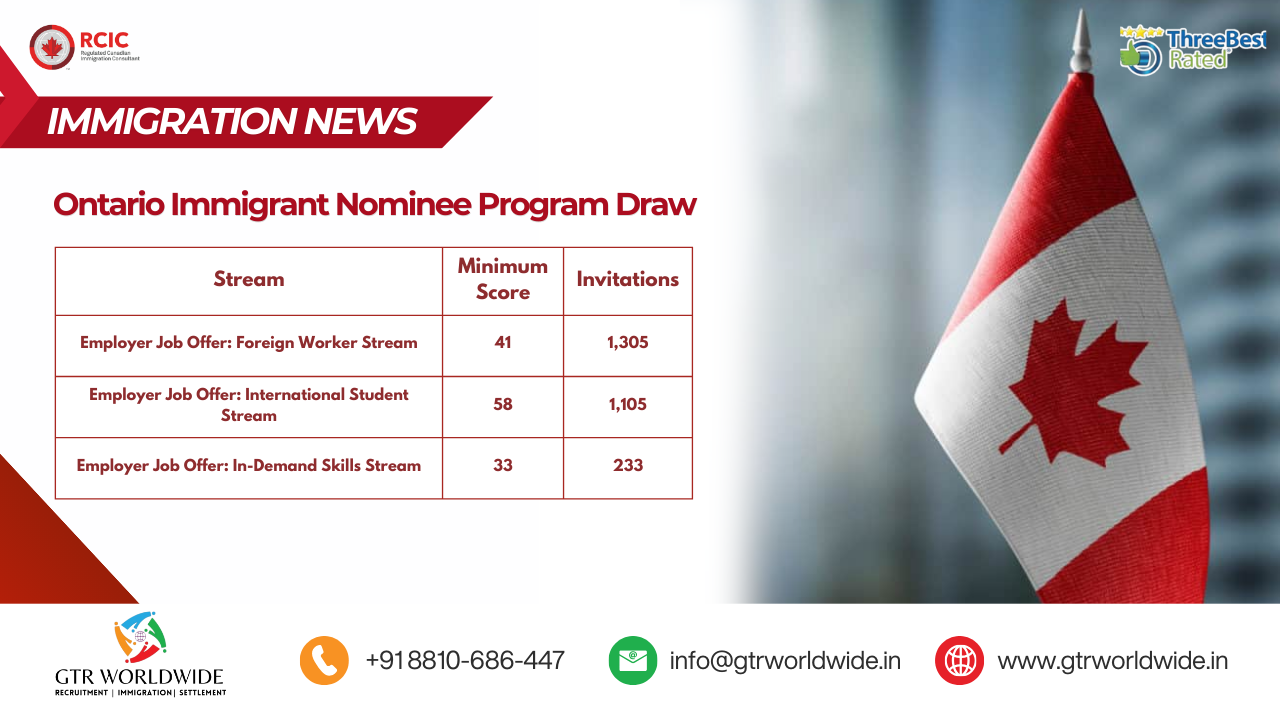
    On September 2, 2025, the Ontario Immigrant Nominee Program (OINP) held one of its largest draws of the year, issuing a total of 2,643 Invitations to Apply (ITAs) under the Employer Job Offer streams. This significant round of selections underscores Ontario’s ongoing demand for skilled workers, international graduates, and professionals in key sectors.

    Breakdown of the September 2, 2025 Ontario PNP Draws:


    Candidates were invited from three major streams under the Employer Job Offer category, as follows:

    StreamMinimum ScoreNumber of Invitations
    Employer Job Offer: Foreign Worker Stream411,305
    Employer Job Offer: International Student Stream581,105
    Employer Job Offer: In-Demand Skills Stream33233

    Focus on Healthcare and Education Sectors:


    The September 2 draws specifically targeted candidates in high-demand fields, including:

    • Healthcare professionals (doctors, nurses, medical technicians)
    • Early childhood educators and assistants
    • Home support and care roles under the In-Demand Skills stream

    Only those with valid job offers in eligible NOC (National Occupational Classification) codes were invited to apply.

    Eligibility and Profile Requirements


    To be eligible for these draws, candidates had to:

    • Have an active Expression of Interest (EOI) profile submitted between July 2, 2025, and September 2, 2025.
    • Possess a valid job offer from an Ontario employer in an eligible occupation.
    • Meet the minimum score cut-off for the relevant Employer Job Offer stream.

    Why This Draw Matters:


    With 2,643 ITAs issued, this marks one of the largest Ontario PNP draws of 2025. It highlights Ontario’s commitment to welcoming skilled immigrants to address workforce shortages, particularly in healthcare, education, and other essential sectors.

    The OINP continues to be a key element in Canada’s immigration strategy, offering a clear path to permanent residency (PR) for foreign workers and international graduates.

  • IRCC’s 2025 Express Entry Draw Schedule Revealed – Categories, ITAs, and CRS Insights

    IRCC’s 2025 Express Entry Draw Schedule Revealed – Categories, ITAs, and CRS Insights

    Immigration, Refugees and Citizenship Canada (IRCC) has released its 2025 Express Entry draw schedule, providing candidates with greater clarity on upcoming opportunities to receive Invitations to Apply (ITAs) for permanent residence. Based on internal memos and Access to Information (ATIP) findings, the details outline category-based priorities, Francophone immigration goals, and how provinces will coordinate their programs with federal draws.

    Key Highlights of Express Entry in 2025

    • Category-Based Draws: Healthcare, trades, and education remain the main focus areas for 2025.
    • Francophone Priority: IRCC targets 8.5% of admissions outside Quebec for 2025, increasing to 9.5% in 2026.
    • ITA Distribution: Tens of thousands of ITAs have already been issued, with more rounds scheduled.
    • Provincial Coordination: Provinces will now receive a three-month ITA forecast to align nominations with federal draws.
    • 2026 Link: ITAs issued late in 2025 may count toward 2026 immigration admissions due to processing times.

    Category-Based Draws Breakdown for 2025

    Healthcare Professionals

    • Planned: 8,000 ITAs
    • Issued: 7,500
    • Remaining: 500
      Healthcare remains the top category, addressing Canada’s urgent demand for nurses, doctors, and allied health staff.

    Education Workers

    • Planned: 3,000 ITAs
    • Issued: 1,000
    • Remaining: 2,000
      Teachers and early childhood educators are in demand, with additional draws expected before year-end.

    Skilled Trades

    • Planned: 3,300 ITAs
    • Issued: 0
    • Remaining: 3,300
      Trades represent the biggest untapped opportunity in 2025. Candidates in construction, transport, and manufacturing could benefit from upcoming draws, often with lower CRS cut-offs.

    Francophone Immigration – A Growing Priority

    IRCC continues to expand Francophone immigration outside Quebec. Recent memos confirm:

    • 18,500 ITAs issued during February–March Francophone draws.
    • 2,500 ITAs issued on August 8, likely counted toward 2026 targets.
    • Annual goal: 8.5% Francophone admissions in 2025.

    Francophone candidates also benefit from up to +50 CRS points, improving competitiveness in both general and category-based draws.

    ITA Forecast for Provinces and Territories

    For the first time, IRCC will share a three-month ITA calendar with provinces and territories, indicating:

    • Scheduled draw weeks
    • Types of draws (general, PNP, or category-based)
    • Projected CRS cut-offs (subject to operational updates)

    This transparency will help provinces align their PNP streams with federal Express Entry rounds, offering candidates more predictability.

    Link Between 2025 and 2026 Admissions

    IRCC confirmed that ITAs issued in late 2025 may contribute to 2026 permanent resident admissions, given standard processing times. This ensures draws in Q4 2025 support both current-year and upcoming immigration targets under the 2025–2027 Immigration Levels Plan.

    What This Means for Candidates

    1. Trades offer the largest opportunity – with 3,300 ITAs still available.
    2. Healthcare and education remain strong priorities, with more draws ahead.
    3. Francophone applicants have an edge, benefiting from high ITA volumes and CRS bonuses.
    4. CRS strategy matters – category-based draws typically cut off 20–40 points lower than general rounds, giving a chance to candidates in the 480–490 range.
    5. Plan around timing – applying in late 2025 may position applications for the 2026 intake.

    Final Takeaway

    IRCC’s 2025 Express Entry schedule confirms that healthcare, education, trades, and Francophone immigration will dominate selection. With thousands of ITAs still available—especially in trades and education—candidates who strategically align their profiles stand an excellent chance of receiving an ITA.

    By understanding category-based allocations, CRS score dynamics, and provincial coordination, skilled workers can better prepare for success in the upcoming draws.

  • Nova Scotia Announces 2025 Immigration Allocation Update

    Nova Scotia Announces 2025 Immigration Allocation Update

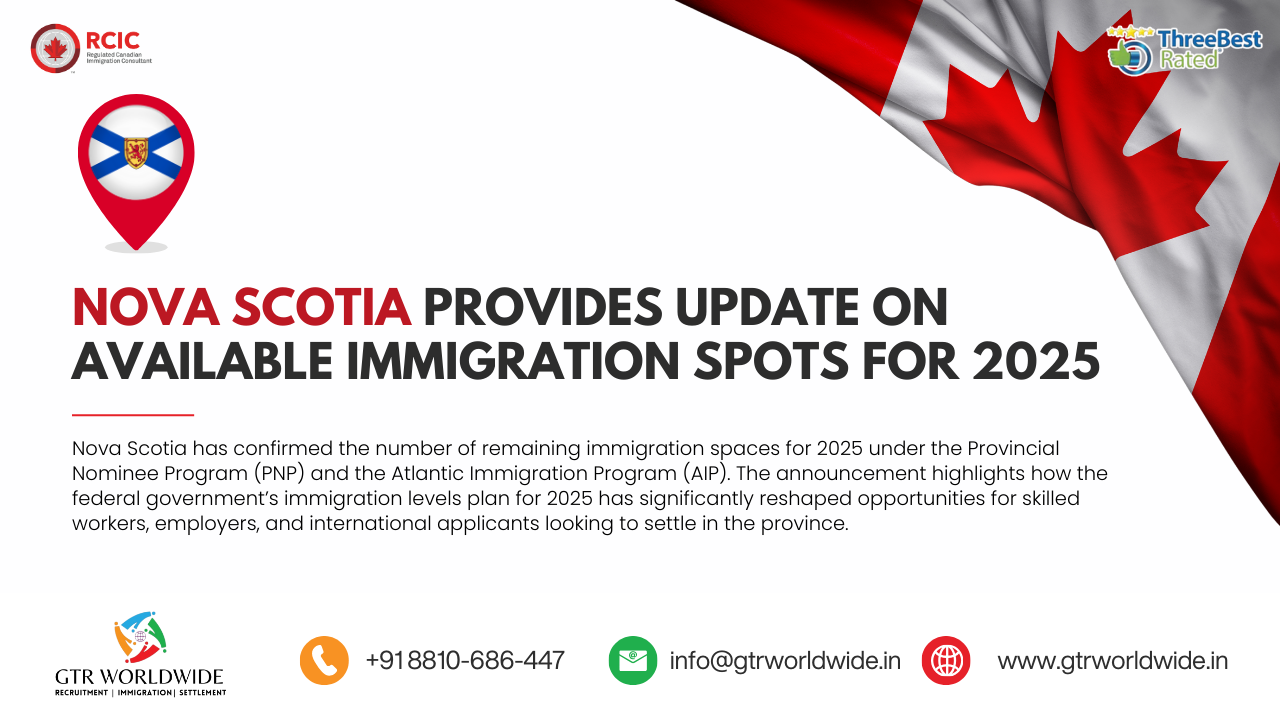
    Nova Scotia has released an update on the number of immigration spaces available in 2025 under the Provincial Nominee Program (PNP) and the Atlantic Immigration Program (AIP). The province highlighted how the federal government’s 2025–2027 Immigration Levels Plan has significantly impacted opportunities for skilled workers, employers, and international applicants seeking to settle in Nova Scotia.

    Federal Immigration Allocation for 2025

    In 2024, Nova Scotia received 6,300 immigration spots through its provincial nomination streams and the AIP. However, under the new 2025–2027 Immigration Levels Plan, that number has been cut by half—leaving only 3,150 spaces available for 2025. This steep reduction has placed additional pressure on the province to carefully manage nominations and prioritize applicants who address its most urgent labour shortages.

    Current Quota Status

    Nova Scotia Immigration confirmed that the 2025 allocation is already full—or nearly at capacity—as applications have surpassed the available spaces. As a result, several categories have been paused, and only select cases will continue to be processed this year.

    Priority Groups for 2025

    With limited immigration spots, Nova Scotia will focus on the following groups:

    • Workers already in Nova Scotia
      • Applicants currently living and working in the province.
      • Individuals with work permits expiring in 2025.
    • High-demand occupations
      • Healthcare professionals (nurses, doctors, support staff).
      • Social assistance sector employees (NAICS 62).
      • Construction workers (NAICS 23).
    • Applicants with strong settlement potential
      • Candidates who demonstrate long-term commitment to living in Nova Scotia.
      • Workers addressing critical regional labour needs.

    Options for Applicants Outside Nova Scotia

    For those living abroad, opportunities in 2025 are extremely limited. Only certain groups may still qualify:

    • Healthcare, social services, and construction workers recruited by Nova Scotia employers.
    • Candidates under the AIP in specific industries such as trucking, transportation, science and technology, clean energy, and resource development.

    Most other international applications will remain on hold until future allocations become available.

    Impact on Workers and Employers

    • Skilled Workers: The best chance of selection lies with those already in Nova Scotia, while international candidates must fit into high-demand sectors.
    • Employers: Businesses in healthcare, construction, and social services may still be able to hire foreign workers through the PNP and AIP despite the reduced quota.
    • Future Applicants: Those unable to apply in 2025 should prepare for the 2026 allocation, which may provide renewed opportunities.

    Key Takeaway

    With only 3,150 spots available this year, Nova Scotia is strictly prioritizing candidates who meet its most urgent labour needs. While opportunities still exist in certain industries, competition is intense, and many applicants will need to prepare for upcoming immigration rounds in 2026.

  • Ontario PNP Issues 468 Invitations in August 28, 2025 Draws

    Ontario PNP Issues 468 Invitations in August 28, 2025 Draws

    On August 28, 2025, the Ontario Immigrant Nominee Program (OINP) conducted multiple draws under the Employer Job Offer streams, issuing a total of 468 invitations to apply (ITAs). The draws targeted skilled workers and international graduates, with a strong focus on candidates with job offers in Northern Ontario and communities participating in the Regional Economic Development through Immigration (REDI) pilot.

    Key Highlights

    • Total invitations issued: 468
    • Streams covered: Employer Job Offer – Foreign Worker, International Student, and In-Demand Skills
    • Targeted regions: Northern Ontario and REDI pilot communities (Lambton, Lanark, Leeds and Grenville)
    • Profile submission period: July 2, 2025 – August 28, 2025

    Invitations for Northern Ontario

    Ontario invited candidates under both the Foreign Worker and International Student streams who had job offers in Northern Ontario.

    StreamMinimum ScoreInvitations Issued
    Employer Job Offer: Foreign Worker5394
    Employer Job Offer: International Student66236

    REDI Pilot – 138 Invitations

    Through the REDI pilot, Ontario issued 138 invitations via the EOI system:

    StreamMinimum ScoreInvitations Issued
    Employer Job Offer: Foreign Worker4594
    Employer Job Offer: International Student6856
    Employer Job Offer: In-Demand Skills3425

    Targeted REDI regions: Lambton, Lanark, and Leeds & Grenville

    NOC codes targeted under REDI:

    • In-Demand Skills Stream: Home support workers, farm machinery operators, machine operators, construction laborers, food processing workers
    • Foreign Worker & International Student Streams: Accountants, HR professionals, software engineers, web developers, nurses, social workers, educators, machinists, carpenters, auto technicians, agricultural supervisors

    The REDI pilot program, active until December 31, 2025, provides a pathway to permanent residency for candidates with job offers in Ontario’s smaller communities.

    Ontario’s Employer-Led EOI System

    As of July 2, 2025, Ontario has implemented a new employer-driven Expression of Interest (EOI) system:

    • Employers must submit job offers through the OINP Employer Portal.
    • Only candidates with employer-approved EOIs are eligible for selection.
    • Candidates who submitted EOIs before July 2 are required to reapply with employer support.

    This transition ensures alignment with real labor market needs, making the Employer Job Offer streams more responsive to Ontario’s workforce demands.


    The August 28, 2025 OINP draws reflect Ontario’s strategy of prioritizing healthcare professionals, IT specialists, skilled trades, finance experts, and social service workers to meet critical labor shortages in both Northern Ontario and REDI pilot communities.