Author: gtrIndia

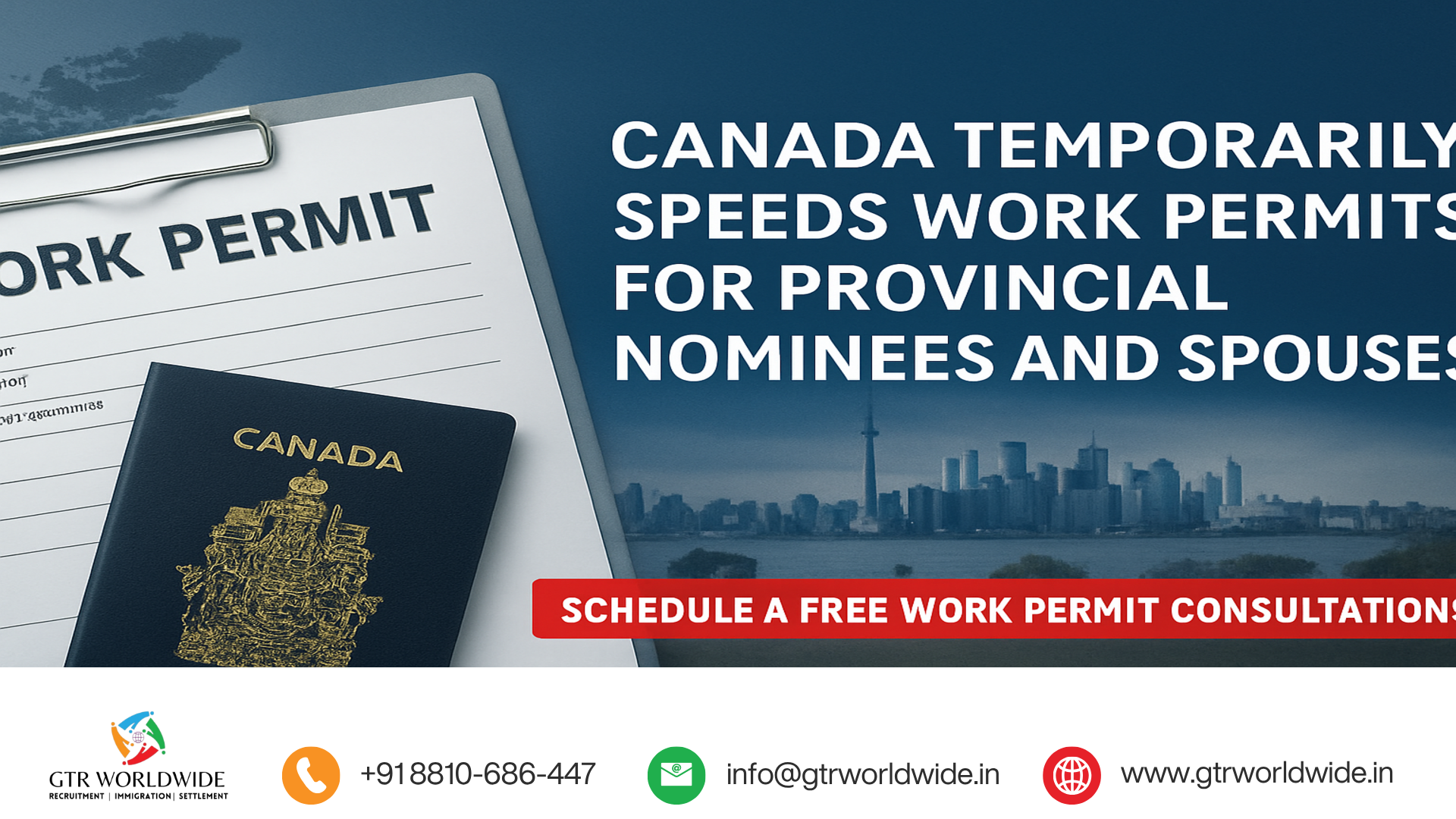
  • Canada temporarily speeds work permits for provincial nominees and spouses

    Canada temporarily speeds work permits for provincial nominees and spouses

    PNP Work Permits Without AOR: IRCC’s Temporary Measures Take Effect June 9, 2026

    Immediate change and why it matters

    On June 9, 2026, Immigration, Refugees and Citizenship Canada (IRCC) activated temporary operational measures allowing in-Canada Provincial Nominee Program (PNP) applicants — and some spouses — to qualify for certain work permits without first providing the formal acknowledgement of receipt (AOR) for their permanent residence (PR) application. For many provincial nominees facing months-long delays in receiving an AOR, this change can prevent a gap in legal work authorization and reduce the risk of losing employment while PR processing continues. The measures are scheduled to remain in place until December 31, 2026.

    Why IRCC introduced the changes

    IRCC implemented the measures in response to extended delays in R10 completeness checks that have pushed AOR issuance far beyond historical timelines. The operational bulletin published on June 9, 2026, explains that long waits for AORs left applicants vulnerable between the date they submitted their PR application and the later issuance of the AOR required under previous practice to apply for a work permit extension.

    A concrete example shared in public user forums shows the scale of the delays: of 141 provincial nominees who filed base-PNP PR applications between November 22 and November 30, 2024, none reported receiving their AOR before October 2025. Those kinds of backlogs created multi-month windows during which workers could lose authorization to work if they could not file a qualifying work permit application.

    Exactly what IRCC will accept instead of an AOR

    Under these temporary operational measures, officers may accept alternatives to the formal AOR when deciding eligibility for specific in-Canada work permit applications. The options are:

    • A copy of the confirmation email generated when the PR application was submitted online, together with proof of payment of PR processing fees; or
    • Confirmation within IRCC’s internal systems that an application for permanent residence (APR) has been received and is pending — officers are instructed to rely on system confirmation when it is available.

    If an applicant has already received an AOR, the AOR must still be submitted with the work permit application. These alternatives are limited to applicants who have not yet received an AOR; they do not change requirements for applicants outside Canada.

    Which work permit categories are covered

    The operational measures apply specifically to the following in-Canada work permit applications linked to PNP-based PR filings:

    • PNP bridging open work permits (BOWPs).
    • PNP employer-specific work permits where the nomination has expired.
    • Eligible spousal open work permits for spouses of PNP applicants.

    Work permit applications submitted from outside Canada remain subject to the standard AOR requirement and are not covered by these temporary measures.

    Who can benefit and who remains excluded

    Primary beneficiaries are foreign nationals physically in Canada who have submitted a PR application under the Provincial Nominee Program but have not yet received an AOR. This includes:

    • Provincial nominees waiting for base-PNP PR AORs.
    • Workers whose provincial nomination has expired but who need an employer-specific PNP work permit.
    • Spouses of PNP applicants who are eligible for a spousal open work permit tied to the main applicant’s PR filing.

    Excluded groups include applicants applying from outside Canada and any applicant who has already received their AOR (they must submit the AOR in the usual way). The measures do not alter substantive PR processing or final eligibility for PR — they only provide temporary flexibility for related in-Canada work permit applications when an AOR is delayed.

    How this interacts with maintained status

    A separate and important protection for in-Canada applicants is maintained status. If a foreign national submits a work permit application before the expiry of their existing permit, they retain maintained status, which authorizes them to continue working under the conditions of the expired permit while their new application is processed, provided they remain in Canada.

    The IRCC bulletin’s temporary allowance is most useful when applicants need to file for a BOWP, an employer-specific PNP permit, or a spousal open work permit but cannot produce an AOR because of the R10-related delays. Submitting a qualifying work permit application before permit expiry — using one of the alternative proofs specified — preserves maintained status and thereby reduces the practical risk of enforced work stoppage.

    Practical steps applicants should follow now

    The operational bulletin creates straightforward but essential documentation and timing considerations for PNP applicants and their spouses. Key practical actions are:

    • Retain and save the PR submission confirmation email and all fee payment receipts. Under the temporary rules, a clear copy of that confirmation email plus proof of payment can replace an AOR for the specified in-Canada work permit applications.
    • Check IRCC online accounts regularly so that officers can verify APR receipt in IRCC systems if a system-based confirmation is available.
    • If your existing work permit is nearing expiry, prepare to file the new work permit application before expiry to benefit from maintained status while the application is processed.
    • If you are outside Canada, be aware that these measures do not apply to overseas work permit applications; plan accordingly.
    • If you already hold an AOR, continue to submit it with any applicable work permit application per standard practice.

    Those preparing applications should assemble both the usual supporting documents and the specific alternate evidence (PR submission email + fee payment receipt) so that processing officers can rely on these proofs where appropriate.

    Operational and timing details to note

    Keep these concrete timeline and operational details in mind:

    • Effective date: June 9, 2026 — IRCC published the operational bulletin on this date and the measures took effect immediately.
    • Temporary status: The operational measures are scheduled to remain in force until December 31, 2026, unless IRCC makes further changes.
    • System verification: Where possible, officers are instructed to rely on IRCC system confirmation that an APR has been received and remains pending.
    • Scope limitation: The alternatives to an AOR apply only to in-Canada work permit applications and only if the applicant has not already received an AOR.

    What this means for employers and families

    While the bulletin focuses on applicants, there are practical ripple effects for employers and families tied to PNP candidates. Employers who depend on provincial nominees can expect fewer forced absences in the short term when workers face delayed AORs. For spouses of PNP applicants, the ability to qualify for an open work permit without an AOR reduces uncertainty and helps families maintain household income while PR is processed. The measures may therefore lower short-term turnover risk for employers and reduce financial stress for families affected by the AOR backlog.

    Limits, risks and things to watch

    These measures are a procedural fix, not a change to legal eligibility for PR or to substantive program rules. Important limits and cautions:

    • The measures do not grant new grounds for PR — they only allow temporary flexibility in proving PR submission for work permit purposes.
    • Applicants outside Canada remain subject to existing AOR requirements and cannot use the PR submission email or system confirmation as substitutes in overseas applications.
    • If IRCC systems cannot confirm an APR and an applicant cannot provide the submission email and fee payment proof, officers will continue to apply normal AOR requirements.
    • The operational measures are time-limited and tied to current processing pressures; applicants should not assume these flexibilities will be extended beyond December 31, 2026.

    Documents and evidence to prepare

    To make the most of the temporary flexibility, applicants should prepare clear, traceable evidence at the time they file their PR application and then maintain those records. Required items under the measures include:

    • The confirmation email generated at the time of online PR submission (save the full message and any transaction or file number contained within).
    • Proof of payment of the PR processing fees (payment confirmation, transaction ID or receipt).
    • Usual work permit supporting documents relevant to the specific category (employer letters, job offer, proof of relationship for spousal permits) — these remain necessary.

    Officers are instructed to use IRCC system confirmations when available, but applicants should not rely solely on that possibility. Maintaining and submitting the confirmation email and fee payment proof will make an application straightforward to assess under the temporary rule.

    How to interpret the reported AOR backlog example

    IRCC cited extended timelines for R10 completeness checks as the driver for these measures. A publicly reported example — drawn from user posts for the period November 22–30, 2024 — showed that 141 provincial nominees who filed base-PNP PR applications did not report receiving an AOR before October 2025. That real-world evidence underscores the practical urgency: some applicants faced nearly year-long waits for AORs under the completeness-check backlog. The temporary operational change is a targeted remedy to lessen the employment and status consequences of such delays while IRCC works through the underlying processing backlog.

    Next steps for applicants and advisors

    Applicants, spouses and employers should treat the temporary measures as an important but time-limited operational accommodation. Steps to consider now:

    • Gather and store PR submission confirmations and fee receipts immediately after filing. Keep electronic copies and backups.
    • When preparing an in-Canada PNP-related work permit application, include the PR confirmation email and proof of fee payment if an AOR is not yet available.
    • Ensure the work permit application is submitted before the expiry of any existing permit to retain maintained status while the new application is processed.
    • Monitor IRCC communications and your online account for any system-based confirmation that can further support your application.
    • Be aware of the December 31, 2026 expiry for these measures and plan accordingly if your timeline extends beyond that date.

    For applicants concerned about timing or documentation, a timely review of supporting materials will reduce the chance of an avoidable refusal or need to refile.

    Why the change matters beyond paperwork

    At the individual level, the operational measures translate into avoided work interruptions and reduced economic uncertainty for provincial nominees and their families. For employers, the measures support continuity of staff and reduce administrative churn resulting from forced departures when a foreign national’s authorization would otherwise lapse. For the immigration system, the measures are a pragmatic bridge: they preserve labour market stability while IRCC addresses underlying processing capacity and R10 check delays.

    For personalized support with your Canadian immigration pathway, contact GTR Immigration. Call us: +91-8810-686-447

    #IRCC #PNP #WorkPermit #AOR #BridgingOpenWorkPermit #MaintainedStatus #CanadaImmigration #PNPApplicants
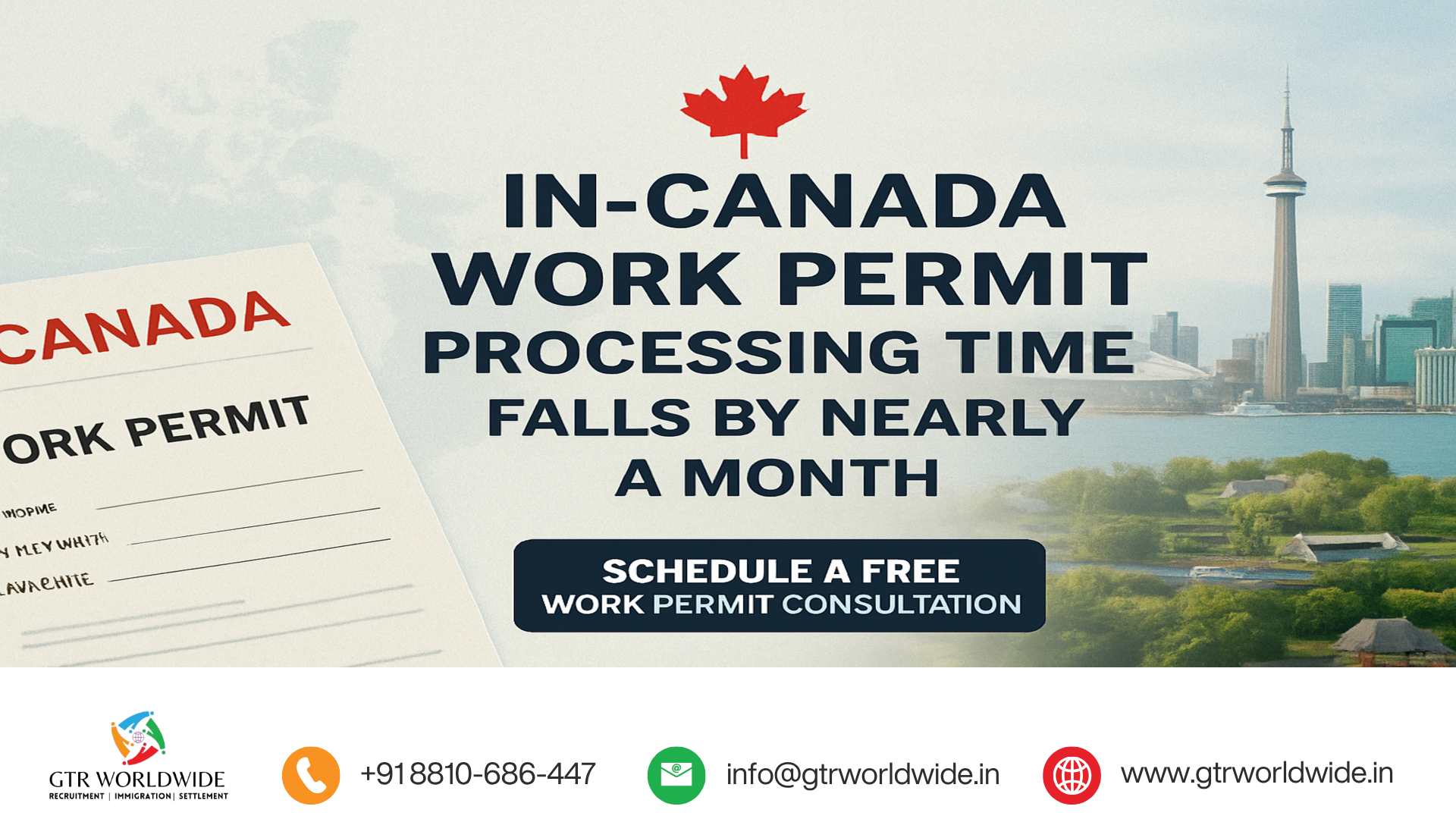

  • In-Canada Work Permit Processing Time Falls by Nearly a Month

    In-Canada Work Permit Processing Time Falls by Nearly a Month

    In-Canada Work Permit Processing Time Falls to 186 Days — What Applicants Should Know (June 2026)

    June 2026 update at a glance

    On June 10, 2026, Immigration, Refugees and Citizenship Canada (IRCC) reported that the estimated processing time for work permit applications submitted from within Canada has fallen to 186 days. That figure represents a meaningful drop from the 212-day estimate recorded on May 6, 2026 — a reduction of nearly a full month. According to IRCC’s publicly released data, the June estimate is also the lowest reported so far in 2026.

    This change matters for foreign nationals already in Canada who are applying for a new work permit or extending an existing one. Processing-time shifts influence planning for employment, documentation, and expectations about when work authorization will be finalized. Understanding how IRCC calculates these estimates, the protections that apply while an application is being processed, and recent administrative changes to supporting documentation will help applicants manage risk and employer relations during the wait.

    How IRCC’s processing-time estimates are calculated

    IRCC reports two broad types of processing estimates: forward-looking and historical. For initial in-Canada work permits and extensions, IRCC uses historical estimates. That means the reported wait time reflects how long it took the department to finalize 80% of similar applications in the past.

    Put simply, the 186-day figure does not guarantee a specific outcome or an exact timeline for any individual file. Instead, it indicates that, historically, 80% of comparable in-Canada work permit applications were finalized within 186 days. Applicants should therefore treat the estimate as a planning benchmark rather than an absolute promise of processing speed.

    IRCC also maintains an aspirational service standard for in-Canada work permit applications: the department aims to finalize 80% of these applications within four months. The current historical estimate remains well above that objective.

    Recent administrative changes that affect applicants

    Two practical items introduced or clarified in 2026 are important to note:

    – Maintained status: Foreign nationals in Canada who apply to extend their work permit before the expiry of their existing permit benefit from maintained status. Maintained status authorizes applicants to continue working under the conditions of their expired permit while their extension request is being processed, provided they remain in Canada and applied before their permit expired. This protection directly addresses the gap between permit expiry and finalization of the extension application.

    – Work permit support letter validity extended: In April 2026, Canada extended the validity period for work permit support letters from six months to one year. These letters serve as documentation that applicants can use to demonstrate maintained status to employers and other government agencies. The one-year validity is a response to extended processing times applicants had been facing, giving them longer-dated evidence to show employers while waiting for a final decision.

    Both developments are administrative responses that reduce immediate disruption for workers and employers during extended processing periods.

    Why the drop to 186 days matters beyond the number

    A decline from 212 to 186 days is notable for several reasons:

    – Momentum and trend direction: It signals an improvement in processing flow compared with the previous reporting period. IRCC’s own dataset indicates June’s level is the lowest in 2026 so far, suggesting the backlog pressure may be easing, at least temporarily.

    – Expectation management: Even with the drop, the historical estimate remains higher than IRCC’s four-month service goal. Applicants and employers should therefore maintain realistic expectations about timelines—improvements are occurring, but processing times have not yet returned to IRCC’s target standard.

    – Operational consequences: For applicants relying on employer confirmation of maintained status, the longer support-letter validity reduces the administrative burden of frequent renewals. For employers, a more stable processing environment reduces uncertainty when hiring or retaining foreign workers whose work permits are being extended.

    – Planning for life and work: Processing-time changes affect when applicants can renew provincial or federal records, make long-term employment decisions, or take steps that require finalized immigration status (for example, pursuing certain permanent residence pathways that depend on valid work authorization). While maintained status offers protection, final decisions still determine the long-run legal footing.

    Who is most directly affected by this update

    Based solely on IRCC’s reported scope, the groups directly affected include:

    – Foreign nationals already in Canada applying for an initial work permit or an extension. These applicants’ files are the ones tracked in the in-Canada historical processing estimate.

    – Employers who hire or retain foreign national workers in Canada and need ongoing proof of the employee’s authorization to work while an extension is processed. The extended validity of support letters is especially relevant to them.

    – Government agencies and other organizations that may request evidence of maintained status or valid support letters when interacting with applicants.

    Note: The IRCC data referenced applies specifically to in-Canada applications. The reported times and administrative adjustments cited do not speak to applications submitted from outside Canada, and the source does not provide information about those files.

    Practical impacts applicants should consider

    Several practical consequences flow from the current state of processing times and the administrative measures IRCC has taken:

    – Continue to apply before expiry: To preserve maintained status, applicants must submit an extension application before their existing permit expires. Maintaining that status allows continued work under the expired permit’s conditions while IRCC processes the extension.

    – Use the extended support-letter validity: Since April 2026, work permit support letters are valid for one year. Applicants should secure and present these letters to employers and relevant agencies as primary evidence of maintained status or ongoing authorization during processing.

    – Plan for longer waits than IRCC’s service standard: Even though the historical estimate dropped, it remains above IRCC’s four-month target. Applicants should account for the possibility that finalization may take several months and avoid making time-sensitive decisions that require a finalized permit unless they have certainty.

    – Keep documentation organized: Employers and applicants will likely be asked for proof of maintained status. Keep copies of the extension application submission confirmation, the support letter (valid up to a year), and any communication from IRCC readily available.

    – Treat the estimate as a guideline: Historical processing times reflect where 80% of decisions fell in the past, not a promise about the future. Variations in individual cases are common; some may be faster, some slower.

    Important numbers and dates from IRCC’s update

    • June 10, 2026: IRCC reported a processing time of 186 days for in-Canada work permit applications (initial or extension).
    • May 6, 2026: Previous reported processing time was 212 days; the June figure represents a 26-day reduction.
    • April 2026: Canada increased the validity period of work permit support letters from six months to one year.
    • IRCC’s aspirational service standard: Finalize 80% of in-Canada work permit applications within four months.

    What applicants should watch next

    Applicants should monitor the following as they manage their files:

    – IRCC processing-time updates: Processing time estimates are updated periodically. The June 10 number showed improvement; continued monitoring will show whether that trend continues or reverses.

    – Support-letter procedures and employer guidance: Confirm with employers how they prefer to receive and retain support letters and other proof of maintained status. Since letters are now valid for a year, clarify whether employers need an updated copy on file or will accept the longer validity automatically.

    – Application timing: Applying before expiry remains essential for maintained status. Pay close attention to your permit’s expiry date and submit the extension with sufficient time to accommodate IRCC’s current processing estimates and any possible delays.

    – Communications from IRCC: Keep an eye on any IRCC messages or requests for additional information. Delays can occur when IRCC requests supplementary documents and applicants do not respond promptly.

    – Personal circumstances that may affect processing: While the source does not enumerate specific case factors, applicants should be mindful that each file is unique. Responding promptly to correspondence and ensuring a complete submission helps reduce avoidable delays.

    Practical checklist for applicants in Canada

    • Submit your extension application before the current permit expires to retain maintained status.
    • Obtain and keep a copy of the work permit support letter; note that it is now valid for one year (as of April 2026).
    • Keep proof of application submission (confirmation emails, receipts) accessible to employers and agencies.
    • Plan employment and personal arrangements with the current estimated processing time (186 days) in mind.
    • Watch IRCC’s publicly released processing-time figures for future changes.

    Final observations

    The move from 212 days to 186 days in June 2026 is a positive sign that in-Canada work permit processing may be improving. However, the historical estimate still exceeds IRCC’s four-month aspirational target, so applicants should continue to plan conservatively and rely on protections such as maintained status while awaiting final decisions. The extension of support-letter validity to one year is a targeted administrative change that eases immediate burdens on workers and employers during extended processing periods. Staying informed of IRCC updates, preserving documentation, and applying before expiry remain practical steps applicants can take to manage uncertainty.

    For personalized support with your Canadian immigration pathway, contact GTR Immigration. Call us: +91-8810-686-447

    #Canada #Immigration #WorkPermit #IRCC #ProcessingTimes #MaintainedStatus #SupportLetter

  • Lewiston’s French-Canadian Heritage: Potential Canadian Citizenship

    Lewiston’s French-Canadian Heritage: Potential Canadian Citizenship

    Canadian citizenship by descent after Bill C-3: why Lewiston’s “Little Canada” may hold unexpected passports

    Immediate change and why Lewiston residents should pay attention

    Bill C-3, which came into force on December 15, 2025, removed the old first‑generation limit on Canadian citizenship by descent. For residents of Lewiston, Maine—where Franco‑American heritage runs deep—this legal change could convert family history into a current legal status. If you were born outside Canada and can document an unbroken line to a Canadian ancestor, you may already be a Canadian citizen under the new rules. To confirm and make that status usable (for example, to apply for a Canadian passport), you must apply for a citizenship certificate. Processing time for that certificate is currently 15 months. This update matters because Lewiston’s population includes a very high concentration of people with Quebec and Maritime French ancestry; many may qualify but have not yet investigated the possibility.

    How a 19th‑century migration explains today’s potential eligibility

    Lewiston’s French‑Canadian identity began in the 1870s when trains arriving at the Grand Trunk Station brought large numbers of workers from Quebec and Acadian communities in the Maritimes. Between roughly 1870 and 1930, about 720,000 French Canadians moved to the United States; Lewiston was one of the primary destinations. Local counts track that change sharply: fewer than 100 French Canadians were recorded in the city in 1860; by 1880 there were 4,714; by 1900 the number was 13,300. Generations of families settled in a compact neighborhood along the Androscoggin River that became known as Little Canada, complete with French parishes, Catholic schools and the long‑running newspaper Le Messager. That density preserved language, community ties, records and family memory across generations—elements that now help in tracing legal descent back to a Canadian ancestor.

    What Bill C‑3 actually changed in legal terms

    Before Bill C‑3, Canada limited citizenship by descent: a person born outside Canada could generally claim citizenship only if their parent was a Canadian citizen at the time of their birth — the so‑called “first‑generation limit.” The 2025 reform removed that barrier in most cases, opening citizenship-by-descent eligibility to people born abroad who can show a continuous chain of descent to a Canadian ancestor. The law does not automatically produce documentation; instead, it changes the legal footing. To demonstrate the status in practice, an individual must obtain a citizenship certificate from Canada’s citizenship authority—the statutory document that proves Canadian citizenship and is needed to apply for a Canadian passport.

    Who in Lewiston could be affected and why the local scale matters

    Lewiston’s Franco‑American profile makes it one of the U.S. cities most likely to contain many people with eligible Canadian ancestors. The University of Southern Maine’s Franco‑American Collection describes Lewiston as a city of roughly 60% French‑Canadian ancestry. Applying that institutional estimate to Lewiston’s 2024 American Community Survey five‑year population of 38,324 produces an illustrative figure of about 23,000 residents with French‑Canadian roots. This is a heritage estimate, not a count of documented descent or citizenship; nevertheless it signals scale. Many of these families came from Quebec or from Acadian communities in New Brunswick and the Maritimes—places where the relevant birth, baptismal and marriage records are likely to be held today. That concentration increases the practical odds that a significant number of Lewiston residents may meet the documentary chain required by the new law.

    Documentary chain: what applicants must show and where to look locally

    The central requirement for a citizenship certificate application is proof of an unbroken chain of descent from a Canadian ancestor to the applicant. In practice this means locating official civil records for each generation in the line—commonly birth certificates, marriage certificates and sometimes baptismal records or equivalent church registers. Because many Lewiston family lines originate in Quebec, applicants will often need Quebec civil records. In Quebec, birth and marriage records are issued by the Directeur de l’état civil (the provincial registrar). The citizenship application must rely on authoritative civil documents from the relevant issuing authorities—not genealogical abstracts alone.

    Lewiston residents have practical advantages when starting this work. Local research collections include:

    • Lewiston Public Library: city directories (back to 1883), cemetery indexes, marriage and baptismal records, naturalization papers and a complete microfilm run of Le Messager.
    • Maine Franco‑American Genealogical Society: Quebec parish marriage abstracts, Acadian and Maritime records, and Maine obituaries connected to French‑Canadian families.
    • University of Southern Maine’s Franco‑American Collection: focused holdings on Lewiston‑Auburn Franco‑American history and community sources.

    These repositories can provide leads and family context, but applicants should remember that official civil records for an application must come from the government authorities that issued them.

    Why anglicized names and lost memory matter for legal tracing

    One practical obstacle is the long history of name changes and assimilation. Across New England, French‑Canadian and Acadian families frequently anglicized surnames as they assimilated: Leblanc could become White; Charpentier might become Carpenter; La Rivière shows up as Rivers. A family that today uses an English surname and no longer identifies publicly as French‑Canadian may nonetheless have a direct Quebec‑born great‑grandparent in its genealogy. That ancestor remains legally relevant to citizenship by descent but may be invisible unless the family traces records deliberately. Because heritage descriptions rely on self‑reporting and memory, official estimates of ancestry likely undercount the true number of people with Canadian ancestors.

    What the change does — and does not — do for everyday life

    Bill C‑3 alters legal eligibility; it does not grant an automatic travel document or passport. The new law creates potential citizenship for many who were born abroad; to make use of that status, individuals must apply for a citizenship certificate. Only once the certificate is issued can a person apply for a Canadian passport. The certificate is the definitive legal proof used by Canada’s citizenship department. Processing is not instantaneous: the current stated processing time for a citizenship certificate is 15 months. The application is documentary in nature; decisions rest on whether the applicant can establish the continuous chain of civil records from the Canadian ancestor to themselves.

    Who should consider investigating their family line now

    The group most directly affected are people born outside Canada who can reasonably point to an ancestor born in Canada—especially those from communities with concentrated migration from Quebec and the Maritimes. In Lewiston, that includes long‑established Franco‑American families and their descendants. The change may also matter to:

    • Individuals who have family lore about a Canada‑born grandparent or great‑grandparent but lack confirmation.
    • Young adults whose parents or grandparents emigrated from Quebec or Acadian New Brunswick.
    • People who currently hold U.S. citizenship but may want the option of a Canadian passport or access to Canada’s systems.

    The mere presence of a Quebec‑born ancestor is not enough; applicants must document the chain of descent.

    Practical steps and common challenges when preparing an application

    Start locally: use Lewiston’s library and archival collections to map family lines, identify names, dates and the likely parish or civil registration district in Quebec or the Maritimes. From there, contact the civil authority that issues the records—such as the Directeur de l’état civil in Quebec—to obtain official copies.

    Expect common challenges:

    • Name variations: anglicized or variant spellings will require extra cross‑checking and supporting documents to match identities across generations.
    • Gaps in records: church registers and civil registrations can be fragmented; where documentary gaps exist, applicants may need alternative supporting documents like baptismal records, naturalization papers or local newspaper notices—but only the official civil documents from the issuing government will ultimately satisfy the citizenship application.
    • Generational proof: the application requires documents for every link in the chain. Missing a single generation’s civil record can halt an otherwise plausible claim.

    Applicants may prepare their application themselves or hire an authorized representative, such as a Canadian immigration lawyer, to assemble documents and submit the file.

    Why local institutional holdings still matter, despite official record requirements

    Genealogy libraries and community archives rarely substitute for civil registration, but they are invaluable in locating leads. City directories, parish indexes, obituaries, and historical newspapers like Le Messager help establish approximate dates, family structures and migration paths. Once a lead points to a specific parish in Quebec or a district in the Maritimes, applicants can target the relevant government office for certified copies. The richer the documentary trail you can assemble from local sources, the easier it becomes to identify the exact civil records you need to request.

    Timing, expectations and next‑step priorities

    If you suspect eligibility, prioritize these steps:

    • Gather what you already have: family birth, marriage and death certificates, baptismal records, and any naturalization papers.
    • Search Lewiston’s local collections for corroborating documents—city directories, cemetery records, parish registers, and microfilmed newspapers.
    • Identify the likely Canadian issuing authority for each ancestor (for Quebec, the Directeur de l’état civil) and request official civil copies when you know precise names and dates.
    • Decide whether to prepare the citizenship certificate application yourself or through an authorized representative.

    Bear in mind the current processing time for a citizenship certificate is 15 months; start early and plan for documentary searches to take time.

    Why this matters beyond personal heritage

    For individuals, confirming Canadian citizenship by descent opens practical options: holding a Canadian passport, exercising rights available to citizens, and having an additional national identity tied to documented ancestry. For communities like Lewiston, the law reconnects legal status to a long transborder history: the same migration flows that built Little Canada in the 19th and early 20th centuries may now provide living descendants with a formal legal link to Canada. That link can alter personal choices about travel, work and family planning for descendants who qualify.

    For personalized support with your Canadian immigration pathway, contact GTR Immigration. Call us: +91-8810-686-447

    #BillC3 #CanadianCitizenship #CitizenshipByDescent #Lewiston #FrancoAmerican #QuébecRecords #Genealogy #ImmigrationAdvice

  • Newfoundland and Labrador holds seventh immigration draw, issues 108 invites

    Newfoundland and Labrador holds seventh immigration draw, issues 108 invites

    Newfoundland and Labrador June 10, 2026 Immigration Draw: NLPNP and AIP Invitation Analysis

    Strong update: what changed on June 10 and why it matters

    On June 10, 2026 Newfoundland and Labrador’s Office of Immigration and Multiculturalism (NL OIM) held its seventh provincial immigration draw of the year and issued 108 invitations to apply — 89 through the Newfoundland and Labrador Provincial Nominee Program (NLPNP) and 19 through the Atlantic Immigration Program (AIP). This update matters because it adds to the province’s cumulative total of 1,487 invitations issued to date in 2026, and because it slightly reversed a recent downward trend in invitation volumes. For anyone with an active Expression of Interest (EOI), a job offer tied to Newfoundland and Labrador, or an employer considering AIP endorsement, the June 10 draw is a reminder that selection activity continues and that procedural timelines remain important for planning a pathway to permanent residence.

    Context: the pattern of NLPNP and AIP draws so far in 2026

    Newfoundland and Labrador’s draw history in 2026 shows front-loaded activity with progressively fewer invitations in later rounds. The sequence of provincial draws and invitations issued is:

    • March 6: 445 invitations (NLPNP 362, AIP 83)
    • March 30: 245 invitations (NLPNP 209, AIP 36)
    • April 13: 210 invitations (NLPNP 177, AIP 33)
    • May 1: 190 invitations (NLPNP 157, AIP 33)
    • May 11: 186 invitations (NLPNP 168, AIP 18)
    • May 28: 103 invitations (NLPNP 84, AIP 19)
    • June 10: 108 invitations (NLPNP 89, AIP 19)

    Cumulatively, the NL OIM has issued 1,487 invitations as of June 10, and 83.8% of those have been to NLPNP candidates. The June 10 draw again favored NLPNP candidates (82.4% of the round), consistent with the overall skew toward NLPNP selections throughout 2026.

    What the June 10 draw actually means for applicants and employers

    The NL OIM’s June 10 round does a few concrete things for stakeholders:

    • It keeps the selection pipeline active. Invitations continue to be issued rather than the province pausing draws.
    • It reinforces a program preference: the majority of invitations remain NLPNP-based rather than AIP-based, both in this draw and in the cumulative total for 2026.
    • It breaks a short-term trend of monotonically lower invitation counts — the total rose slightly from 103 on May 28 to 108 on June 10 — which can signal modest adjustments in intake pacing or operational capacity.
    • It leaves some information unannounced. The NL OIM did not disclose which specific NLPNP streams, occupations, or sectors were targeted in this selection round, so applicants cannot infer a precise occupational focus from this release alone.

    In practical terms, those issued invitations must respond within 60 days by submitting a provincial nomination application (NLPNP) or by having their employer submit an AIP endorsement application. EOIs remain the entry point for both programs.

    Who the update affects and how

    This draw has implications across several groups tied to Newfoundland and Labrador immigration pathways:

    • EOI candidates with a valid job offer: Candidates who have already submitted an EOI and hold a provincially valid job offer are the primary audience. An invitation means moving to the next step — the 60‑day response window for application submission.
    • Employers using AIP: For AIP candidates, the employer submits the endorsement application. An AIP invitation count of 19 in this round shows continued, but smaller, use of the employer-driven AIP pathway relative to NLPNP.
    • International graduates and those with ties to the province: The NL OIM may prioritize candidates who graduated locally or who show strong settlement prospects. These groups should monitor draws and ensure their EOI profiles highlight relevant ties.
    • Healthcare workers and regional workers: The OIM has listed prioritization criteria that include healthcare occupations and employment outside major urban centres. Those groups remain potentially prioritized, even though specific occupational targets for this draw were not released.
    • Prospective entrepreneurs: Entrepreneur-stream candidates are an important exception — a valid job offer is not required for the NLPNP’s entrepreneur-focused streams. The draw details do not state if any entrepreneur candidates were selected.

    Practical impact for applicants: timelines, requirements and next steps

    Several concrete process and timeline points from the NL OIM’s update will affect planning:

    • EOI validity: EOIs are valid for 12 months. If an EOI expires without an invitation, candidates must submit a new EOI to remain in consideration.
    • Job offer requirement: A valid job offer from a Newfoundland and Labrador employer is required to submit an EOI for either NLPNP or AIP, except for the NLPNP entrepreneur streams. Candidates should verify their job offer meets any provincial requirements before submitting or renewing an EOI.
    • Invitation response window: Once invited, candidates have 60 days to submit a nomination application (for NLPNP) or an AIP endorsement application (submitted by the employer). Missing this deadline would likely forfeit the invitation.
    • Who submits what: AIP endorsement applications are employer‑led; NLPNP nomination applications are candidate‑led. Applicants should coordinate with their employer promptly when an AIP invitation is received.
    • Processing times to expect: When a nomination or endorsement is obtained, permanent residence applications are processed at federal level with the following times reported by the NL OIM: 13 months for applications submitted through the base PNP, six months for applications submitted through the enhanced PNP, and 26 months for those submitted through the AIP. These timelines are critical for personal and employment planning.

    Numbers that matter from this draw and year-to-date

    It is important to keep the actual figures front of mind because they reflect selection scale and program emphasis:

    • June 10, 2026 invitations: 108 total — NLPNP 89, AIP 19.
    • Share in this draw: NLPNP 82.4% of invitations; AIP 17.6%.
    • Year-to-date total (as of June 10): 1,487 invitations across all 2026 draws.
    • Year-to-date program split: 83.8% of the 1,487 invitations have been issued to NLPNP candidates.
    • Processing times announced: 13 months (base PNP), 6 months (enhanced PNP), 26 months (AIP).
    • EOI validity and response windows: EOIs valid for 12 months; invited candidates have 60 days to submit application/endorsement.

    These figures show the province’s predominant reliance on the NLPNP channel in 2026 and illustrate the operational rhythm applicants should anticipate.

    What applicants and employers should watch next

    Given the information released and the elements that remain unspecified, stakeholders should monitor and prepare for the following:

    • EOI accuracy and renewal: Ensure your EOI is current, accurately lists occupation, education, language proficiency, and settlement intent, and is renewed before expiry if not selected.
    • Job offer documentation: Keep the job offer and employer documentation up-to-date and compliant with provincial requirements so an invitation can be converted into an application without delay.
    • Employer readiness for AIP: If you were invited under AIP or anticipate AIP endorsement needs, coordinate immediately with your employer about submission responsibilities and timing.
    • Evidence of provincial ties: If you have ties like a local post‑secondary credential or work outside major urban centres, ensure your EOI clearly highlights this information since it may influence prioritization.
    • Stream-specific eligibility: Because the NL OIM did not specify which NLPNP streams were drawn, do not assume an occupation-based focus unless the OIM explicitly states it in future releases. Instead, verify your eligibility for specific NLPNP streams and ensure your profile reflects qualifying factors.
    • Federal PR processing expectations: When you obtain a nomination or endorsement, plan around the processing timelines provided — differences between base, enhanced, and AIP paths are substantial and will affect when you can expect a confirmation of permanent residence.

    Why the provincial choices and lack of stream detail matter

    Two connected points from the June 10 release deserve attention:

    • Program emphasis: The persistent preference for NLPNP over AIP (both in the June 10 draw and across 2026) suggests the province is relying mainly on its nominee streams to shape economic immigration. For many applicants, this means the candidate-driven NLPNP route will continue to be the principal selection vehicle.
    • Limited public detail: Because the NL OIM did not disclose which NLPNP streams or occupations were targeted in this draw, applicants cannot definitively identify the specific labour needs being prioritized this round. That creates a need for careful EOI preparation and for candidates to rely on the OIM’s publicly stated prioritization criteria (healthcare, regional employment, settlement prospects, ties to the province) instead of presuming a particular occupation list for this draw.

    Not knowing stream specifics makes it more important that candidate EOIs are comprehensive and highlight any prioritized attributes.

    Practical checklist for someone aiming to be competitive in upcoming draws

    Based strictly on the NL OIM’s processes and the prioritization criteria it has communicated, here is a focused checklist you can use to strengthen your EOI and application readiness:

    • Confirm your job offer is valid and documented; entrepreneur-stream applicants should verify their distinct eligibility criteria since a job offer is not required there.
    • Clearly record and upload evidence of any ties to Newfoundland and Labrador, such as local post‑secondary credentials or previous residency.
    • If working in healthcare or employed outside major urban centres, ensure your EOI emphasizes these facts and provides supporting documentation where possible.
    • Keep language tests, credential assessments, and employment records updated and accessible for application submission within the 60‑day invitation window.
    • Coordinate with your employer about AIP application responsibilities so that an employer-led endorsement can be filed swiftly if required.
    • Monitor your EOI expiry date and submit a new EOI before the 12-month validity lapses if not selected.
    • Plan your timeline around federal processing times: understand the significant difference between base PNP, enhanced PNP and AIP processing durations for permanent residence outcomes.

    Final perspective: read the signals, but follow the rules

    The June 10 draw is a modest but meaningful datapoint in Newfoundland and Labrador’s 2026 selection cycle. It shows continuity: draws are ongoing, the NLPNP remains the dominant channel, and prioritization continues to favor certain candidate profiles (healthcare, regional workers, local graduates). At the same time, the province’s decision not to publish stream‑level or occupation‑level details in this round means applicants must keep EOIs accurate, maintain strong employer relationships, and be prepared to act quickly if invited.

    For candidates and employers alike, the practical actions are straightforward and procedural: maintain valid EOIs and job offers, gather up-to-date evidence of qualifications and settlement intent, coordinate on AIP endorsement responsibilities, and be ready to submit required applications within the 60‑day window. Understanding the reported federal processing times will also help set realistic expectations once a nomination or endorsement is obtained.

    For personalized support with your Canadian immigration pathway, contact GTR Immigration. Call us: +91-8810-686-447

    #NLPNP #AtlanticImmigrationProgram #NewfoundlandAndLabrador #CanadianImmigration #EOI #ProvincialNominee #AIP #ImmigrationUpdate

  • Woonsocket: America’s Most French City May Hold Many Canadians

    Woonsocket: America’s Most French City May Hold Many Canadians

    Canadian citizenship by descent after Bill C-3: what Woonsocket residents need to know

    Immediate update: who should pay attention and why

    Bill C-3, which came into force on December 15, 2025, removed Canada’s old “first-generation” limit on citizenship by descent. That means many people born outside Canada who can trace an unbroken line to a Canadian ancestor may already be Canadian citizens — they just lack the official certificate that proves it. This change matters particularly in places like Woonsocket, Rhode Island, where a conservative estimate suggests roughly 7,000 residents (about 16.1% of the city’s population) report French-Canadian ancestry. For descendants of Quebec migrants, the practical next step is applying for a proof of Canadian citizenship certificate so they can get a Canadian passport and exercise dual-citizen rights if they choose.

    How a legal tweak converts heritage into legal status

    Before Bill C-3, Canadian law limited automatic citizenship by descent to the first generation born abroad: a Canadian-born parent could pass citizenship to a child born outside Canada, but further generations born abroad were excluded. Bill C-3 changed that principle. Under the new framework, most people born outside Canada before December 15, 2025 who can document a continuous chain of descent to a Canadian ancestor are considered to be citizens by operation of law. They are not required to have applied earlier; they simply need to submit an application to obtain a proof of citizenship certificate that documents that legal status.

    That certificate is more than a keepsake. It is the official document needed to obtain a Canadian passport, and it is the usual evidence requested to confirm citizenship for all administrative purposes. The law thus converts an historical family connection into immediate, provable legal status once the paperwork is in place.

    Why Woonsocket is an important test case

    Woonsocket’s demographics and history make the city an obvious focal point for the impact of Bill C-3. The French-Canadian migration to Woonsocket began in the 1840s when mill owners recruited workers from Quebec. The flow accelerated between roughly 1865 and 1910, as Quebecois migrants left farm life for factory wages in the Blackstone Valley. By 1900, French Canadians made up about 60% of the city; by 1930 that share had grown to roughly 70%, or about 35,000 of 50,000 residents. A 1913 study placed Woonsocket first among U.S. cities by share of French speakers.

    That deep, concentrated settlement explains why an update to descent-based citizenship has outsized relevance in Woonsocket: even conservative estimates put the share of residents with French-Canadian ancestry at 16.1% (applied to a 2024 population estimate of 43,521 yields about 7,000 people). Importantly, this estimate is based on self-reported ancestry and almost certainly understates the true number of residents who could trace an ancestor to Canada.

    Why self-reported ancestry understates eligible people

    Several common historical processes make ancestry-based surveys unreliable for identifying potential applicants. Over generations many French-Canadian families in New England anglicized their surnames (for example, Leblanc to White, Charpentier to Carpenter, La Rivière to Rivers). “Dit names” — a naming practice where a family used two connected surnames and later dropped one — further fragmented genealogical traces. Families that have used an anglicized name for a century may not identify as French-Canadian on surveys even though they have a Quebec-born ancestor.

    Because ancestry data depends on personal identification and memory, it misses descendants who no longer report French-Canadian heritage or who do not recognize the ancestral connection. The only reliable way to determine eligibility under Bill C-3 is to trace a continuous line of documented descent to a Canadian ancestor and apply for the proof of citizenship certificate.

    What the certificate application requires and common evidence

    To convert the legal presumption into usable proof, applicants must file for a proof of Canadian citizenship certificate with Canada’s citizenship department. The application must demonstrate a continuous chain of descent from a Canadian ancestor to the applicant. The typical documentary building blocks are:

    • Birth certificates (for each generation linking ancestor to applicant)
    • Baptismal records where civil birth registrations are missing
    • Marriage certificates to confirm family connections
    • Death certificates where relevant to close gaps

    For many Woonsocket applicants, those records will come from Quebec’s provincial vital records registry. Because Quebec recorded many births, marriages and deaths historically, applicants tracing Quebec-born ancestors will often need documents held by the province.

    Administrative realities: demand and processing timelines

    The law change has triggered a surge in interest and record requests. Quebec’s national archives reported about a 3,000% increase in requests since the law took effect. At the same time, the citizenship department’s processing queue for proof of citizenship certificates has lengthened. The source material indicates a current processing time of roughly 15 months.

    Applicants should understand two practical consequences of these administrative realities. First, obtaining Québec vital records may take time both because of higher demand and because older records sometimes require special handling. Second, the citizenship certificate process itself can be slow; plan for roughly a year or more from application to certificate in current conditions.

    Who stands to gain from this change

    The new law primarily affects people born outside Canada who can document descent from a Canadian ancestor. In practical terms in Woonsocket that includes:

    • Descendants of Quebec migrants whose families settled in Woonsocket during the 19th and early 20th centuries
    • People who do not currently hold documentary proof of Canadian citizenship but whose family records can show an unbroken chain of descent
    • U.S.-born residents who may have assumed they had no eligibility because of older “first-generation” rules

    Not everyone reporting French-Canadian ancestry automatically becomes a citizen. Self-reported heritage is not the same as a documented chain of descent. The only way to convert heritage into confirmed status is to assemble the documentary chain and apply for the proof of citizenship certificate.

    Practical impacts for daily life and choices

    For those who successfully obtain citizenship proof, the legal benefits are straightforward: holding Canadian citizenship allows the right to live and work in Canada permanently and to vote in Canadian elections, subject to any residency rules that apply to voting. The source material also notes an important financial point for U.S. residents: claiming Canadian citizenship does not trigger new U.S. tax obligations.

    Most people obtaining proof are not necessarily planning immediate relocation. Many are established locally — professionals and families who want a legal “backup” option, a passport that can be passed to descendants, or the ability to access Canada’s services when needed. For some, it’s about identity and family history being recognized in law as well as in memory.

    Common documentary challenges applicants should expect

    The documentation standard is an unbroken chain of descent. That sounds simple but presents predictable challenges:

    • Missing records for older generations, especially where civil registration was incomplete, requiring baptismal or parish records instead.
    • Surname changes and “dit” names that obscure links unless both forms of the family name are traced.
    • Record retrieval delays because provincial archives, especially Quebec’s, are experiencing massive request volumes.
    • Gaps in registration when families moved across borders or between provinces and states.

    Preparing for these issues means starting genealogy work early, assembling alternative records (baptisms, newspaper notices, cemetery records where available), and factoring in time for provincial archives to respond.

    Local resources that can shorten the search

    Woonsocket residents have an unusual advantage: the American-French Genealogical Society, located at 78 Earle Street, holds more than 20,000 volumes of vital records, family genealogies and historical material focused on French-Canadian descent. For anyone tracing a line back to Quebec, that repository can provide a significant head start by pointing to parish records, family histories, and local documents that help connect the dots.

    Using a local genealogical center does not replace official vital records, but it often accelerates discovery of the necessary facts and helps applicants identify which official documents to order from Quebec’s vital records registry.

    Options for preparing and filing the citizenship proof application

    Applicants can file the proof of citizenship application on their own. That requires assembling certified copies of the supporting documents and completing the required forms. Alternatively, applicants may hire an authorized representative — the source mentions representatives authorized by the Canadian government such as Canadian immigration lawyers — to manage the application and help assemble complex genealogical evidence.

    Choosing to work with an authorized representative can reduce errors and provide guidance on how to document unusual family-name transitions or gaps in the record. But it does not change the basic documentary standard: the application must show the continuous chain of descent. Either route requires patience for current processing times and for record retrieval from Quebec archives.

    Numbers, dates and timelines to keep in mind

    • Law effective date: December 15, 2025 (Bill C-3 took effect).
    • Estimated Woonsocket population (2024 ACS 5-year estimate): 43,521.
    • Conservative estimate of residents reporting French-Canadian ancestry: 16.1% (~7,000 people), based on American Ancestors’ summary of U.S. Census Bureau ancestry data.
    • Historical settlement window: first arrivals in the 1840s; major migration roughly 1865–1910; parish Precious Blood organized in 1872.
    • Reported surge in Quebec archives requests since the law: roughly 3,000% increase.
    • Current processing time for proof of Canadian citizenship certificates: approximately 15 months.

    Note that the ancestry estimate is a heritage figure and not a count of confirmed citizens or eligible applicants; ancestry is self-reported and can understate the number of people with documented Canadian ancestors.

    Questions every prospective applicant should ask

    Prospective applicants should evaluate several practical points before beginning:

    • Can I document an unbroken chain of descent to a Canadian ancestor using birth, marriage, baptismal or death records?
    • Do I have access to Quebec vital records or local resources that can identify the ancestral record?
    • Am I ready for current processing timelines — roughly 15 months for the citizenship certificate plus time to retrieve archival records?
    • Would hiring an authorized representative or immigration lawyer help with complex name changes or gaps in documentation?
    • Do I understand the legal and practical outcomes of holding dual citizenship, including rights to live and work in Canada and voting subject to residency rules?

    Answering these questions early will help applicants set realistic expectations and timelines.

    Why this matters beyond Woonsocket

    Although Woonsocket is a vivid local example, the legal principle behind Bill C-3 has broader implications. Large pockets of North American descendants of Canadian migrants — not only in New England but elsewhere — may find that an ancestral connection now confers citizenship status they did not previously realize. The practical barriers remain documentary, not legal: if the chain of descent can be documented, the law is already on the applicant’s side.

    How to approach next steps carefully

    Start with a focused genealogy effort: gather family birth and marriage records you already possess, interview older relatives to capture names, places and dates, and use local repositories like the American-French Genealogical Society to narrow the search. When Quebec records are needed, anticipate delays and plan accordingly. Decide early whether you will prepare the application yourself or retain an authorized representative to reduce the risk of avoidable mistakes that can cost time.

    Finally, treat self-reported ancestry as an initial clue, not proof. Even families that no longer identify as French-Canadian — because of anglicized names or changed identity over generations — may still have a Quebec-born ancestor who triggers eligibility under Bill C-3.

    For personalized support with your Canadian immigration pathway, contact GTR Immigration. Call us: +91-8810-686-447

    #BillC3 #CanadianCitizenship #CitizenshipByDescent #Woonsocket #QuebecGenealogy #DualCitizenship #CanadaImmigration

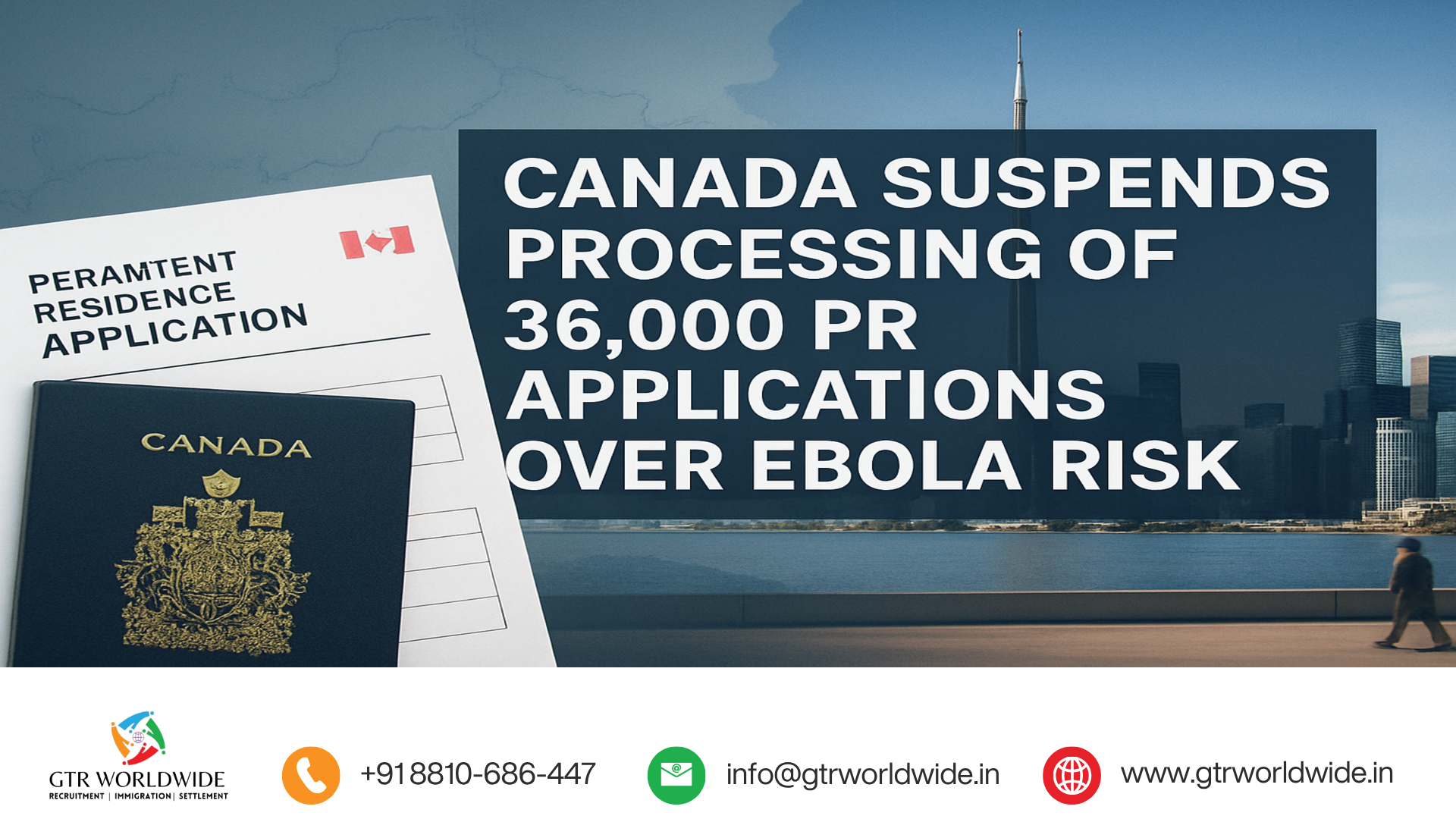
  • Canada suspends processing of 36,000 PR applications over Ebola risk

    Canada suspends processing of 36,000 PR applications over Ebola risk

    Canada suspends processing of around 36,000 PR applications amid Ebola risk in DRC, Uganda and South Sudan

    Immediate summary: what changed and why it matters

    On 27 May 2026, the Government of Canada suspended processing of roughly 36,000 permanent residence (PR) applications and halted issuance and use of approximately 1,700 PR visas issued to people from the Democratic Republic of the Congo (DRC), Uganda and the Republic of South Sudan. The move — announced in the Canada Gazette on 13 June 2026 at 2 p.m. and set to remain in effect for 90 days — also affects temporary residence travel documents, including temporary resident visas (TRVs) and electronic travel authorizations (eTAs). Ottawa says the action responds to a “high or very high risk of an outbreak of Ebola disease” in those three countries. Affected applications will not be processed while the suspension is in force and affected document holders are unable to travel to Canada unless they fall under a specified exemption.

    This update matters because it interrupts the normal path for many people who were at various stages of immigration to Canada: permanent residence applicants, recent PR visa recipients who planned to travel, and holders of temporary travel documents. The suspension is the first public use of powers granted by Bill C-12, which took effect in March 2026 and allows the Governor in Council to issue orders suspending immigration application processing and related permits.

    Legal and policy context behind the measure

    The government framed the measure as a public‑health and border‑management response. Bill C-12, a law that came into force in March 2026, expanded executive authority to pause immigration processing in defined circumstances. According to the official publication in the Canada Gazette, the order targeting the DRC, Uganda and South Sudan invokes that authority as a temporary quarantine-related measure tied to the identified Ebola risk.

    Because the action was published in the Canada Gazette, the numbers reported there — about 36,000 affected PR applications and roughly 1,700 PR visas — are the official counts tied to this order as of the Gazette publication timestamp (June 13, 2026 at 2 p.m.). The suspension covers both permanent and temporary travel documents originating from the specified countries, creating a single, time-limited policy response across several immigration categories rather than a narrower program-specific pause.

    Exactly what has been suspended

    The Canada Gazette notice and related announcements specify these concrete elements:

    • Processing for approximately 36,000 pending permanent residence applications linked to foreign nationals in the Democratic Republic of the Congo, Uganda and the Republic of South Sudan has been suspended.
    • About 1,700 PR visas already issued to individuals from those same countries have been suspended, effectively preventing those visa holders from travelling to Canada while the measure is in force.
    • Temporary residence documents — including temporary resident visas (TRVs) and electronic travel authorizations (eTAs) — tied to people from the listed countries are also impacted.
    • The suspension took effect on 27 May and is set to remain in effect for 90 days from that date. While in force, affected applications will not be processed and affected document holders cannot travel to Canada unless they qualify under a specified exemption set out by the government.

    No further procedural details or lists of exemptions were included in the Gazette figures published on June 13, 2026; the government has indicated the suspension is tied to assessments of Ebola risk in the named countries.

    Why this step is notable in immigration policy

    Two aspects make this development notable:

    First, the intervention is explicitly framed as quarantine-related and tied to infectious disease risk — a public-health justification that can directly affect immigration processing timelines. Second, this is the first recorded use of the specific authority created or clarified by Bill C-12, which provides the Governor in Council the power to suspend processing of immigration applications and permits in circumstances deemed necessary. That first use establishes a precedent for how such powers might be applied in future public‑health or other emergency scenarios.

    For applicants and stakeholders, the combination of health rationale and new statutory authority signals that immigration processing can be paused nationwide for narrowly defined geopolitical or epidemiological situations. The government’s choice to apply the suspension to multiple document types — PR visas, TRVs and eTAs — shows a broad, transport‑and‑entry focus rather than a narrow administrative tweak.

    Who is directly and indirectly affected

    Directly affected parties named in the official notice include:

    • Foreign nationals from the Democratic Republic of the Congo, Uganda and the Republic of South Sudan with pending permanent residence applications — these roughly 36,000 files will not be processed while the suspension is active.
    • People from those three countries who already hold PR visas — around 1,700 individuals who received PR visas before the order are prevented from travelling to Canada to activate those visas while the suspension applies.
    • Holders of temporary residence travel documents from those countries, including TRVs and eTAs, who face restrictions on travel to Canada unless they meet a specified exemption.

    Indirectly affected parties could include family members in Canada expecting reunification, employers awaiting incoming workers, educational institutions expecting international students, or service providers involved in travel and relocation. The source content does not provide a list of exempt categories or examples of indirect consequences; any broader impacts must be understood as logical ripple effects rather than stated facts in the official notice.

    Practical implications for applicants and document holders

    From the information published in the Canada Gazette, applicants and visa holders should expect these immediate practical outcomes:

    • Processing delays for those 36,000 permanent residence applications. Files that were active on or after 27 May will not move forward during the 90‑day suspension window.
    • PR visa holders from the affected countries will be unable to travel to Canada to use their visas while the suspension is in force, which may delay landing dates and the activation of permanent resident status.
    • Temporary travel permissions (TRVs, eTAs, and other temporary residence travel documents) tied to the specified countries are likewise suspended for travel unless the holder meets a government exemption.
    • The suspension is explicitly time‑limited to 90 days from its effective date. During that timeframe, no processing of affected applications will occur under this order; after the 90 days, the government may allow processing to resume, extend the suspension, or take other measures — the Gazette publication provides the snapshot of the decision but not any subsequent administrative steps.

    Because the published notice cites public‑health risk as the reason, travellers and applicants should not assume processing simply resumes automatically once the 90 days expire; follow-up announcements or further orders could modify the timeline.

    What applicants should watch and verify next

    Given the suspension’s temporary nature and the limited detail in the official notice, applicants and document holders should monitor official Government of Canada publications and any specific communication that may be sent to them. Practical points to pay attention to include:

    • Official updates published in the Canada Gazette or by immigration authorities confirming whether the suspension will be lifted, extended, or refined after the 90-day period.
    • Any personal communications from immigration authorities regarding the status of a named application or visa, including whether an individual applicant may qualify for a specified exemption. The Gazette notice mentions exemptions but does not enumerate them; affected people should look for official guidance on those exemptions.
    • Timing implications for landing, family reunification, employment start dates, or study plans that depend on travel to Canada. Where timelines were already tight, affected parties should prepare for delays and consider notifying Canadian employers, educational institutions, or family members as appropriate.
    • Verification of official documentation: PR visa holders should check whether their visa has been administratively marked as suspended and whether any instructions have been provided about rebooking travel or reissuing documents once the suspension ends.

    Because the source material does not list exemptions or procedural steps, applicants must rely on future official updates for firm guidance rather than speculative interim fixes.

    Numbers and dates to keep in mind from the official notice

    • Effective date of suspension: 27 May 2026 (measure took effect on this date).
    • Publication of figures: Canada Gazette, June 13, 2026 at 2 p.m. — the counts are accurate as of that publication.
    • Duration specified in the notice: 90 days from the effective date.
    • Reported counts: approximately 36,000 permanent residence applications suspended; about 1,700 PR visas suspended preventing travel to Canada.

    These are the concrete figures and timestamps provided in the official Gazette notice; any other timelines or numbers are not included in the source content and should not be assumed.

    How to remain informed and practical next steps

    Because this situation is active and the government has indicated updates will follow, the most reliable course is to watch for new, official communications. Applicants and visa holders should retain copies of their immigration correspondence and be ready to present documentation if an exemption or special processing path is announced. Where travel or arrival in Canada was already planned, affected parties should prepare contingency plans in consultation with Canadian contacts (for example, employers or educational institutions), while avoiding assumptions about alternative arrangements until the government provides explicit guidance.

    Finally, those assessing eligibility for Canadian permanent residence are reminded that the official notice itself repeats the prompt to “See your eligibility for Canadian permanent residence.” Affected applicants who believe their case might be eligible for an exemption will need to wait for the government to publish or clarify the specific exemption criteria referenced in the Gazette.

    For personalized support with your Canadian immigration pathway, contact GTR Immigration. Call us: +91-8810-686-447

    #CanadaImmigration #EbolaRisk #PermanentResidence #PRApplications #TravelRestrictions #ImmigrationUpdate #BillC12

  • Two Surnames, One Heritage: Could You Be Eligible for Canadian Citizenship?

    Two Surnames, One Heritage: Could You Be Eligible for Canadian Citizenship?

    Hidden Quebec Roots: How French-Canadian “dit” Names Can Unlock Canadian Citizenship by Descent

    What changed and why it matters now

    Canada’s recent change to citizenship by descent removed the generational limit that once blocked many descendants of Canadian-born parents and grandparents from claiming citizenship. That legal shift has produced a wave of Americans discovering they may qualify — sometimes because a French-Canadian family name they carry today is only half the story. For descendants of Quebec families, an unfamiliar second surname — a “dit” name — can point to a Canadian-born ancestor and a potential route to citizenship. If your family line includes French first names or names that look English but sound French in older records, this update could affect you and several relatives.

    How the “dit” name tradition hides origins

    The dit name was a common French-Canadian custom: a household used two linked surnames, usually written as “[original surname] dit [second name]” (dit = “called”). Examples from parish registers include Miville dit Deschenes, Pelletier dit Bellefleur, and Roy dit Desjardins. Library and Archives Canada traces the practice to France, where communities with many families sharing a single surname needed an additional label to distinguish them.

    Until roughly the 1850s, parish, census and notarial records often recorded both halves of a dit pair. After that point, many families began keeping only one name — and which half persisted was essentially a coin toss. A man recorded as “Homand dit Francoeur” in one parish might later appear as Francoeur, Homand, or even Oman in another record. The practical effect is that a single bloodline can scatter into very different-looking modern surnames.

    Why surnames alone can mislead genealogical and citizenship research

    Surnames that started as French sometimes translated into English (Roi → King; Lenoir → Black). Other names were respelled phonetically by English-speaking clerks (Michaud → Mitchell; Bousquet → Bostwick; Chouquette → Shackett). Between about 1840 and 1930, hundreds of thousands of Quebec-born people migrated into the United States (notably down the Richelieu Valley into Vermont and northern New York). During that migration the original French forms of names were often lost, altered, or dropped.

    Because of these changes, simple lists of “French” last names undercount Americans with Quebec-born ancestors. A family that left Quebec as “Roy dit Desjardins” and later settled in the United States using only “Roy” or only “Desjardins” may not show up on any basic surname-based search for Canadian roots — yet the Canadian thread remains in baptismal or parish records. That mismatch is why many Americans who look at their modern surname alone would never suspect they are “secret Canadians” under the new citizenship rules.

    How the law change interacts with hidden names

    With the generational limit removed, anyone who can document descent from a Canadian-born ancestor may have a pathway to citizenship by descent. The dit-name pattern is not proof of eligibility, but it is a valuable research clue: it signals a family origin that might lead to a Quebec parish record showing a birth in Canada. Since the change in law, Quebec archives have reported a dramatic surge in requests for vital records — a roughly 3,000% increase — mostly from the United States. That rush reflects how many people are now reassessing family histories in light of the new eligibility rules.

    Applicants should expect longer processing times as a result: current information shows citizenship-by-descent applications are facing about a 15-month processing period. The combination of higher demand for archival records and a backlog in citizenship applications means that applicants must plan for delays in both document gathering and official adjudication.

    Who is most likely affected

    – Americans whose families trace to Quebec, especially those with roots in New England, upstate New York, or the Upper Midwest, where many Quebec migrants settled between 1840 and 1930.
    – People whose living relatives remember French first names (Jean, Pierre, Marie, Joseph) even when the current surname is English.
    – Those whose last names look English today but may be translated or phonetic forms of French names (for example, King from Roi, Black from Lenoir).
    – Families that find hyphenated or unusual spellings in older records, or whose genealogies include two different surnames across generations.
    – Siblings, cousins, and other descendants of the same ancestor: if one descendant qualifies, many others likely do too.

    Practical implications for research and application

    The law change does not change what records are required: applicants must still prove descent from a Canadian-born ancestor with supporting civil or parish documents. Where the dit-name tradition complicates matters is in locating that ancestor. Expect to:

    – Spend more time cross-checking multiple name variants, phonetic spellings and translated forms.
    – Search Quebec parish, census, and notarial records where both halves of a dit name often appear together.
    – Be prepared for longer wait times to obtain vital records from Quebec archives because of the surge in requests.
    – Recognize that a surname is a starting clue, not conclusive proof. A “dit” pair can point you to an ancestor’s parish entry, but you still need certified copies of birth, marriage or death records to prove descent for a citizenship application.

    Because archives demand has risen sharply, gathering original documents may become the most time-consuming step. Applicants should allocate extra time and budget for ordering official copies and for potential translation if records are in French.

    Concrete research steps to follow

    • Interview the oldest living relatives for place names, towns, and family nicknames; note any French first names or stories about “another” family name.
    • Search for both the modern surname and potential French originals separately and together (for example, Mitchell and Michaud).
    • Include phonetic and translated spellings when searching historical records: consider King/Roi, Black/Lenoir, Shackett/Chouquette, Bostwick/Bousquet.
    • Search Quebec parish registers, census returns and notarial records, where both halves of a dit name may appear in the same entry.
    • Focus searches on geographic corridors of migration from Quebec to the U.S., notably the Richelieu Valley to Vermont and northern New York, and broader New England and Upper Midwest settlement patterns between 1840 and 1930.
    • Remember the multiplier effect: if you trace one qualifying ancestor, siblings, cousins and their descendants may also be eligible, so coordinate efforts with relatives.

    Examples that illustrate how names changed

    These examples show common patterns that hide Quebec origins:
    – King ← Roi (direct translation)
    – Black ← Lenoir (translation of a descriptive surname)
    – Mitchell ← Michaud (phonetic respelling by English clerks)
    – Bostwick ← Bousquet (phonetic respelling)
    – Shackett ← Chouquette (phonetic respelling)
    – Homand dit Francoeur → could appear as Homand, Francoeur, or Oman in different records
    – Roy dit Desjardins → descendants might show as Roy, Desjardins, or both in older documents

    Seeing one of these modern names in your family tree does not prove eligibility by itself, but knowing these transformations helps you target which archives and record sets to consult.

    Document and timeline realities to plan for

    Two numbers from archival and processing reports should shape expectations: the substantial surge in requests to Quebec archives (about 3,000%) and the current approximate 15-month processing time for citizenship-by-descent applications. These figures indicate where delays will likely occur — in obtaining certified vital records and in final adjudication. Applicants should prioritize early document gathering and allow extra time between confirming lineage and submitting a formal citizenship application.

    Common pitfalls and how to avoid them

    – Relying exclusively on a modern surname. The dit name custom and translations mean the original French surname may be hidden.
    – Assuming oral family memory is complete. Relatives may remember only one name or an anglicized form; cross-check stories against parish records.
    – Not searching for phonetic variants or translations. Clerks often recorded names according to how they sounded or translated descriptive names into English.
    – Overlooking local migration patterns. Knowing that many Quebec families moved along specific corridors into Vermont, northern New York and New England between 1840 and 1930 can narrow your search.
    – Underestimating paperwork lead time. Order Quebec vital records early and expect delays because of increased demand.

    Next steps for readers who suspect a hidden Canadian ancestor

    Begin with family interviews and collect any existing paper documents — baptismal certificates, family Bible entries, old letters, funeral cards — that might contain place names or French forms. Use those clues to search parish registers and notarial records in Quebec. If you find a Canadian-born ancestor, gather certified vital records to support a citizenship-by-descent claim and anticipate a longer processing window for the application.

    Remember: a dit name is rarely conclusive by itself. It’s a research signal that points toward records that can establish the key fact for citizenship by descent: that an ancestor was born in Canada. If you reach that point, prepare for a formal application process that, according to recent reports, can take roughly 15 months to resolve.

    Why this matters for families and identity

    The consequence of the legal change is not only administrative; it’s genealogical and personal. A surname that once seemed entirely American may conceal a Canadian origin that restores citizenship rights across generations. For many families, discovering a lost Quebec ancestor reshapes narratives about migration, belonging, and legal status — and it can have practical implications for immediate family members who may now be eligible themselves.

    For personalized support with your Canadian immigration pathway, contact GTR Immigration. Call us: +91-8810-686-447

    #CanadianCitizenship #CitizenshipByDescent #QuebecGenealogy #DitNames #FamilyHistory #ImmigrationNews #GenealogyResearch

  • MPNP Ends Career Employment Pathway for International Students

    MPNP Ends Career Employment Pathway for International Students

    Manitoba PNP: Career Employment Pathway (CEP) Closed — What International Graduates Need to Know

    Immediate change announced and why it matters

    On June 11, 2026, the Manitoba Provincial Nominee Program (MPNP) announced the immediate closure of the Career Employment Pathway (CEP) within its International Education Stream. For international graduates who were pursuing the CEP as a route to permanent residence in Manitoba, this is a significant shift: they can no longer be advanced under CEP and must consider other MPNP pathways if they wish to remain in the province and pursue PR. The change is important for students, recent graduates, and their employers because it affects which nomination routes are available, how candidates are prioritized in Expression of Interest (EOI) draws, and what documentation and work history will matter going forward.

    How Manitoba described the rationale

    MPNP explained that the closure of the CEP aims to create “clear, consistent criteria for all Manitoba graduates” and to better align education, work experience, and provincial labour market needs. As part of this shift, the province will prioritize graduates who have both Manitoba post-secondary credentials and in-province work experience, particularly in targeted Skilled Worker in Manitoba draws. The announcement makes a distinction between CEP (now closed) and other MPNP pathways that remain available, notably the Skilled Worker in Manitoba pathway and the Graduate Internship Pathway for certain master’s and doctoral graduates who complete a Mitacs internship.

    What the closure actually means in practical terms

    – CEP is closed effective immediately: candidates can no longer be selected under that pathway. If you had been planning to use CEP to qualify for provincial nomination, that route is no longer available.
    – Active CEP EOIs are not automatically converted to nomination: candidates with an active EOI under CEP must review other pathway criteria and update their profiles if they meet the alternative pathway requirements.
    – Skilled Worker in Manitoba becomes the primary path for many grads: MPNP indicates candidates with at least six months of in-province work experience can be considered for selection under the Skilled Worker in Manitoba pathway, if eligible. This pathway will be used to prioritize graduates in targeted draws.
    – Graduate Internship Pathway preserved for Mitacs-eligible grads: the Graduate Internship Pathway remains available for eligible master’s and doctoral graduates who complete a Mitacs internship. That exception is explicitly retained in the announcement.
    – Ongoing regular draws: Skilled Worker in Manitoba draws will continue on a regular basis; the province has already held 11 draws targeting MPNP candidates through its Skilled Worker Stream in 2026.

    Who should pay closest attention to this change

    – International graduates who previously applied, or intended to apply, through the CEP: these applicants must find alternative nomination routes and may need to update their EOI profiles.
    – Graduates currently working in Manitoba with at least six months of in-province work experience: these candidates may now be eligible for the Skilled Worker in Manitoba pathway and could be prioritized in targeted draws.
    – Master’s and doctoral graduates who are eligible for a Mitacs internship: they should note that the Graduate Internship Pathway remains in place, and completing a Mitacs internship preserves a specific route to nomination.
    – Candidates holding active EOIs under the CEP: they are explicitly asked by MPNP to review Skilled Worker in Manitoba eligibility and to update their profiles accordingly, ensuring all Manitoba connections are declared.
    – Employers who support international graduates: employers should be aware that the criteria for provincial selection have shifted and that employee candidates may need to demonstrate in-province work experience to be considered.

    Practical impact for applicants and employers

    For individual applicants, the most immediate practical effects are administrative and strategic. If you had an active EOI under CEP, you should not assume nomination will follow; instead you must take action to be considered under a different pathway. Specifically, MPNP advises CEP EOI holders to update their profile, ensure declaration of all Manitoba connections (including completion of post-secondary education in Manitoba), and confirm whether they meet the Skilled Worker in Manitoba pathway criteria. One concrete requirement highlighted by MPNP is the six-month minimum in-province work experience threshold for consideration under Skilled Worker in Manitoba — this becomes crucial evidence for selection.

    For employers, the change potentially shifts which employees can be put forward for nomination. Employers who previously relied on CEP as a predictable pipeline for newly graduated hires may now need to confirm their employees meet Skilled Worker in Manitoba requirements or are eligible for the Graduate Internship Pathway. Employers may also face timing considerations: because Skilled Worker in Manitoba draws are conducted regularly, staying informed about draw targets and ensuring candidate profiles are up to date will be important for employers supporting nominations.

    What to check and update in your MPNP profile

    MPNP’s announcement is specific about what candidates with active CEP EOIs should do:

    • Review the eligibility criteria for the Skilled Worker in Manitoba pathway to determine whether you meet them.
    • Update your EOI profile if you meet pathway criteria.
    • Ensure you have declared all Manitoba connections in your profile, including completion of post-secondary education in the province.

    These are the explicit procedural steps MPNP set out. Candidates who do not take these actions risk being overlooked in targeted draws that prioritize Manitoba-connected graduates and workers.

    Numbers, dates and explicit exceptions from the announcement

    • Announcement date: June 11, 2026 (MPNP official news webpage).
    • CEP closure: effective immediately as of that announcement date.
    • Work experience threshold noted: candidates with at least six months of in‑province work experience can be considered for selection under Skilled Worker in Manitoba, if eligible.
    • Draw activity in 2026: Manitoba has held 11 Skilled Worker Stream draws targeting MPNP candidates to date in 2026.
    • Graduate Internship Pathway exception: remains available for eligible master’s and doctoral graduates who complete a Mitacs internship.
    • Contact route: candidates with questions or requiring assistance can contact MPNP via its online contact form (MPNP’s communication channel indicated in the announcement).

    Why Manitoba may be emphasizing in‑province work experience and clearer criteria

    MPNP’s stated goal is to create clear, consistent criteria for Manitoba graduates and better align education, work experience and labour market needs. Emphasizing in‑province work experience signals a focus on candidates who have begun integrating into Manitoba’s workforce and labour market. Prioritizing those who can demonstrate both Manitoba education and work connection can help the province select nominees who are already partly established locally, which aligns with the program’s objective to address provincial labour needs while supporting newcomer retention. The specific operational outcome in this announcement is shifting selection activity toward the Skilled Worker in Manitoba pathway and targeted EOIs.

    Key considerations and potential next steps for affected candidates

    – If you are an active CEP candidate: immediately review the Skilled Worker in Manitoba criteria and update your profile if you meet the requirements. Ensure all Manitoba connections are recorded.
    – If you have less than six months of in-province work experience: the announcement indicates six months is the threshold for consideration under Skilled Worker in Manitoba. If that applies to you, carefully assess whether other options (such as the Graduate Internship Pathway, if eligible) remain open.
    – If you are a master’s or doctoral graduate who completed or expects to complete a Mitacs internship: the Graduate Internship Pathway remains available and should be evaluated as an alternative to CEP.
    – If you are relying on employer support: coordinate with your employer to confirm job details, in-province employment duration, and documentation needed to demonstrate Manitoba work experience.
    – If your EOI profile still lists CEP: update it to reflect the closure and your candidacy under a different pathway where appropriate.

    What to watch going forward

    Candidates and employers should monitor a few practical items:

    • Regular Skilled Worker in Manitoba draws: since these continue on a regular basis and have already occurred 11 times in 2026, staying current with draw notices and any targeting information will be important.
    • Any further guidance from MPNP: the announcement is clear about immediate changes, but MPNP may publish additional instructions or clarifications; check official communications for updates.
    • Documentation standards for showing Manitoba connections: ensure all education completion documentation and employment records are accurate and declared in EOI profiles.

    Where to get help and how to contact MPNP

    MPNP’s announcement notes applicants who have questions or who need assistance can reach out through its online contact form. Beyond that, the pathway advice in the announcement is explicit: candidates with active CEP EOIs need to review Skilled Worker in Manitoba eligibility, update profiles, and declare Manitoba connections including post-secondary completion. For those eligible for the Graduate Internship Pathway, completing a Mitacs internship remains a defined pathway option.

    For personalized support with your Canadian immigration pathway, contact GTR Immigration. Call us: +91-8810-686-447

    #MPNP #ManitobaPNP #CanadianImmigration #InternationalGraduates #SkilledWorker #Mitacs #PermanentResidence #ImmigrationNews

  • High-wage factor to boost 40% of Express Entry priority occupations

    High-wage factor to boost 40% of Express Entry priority occupations

    Express Entry: How the proposed “high‑wage occupation factor” could boost scores for 37 of 89 priority jobs

    Quick summary: what changed and why it matters

    The federal government has proposed a new “high‑wage occupation factor” for Express Entry that would award extra Comprehensive Ranking System (CRS) points to candidates whose occupations have median wages well above the Canadian median. This matters because roughly four in ten of the 89 occupations already prioritized under category‑based selection (CBS) — 37 occupations — would receive higher CRS scores under the proposed tiers, improving those candidates’ chances of receiving an invitation to apply (ITA) for permanent residence. The change is tied to Job Bank median wages and not to an individual’s personal pay. Officials have signalled a 12–18 month implementation timeline for the suite of Express Entry reforms, though the high‑wage factor could be rolled out sooner.

    How the new factor is designed

    The proposed design creates three tiers of bonus points for high‑wage occupations, using Job Bank occupational medians as the benchmark. The tiers are:

    • Occupations with median wages at least 2.0 times the national median
    • Occupations with median wages at least 1.5 times the national median
    • Occupations with median wages at least 1.3 times the national median

    For the calculations in the government data cited here, Statistics Canada’s 2025 median hourly wage of $30.77 was used. Under that median, the three thresholds correspond to occupations with median hourly wages of roughly $61.54 and above (2x), $46.16 and above (1.5x), and $39.99 and above (1.3x). The government will use Job Bank data to determine whether a candidate’s occupation qualifies; an individual candidate’s actual or offered wage is not considered.

    Why the update matters inside the Express Entry system

    Express Entry manages the federal skilled worker selection process using the CRS, and CBS currently gives targeted groups of occupations periodic, lower‑score draws. By attaching additional CRS points to high‑wage occupations, the government is shifting selection emphasis toward occupations that pay meaningfully more than the national median. That can change invitation dynamics in two ways:

    • Candidates in qualifying high‑wage occupations gain a direct CRS advantage, improving their ranking relative to other profiles in the pool.
    • Because CBS draws already permit lower cut‑offs for targeted occupations, layering a high‑wage bonus on top of category eligibility can substantially increase the likelihood of an ITA during a category‑based round.

    The difference is tangible when compared with recent draw behaviour: in 2026 there were 10 category‑based draws with CRS cut‑offs between 169 and 477, while Canadian Experience Class draws during the same period had cut‑offs in the 507–518 range. Any additional CRS points for high‑wage occupations could help CBS candidates hit or remain above those lower occupational cut‑offs.

    Which prioritized occupations stand to gain most

    Of the 89 occupations currently eligible for CBS, 37 meet one of the high‑wage thresholds based on available Job Bank medians and the $30.77 benchmark. Below are examples from each tier, including the occupation category, the most recent CBS CRS cut‑off for that occupational category (when available), and the occupation’s Job Bank median hourly wage used in the government’s dataset.

    Occupations with medians at least 2x the national median

    • Specialists in surgery (NOC 31101) — Healthcare and social services; Physicians with Canadian work experience — recent CBS cut‑offs: 467; 169 — median hourly wage $201.52
    • Specialists in clinical and laboratory medicine (NOC 31100) — Healthcare and social services; Physicians with Canadian work experience — recent cut‑offs: 467; 169 — median hourly wage $149.66
    • General practitioners and family physicians (NOC 31102) — Healthcare and social services; Physicians with Canadian work experience — recent cut‑offs: 467; 169 — median hourly wage $111.64
    • Senior managers — financial, communications and other business services (NOC 00012) — Senior managers with Canadian work experience — recent cut‑off: 429 — median hourly wage $96.15
    • Architecture and science managers (NOC 20011) — STEM — median hourly wage $62.56
    • Nurse practitioners (NOC 31302) — Healthcare and social services — recent cut‑off: 467 — median hourly wage $61.54

    Occupations with medians at least 1.5x the national median

    • University professors and lecturers (NOC 41200) — Researchers with Canadian work experience — median hourly wage $58.89
    • Pharmacists (NOC 31120) — Healthcare and social services — recent cut‑off: 467 — median hourly wage $55.49
    • Commissioned officers of the Canadian Armed Forces (NOC 40042) — Skilled military recruits — median hourly wage $55.03
    • Dentists (NOC 31110) — Healthcare and social services — recent cut‑off: 467 — median hourly wage $52.88
    • Psychologists (NOC 31200) — Healthcare and social services — recent cut‑off: 467 — median hourly wage $52.88
    • Electrical and electronics engineers (NOC 21310) — STEM — median hourly wage $50.67
    • Cybersecurity specialists (NOC 21220) — STEM — median hourly wage $49.52
    • Geological engineers (NOC 21331) — STEM — median hourly wage $49.81
    • Construction managers (NOC 70010) — Trade — recent cut‑off: 477 — median hourly wage $48.72
    • Air pilots, flight engineers and flying instructors (NOC 72600) — Transport — median hourly wage $52.00
    • Nursing coordinators and supervisors (NOC 31300) — Healthcare and social services — recent cut‑off: 467 — median hourly wage $46.43
    • Veterinarians (NOC 31103) — Healthcare and social services — recent cut‑off: 467 — median hourly wage $60.00
    • Contractors and supervisors, oil and gas drilling and services (NOC 82021) — Trade — recent cut‑off: 477 — median hourly wage $50.00
    • Physician assistants, midwives and allied health professionals (NOC 31303) — Healthcare and social services — recent cut‑off: 467 — median hourly wage $46.81

    Occupations with medians at least 1.3x the national median

    • Registered nurses and registered psychiatric nurses (NOC 31301) — Healthcare and social services — recent cut‑off: 467 — median hourly wage $43.27
    • Secondary school teachers (NOC 41220) — Education — recent cut‑off: 462 — median hourly wage $45.67
    • Elementary school and kindergarten teachers (NOC 41221) — Education — recent cut‑off: 462 — median hourly wage $43.27
    • Mechanical engineers (NOC 21301) — STEM — median hourly wage $45.67
    • Industrial and manufacturing engineers (NOC 21321) — STEM — median hourly wage $44.23
    • Occupational therapists (NOC 31203) — Healthcare and social services — recent cut‑off: 467 — median hourly wage $46.00
    • Physiotherapists (NOC 31202) — Healthcare and social services — recent cut‑off: 467 — median hourly wage $46.15
    • Dental hygienists and dental therapists (NOC 32111) — Healthcare and social services — recent cut‑off: 467 — median hourly wage $45.00
    • Medical sonographers (NOC 32122) — Healthcare and social services — recent cut‑off: 467 — median hourly wage $42.00
    • Industrial electricians (NOC 72201) — Trade — recent cut‑off: 477 — median hourly wage $42.00
    • Respiratory therapists, clinical perfusionists and cardiopulmonary technologists (NOC 32103) — Healthcare and social services — recent cut‑off: 467 — median hourly wage $41.00
    • Audiologists and speech‑language pathologists (NOC 31112) — Healthcare and social services — recent cut‑off: 467 — median hourly wage $46.15
    • Dietitians and nutritionists (NOC 31121) — Healthcare and social services — recent cut‑off: 467 — median hourly wage $41.63
    • Aircraft instrument, electrical and avionics mechanics, technicians and inspectors (NOC 22313) — Transport — median hourly wage $40.47
    • Senior managers — construction, transportation, production and utilities (NOC 00015) — Senior managers with Canadian work experience — recent cut‑off: 429 — median hourly wage $46.04
    • Senior managers — trade, broadcasting and other services (NOC 00014) — Senior managers with Canadian work experience — recent cut‑off: 429 — median hourly wage $42.38

    Note: NOCs 31102, 31100 and 31101 are listed under both “Healthcare and social services” and “Physicians with Canadian work experience” categories and may be drawn under either occupational CBS stream.

    How selection will be evaluated — an important technical point

    Under the proposed rules, qualification for the high‑wage factor is occupation‑based: the Job Bank median wage for the NOC(s) in which a candidate has the required work experience and/or a valid job offer determines eligibility for bonus points. Crucially, the candidate’s individual hourly wage, previous salary, or future offered pay is not used. The IRCC will maintain an official list of eligible occupations for the high‑wage factor on its website and intends to update it regularly, likely annually.

    Who is most likely to see a meaningful change

    The group most directly affected is CBS‑eligible Express Entry candidates whose NOC falls into one of the high‑wage tiers. That includes:

    • Physicians, surgeons and specialists who already feature high Job Bank medians and are drawn in physician‑category rounds.
    • High‑earning senior managers, engineers, certain healthcare professionals (pharmacists, dentists, nurse practitioners) and selected STEM occupations such as cybersecurity specialists and electrical engineers.
    • Candidates in occupations with historical CBS draws at relatively low CRS cut‑offs (for example, occupations with most recent cut‑offs in the 400s or below), who would likely improve their rank further with extra high‑wage points.

    Less directly affected are candidates whose occupations do not meet the Job Bank thresholds; those candidates will not receive the bonus even if their personal pay is high. Also, CBS‑ineligible occupations or candidates who do not meet the 12‑month work requirement for category selection will not benefit from this factor.

    Practical effects for applicants and employers

    The proposed factor changes the strategic landscape in several practical ways:

    • Stronger incentive to confirm correct NOC mapping: Because bonus points are tied to the Job Bank median for a specific occupation, ensuring your Express Entry profile correctly lists the NOC that matches your work history is essential.
    • Increased competitiveness for qualifying occupations: Candidates in the 37 identified occupations stand to improve their CRS ranking, especially during CBS rounds that historically have lower cut‑offs.
    • No shortcut via salary negotiation alone: Employers and applicants should note that negotiating a higher personal wage will not affect eligibility for the high‑wage factor — the factor is occupation‑level, not pay‑level.
    • Annual list updates will matter: IRCC intends to publish and regularly update the eligible list, so occupation status can change over time as Job Bank medians shift.

    Numbers and timelines to watch closely

    Key figures and timelines referenced by officials and in available data:

    • 89 occupations currently prioritized through category‑based selection (CBS).
    • 37 of those 89 occupations would qualify for additional points under the proposed high‑wage factor based on Job Bank medians and a $30.77 hourly median from Statistics Canada (2025).
    • Tier thresholds are multiples of the median wage: 2.0x, 1.5x and 1.3x.
    • Examples of recent CBS cut‑offs cited in 2026 draws include 169, 429, 462 and 477 for different occupational categories; Canadian Experience Class draws ranged from 507–518.
    • Officials have given a 12–18 month timeline for full implementation of Express Entry reforms, while indicating some elements — including the high‑wage factor — could be introduced earlier.

    What applicants should monitor now

    Candidates and employers should track several elements as the proposal moves toward implementation:

    • IRCC’s official list of eligible high‑wage occupations — the department said it will publish a full list on its website and update it, likely annually.
    • Job Bank median wages for your NOC(s) — since eligibility depends on those medians, changes in occupational medians can add or remove eligibility.
    • Your Express Entry profile accuracy — ensure your work experience is correctly mapped to the NOC that best describes your role; CBS generally requires at least 12 months of work experience in a single eligible occupation within the past three years.
    • Category‑based draw patterns — CBS rounds historically have much lower cut‑offs than general CEC draws; if your occupation is both CBS‑eligible and high‑wage qualifying, you may benefit disproportionately from occupational draws.
    • The IRCC communications on the timing and sequencing of the Express Entry reforms; while a 12–18 month timeline was provided for full implementation, individual elements may be announced and applied earlier.

    Practical next steps for candidates

    Without presuming to give legal advice, candidates can act on available information:

    • Review your Express Entry profile NOC and ensure work experience documentation is consistent with that NOC.
    • Check whether your occupation is listed among the 89 CBS occupations and whether it appears in the sets of occupations identified here as meeting high‑wage thresholds.
    • Monitor IRCC’s forthcoming official list; eligibility will be determined by Job Bank medians and the IRCC list, not by personal salary.
    • Be prepared for category‑based invitations: CBS draws historically have lower CRS cut‑offs — having the additional high‑wage points could be decisive.

    Final observations on broader policy intent

    The high‑wage occupation factor is clearly an effort to steer permanent residence selection toward occupations that pay meaningfully above the national median. By tying points to occupational medians, the government signals a preference for skilled workers in higher‑paid roles while preserving occupation‑based pathways in Express Entry. For candidates, the key implication is that occupation choice — and correct NOC alignment — will matter not only for category eligibility but also for potential extra CRS points tied to labour‑market wages.

    For personalized support with your Canadian immigration pathway, contact GTR Immigration. Call us: +91-8810-686-447

    #ExpressEntry #CRS #CanadianImmigration #HighWageFactor #CategoryBasedSelection #JobBank #PermanentResidence #ImmigrationNews

  • FHSA Basics for Newcomers Buying Their First Home in Canada

    FHSA Basics for Newcomers Buying Their First Home in Canada

    First Home Savings Account (FHSA) in Canada: What Newcomers and First-Time Buyers Need to Know

    Why the FHSA matters now — and why you should read this

    The Canadian federal government created the First Home Savings Account (FHSA) to help eligible residents save for a first home with clear tax advantages: tax-deductible contributions, tax-free investment growth inside the account, and tax-free withdrawals when used to buy a qualifying first home. For newcomers and first-time buyers, the FHSA can change how you plan for a down payment and how you combine different registered accounts. This article explains how the FHSA works, who can open one, how it compares with other registered plans, what practical decisions you’ll face, and the specific details you must watch as you plan to buy your first home in Canada.

    How the FHSA is structured — the essential mechanics

    The FHSA is a registered savings plan that blends features from two familiar Canadian accounts. You can contribute up to $8,000 per year, up to a lifetime maximum of $40,000. Contributions may be claimed as a tax deduction in the year you make them. Any investment growth inside the FHSA is sheltered from tax while it remains in the account. If you use FHSA funds to buy a qualifying first home, withdrawals of both contributions and investment growth are tax-free. These three characteristics — tax-deductible contributions, tax-deferred growth, and tax-free qualifying withdrawals — are the core reasons the FHSA was introduced to support first-time homebuyers.

    Opening an FHSA requires meeting Canada Revenue Agency (CRA) eligibility rules and working with a registered FHSA issuer (for example, a bank, credit union, trust company or insurance company). To open an account you must provide valid identification, a Social Insurance Number (SIN), proof of Canadian residency, and a completed application. Before you open an FHSA, be sure you meet the first-time home buyer requirement; failing to meet it can create tax consequences.

    Where the FHSA fits compared with RRSP and TFSA

    The FHSA was purpose-built for first home purchases, but Canadians already use other registered plans for down payment savings. Understanding differences matters for strategy:

    – RRSP (Registered Retirement Savings Plan): Primarily a retirement vehicle. Through the Home Buyers’ Plan (HBP), eligible first-time buyers may withdraw up to $60,000 from an RRSP to buy a qualifying home, but those withdrawals must be repaid to the RRSP over time. Missed repayments are reported as income in the year missed. The HBP is a loan-from-yourself that requires structured repayment.

    – TFSA (Tax-Free Savings Account): Flexible for many goals. Contributions are not tax-deductible, but eligible withdrawals are tax-free and contribution room is restored in the following calendar year. People often use a TFSA for down payment savings due to its flexibility and tax-free withdrawals.

    – FHSA: Combines elements of RRSP and TFSA. Contributions are tax-deductible like an RRSP, but qualifying withdrawals for a first home are tax-free like a TFSA. Unlike HBP withdrawals from an RRSP, FHSA withdrawals for a qualifying first home do not need to be repaid. The FHSA is specifically targeted at first-time homebuyers and carries annual and lifetime contribution limits ($8,000 annually, $40,000 lifetime).

    The presence of these three tools raises practical choices: whether to prioritize RRSP, TFSA, FHSA, or some combination. The FHSA’s tax-deduction plus tax-free qualifying withdrawal is a notable structural advantage for eligible first-time buyers.

    Who is eligible to open an FHSA — the key criteria

    To open an FHSA you must meet CRA eligibility rules:

    – Be a resident of Canada.
    – Be at least 18 years old (note: the age of majority is 19 in some provinces and territories; you must meet the age of majority where you live).
    – Have a valid Social Insurance Number (SIN).
    – Be a first-time home buyer as defined by the CRA.

    These rules mean many newcomers who establish Canadian residency and obtain a SIN can be eligible. However, the “first-time home buyer” condition is central — ensure you qualify before opening an FHSA to avoid unintended tax consequences.

    Practical steps to open and manage an FHSA

    Opening an FHSA typically follows these steps:

    – Speak with an FHSA issuer (bank, credit union, trust or insurance firm) about your goals and eligibility.
    – Provide identification, your SIN, proof of Canadian residency, and a completed application.
    – Choose account features that match your risk tolerance and timeline (cash, GICs, mutual funds, or broader investment options if available through a self-directed account).

    FHSA products vary by issuer. Some accounts are “multi-holding,” allowing a mix of cash, Guaranteed Investment Certificates (GICs) and mutual funds in one account. Other FHSA options are self-directed and let you hold a wider range of investments including stocks, bonds, mutual funds and GICs. The investment mix you choose will influence the growth potential inside the FHSA and your risk exposure.

    Why the FHSA can be attractive for newcomers

    For newcomers, the FHSA addresses several common challenges:

    – Tax efficiency when saving for a home: Contributions that reduce taxable income can be valuable if you have Canadian-earned income and are paying income tax.
    – No repayment requirement: Unlike the RRSP Home Buyers’ Plan, qualifying FHSA withdrawals do not need to be repaid, simplifying the path from savings to purchase.
    – Flexibility in how you invest: Issuers may offer options from low-risk GICs to self-directed stock and bond investments, allowing alignment with your timeline and comfort with risk.
    – Clear contribution limits: Annual and lifetime maximums set expectations and help you plan the pace of saving.

    These features can make the FHSA an efficient and simple vehicle for eligible newcomers planning to buy their first home in Canada.

    Who should consider the FHSA — scenarios and considerations

    The FHSA is relevant for several groups:

    – Newcomers who are residents of Canada, have a SIN, and meet the first-time buyer test. If you expect to earn Canadian income and file taxes, an FHSA can deliver immediate tax relief through deductible contributions.
    – Young professionals or early-stage earners who can benefit from tax deductions now and tax-free withdrawals when they buy a home.
    – Individuals who want to avoid the HBP repayment obligation and would prefer a straightforward tax-free withdrawal for a qualifying purchase.
    – Savers who prefer a targeted vehicle expressly designed for home purchase savings rather than using up TFSA room intended for other goals.

    However, people who lack Canadian taxable income in the near term may see less immediate benefit from the deduction feature. Also, if you are unsure whether you meet the first-time home buyer definition, clarify this before opening an FHSA.

    Practical impacts — how the FHSA affects your down-payment planning

    The FHSA changes down-payment planning in several practical ways:

    – Tax planning: Contributions reduce your taxable income for the contribution year. For people paying Canadian income tax now, this can produce short-term tax savings.
    – Investment strategy: Because FHSA funds can grow tax-free, your choice of investments inside the account affects how quickly the account can reach the funds you need. Conservative investments reduce volatility but may limit growth, while a self-directed approach may increase potential returns (and risk).
    – Account interaction: The FHSA sits alongside TFSA and RRSP options. You may choose to split your savings across accounts to balance tax planning, flexibility and repayment obligations (for RRSP HBP).
    – Timing: The annual $8,000 limit and $40,000 lifetime cap shape how long it will take to reach a target down payment using the FHSA alone. If your down payment goal exceeds FHSA capacity, you will need complementary savings strategies.

    Because the FHSA removes repayment obligations for qualifying withdrawals, it simplifies your cash flow planning at purchase compared with RRSP HBP strategies.

    Key numbers and account limits to remember

    The FHSA includes clear numerical constraints that affect planning:

    • Annual contribution limit: $8,000
    • Lifetime contribution limit: $40,000

    Other program figures referenced in the registered plan landscape include the RRSP Home Buyers’ Plan maximum withdrawal of $60,000 (for those who qualify under HBP rules). Remember to confirm these numbers against CRA guidance when you plan, and ensure you understand the eligibility rules for tax treatment and qualifying withdrawals.

    Common pitfalls and points to watch closely

    Several practical cautions matter:

    – First-time home buyer test: Confirm you meet this requirement before contributing. Failure to meet the test when you withdraw can trigger tax consequences.
    – Age of majority: In some provinces the legal age to enter into contracts is 19. Ensure you meet your provincial age of majority as well as the CRA’s baseline age requirement.
    – Contribution tracking: The FHSA contribution limits are strict. Over-contributing may trigger penalties. Track annual and lifetime contributions across issuers.
    – Investment choice: If you choose a self-directed FHSA, understand how investment risk aligns with your time horizon to purchase. Volatility can be costly if a market downturn occurs near your planned purchase date.
    – Combining accounts: If you use RRSP HBP and FHSA together, be mindful of the RRSP repayment schedule and tax rules. FHSA withdrawals for a qualifying home do not require repayment; RRSP HBP funds do.
    – Documentation and proof: Keep documentation that demonstrates your qualifying use of FHSA funds and first-time buyer status, as issuers or tax authorities may require confirmation.

    Practical next steps for prospective FHSA users

    If you are considering an FHSA, a practical approach is:

    – Confirm eligibility: Check residency, age and first-time buyer status before opening the account.
    – Clarify your timeline: Decide how soon you plan to buy and how much you need for a down payment to choose appropriate investments inside the FHSA.
    – Compare account types: Talk to FHSA issuers about multi-holding options versus self-directed accounts and consider how fees and available investments affect returns.
    – Track contributions: Keep meticulous records of yearly contributions and lifetime totals to avoid over-contribution penalties.
    – Coordinate with other plans: If you already have an RRSP or TFSA, map how the FHSA fits into your larger tax and savings plan.
    – Prepare documentation: When you withdraw FHSA funds to purchase a home, be ready to provide documentation that the property and purchase meet qualifying rules.

    How this update affects broader immigration and settlement planning

    For newcomers, the FHSA is more than a savings vehicle: it becomes part of financial settlement in Canada. Creating a plan to accumulate a down payment intersects with employment, tax filing and credit-building — all important elements of longer-term settlement. Because FHSA contributions are tax-deductible, newcomers who begin earning Canadian income can see an immediate tax benefit that supports cash flow in early years. The FHSA also offers a straightforward withdrawal path for first-time purchases, reducing administrative complexity at the moment of buying.

    This account can therefore influence decisions such as whether to prioritize building TFSA room, contributing to an RRSP, or focusing savings into an FHSA for house purchase. Each choice has trade-offs related to immediate tax savings, long-term retirement planning, and flexibility.

    Questions to ask your financial institution or advisor

    When you discuss an FHSA with an issuer or advisor, useful questions include:

    • What identification and documentation do you require to open an FHSA for a newcomer?
    • What investment options are available inside each FHSA product, and what are the fees?
    • How do you report FHSA contributions and withdrawals to the CRA?
    • What process and documentation are needed to demonstrate a qualifying first-home purchase when withdrawing funds?
    • How do you help clients who want a combination of FHSA, TFSA and RRSP strategies?

    Asking these practical questions helps you avoid surprises and ensures the FHSA you open matches your intended use.

    Final observations: where FHSA fits in a newcomer’s toolbox

    The FHSA is a targeted, tax-advantaged savings plan that can simplify and strengthen a first-time homebuying strategy for eligible residents in Canada. Its combination of deductible contributions and tax-free qualifying withdrawals offers a distinct advantage over using RRSP HBP alone, while preserving some of the TFSA’s flexibility. For newcomers who meet eligibility rules and plan to buy a first home in Canada, the FHSA can be a central part of an organized down-payment strategy — provided you understand the contribution limits, documentation requirements and investment options available through your chosen issuer.

    For personalized support with your Canadian immigration pathway, contact GTR Immigration. Call us: +91-8810-686-447

    #FHSA #FirstHomeSavingsAccount #CanadaHousing #NewcomersToCanada #FirstTimeHomeBuyer #CanadianTaxes #HomeBuyingPlanning