Category: Immigration

  • Manitoba invites candidates through Skilled Worker Stream

    Manitoba invites candidates through Skilled Worker Stream

    he province of Manitoba has conducted a new immigration draw under the Manitoba Provincial Nominee Program (MPNP), inviting skilled workers to apply for provincial nomination and move one step closer to obtaining Canadian permanent residence.

    The latest draw was conducted through the Skilled Worker Stream, one of Manitoba’s key immigration pathways designed to attract workers with the skills and experience needed to support the province’s labour market and economic growth.

    Latest Manitoba Skilled Worker Draw

    In the recent MPNP draw, Manitoba issued invitations to eligible candidates through its Skilled Worker pathway.

    Manitoba PNP Draw Results

    StreamInvitations IssuedMinimum Score
    Skilled Worker in Manitoba36613
    Skilled Worker Overseas14711
    International Education Stream54No Score Required
    Total104

    Among the candidates invited, several had active Express Entry profiles and valid job seeker validation codes, increasing their opportunities to transition to permanent residence through both federal and provincial immigration pathways.

    What Is the Skilled Worker Stream?

    The Skilled Worker Stream is designed for individuals who possess the skills, education, work experience, and language abilities required by Manitoba employers.

    The stream focuses on candidates who can demonstrate strong connections to the province through:

    • Current employment in Manitoba
    • Previous work experience
    • Education completed in Manitoba
    • Family or community ties
    • Invitations received through strategic recruitment initiatives

    The program aims to help employers address labour shortages while supporting Manitoba’s long-term economic development.

    Skilled Worker in Manitoba Stream

    The Skilled Worker in Manitoba category primarily targets individuals who are already working in the province and have established employment relationships with Manitoba employers.

    To qualify, applicants generally need:

    • A full-time job in Manitoba
    • Relevant work experience
    • Language proficiency
    • Educational qualifications
    • Intent to reside permanently in Manitoba

    Candidates are assessed through Manitoba’s Expression of Interest (EOI) system, where points are awarded based on factors such as age, education, language skills, work experience, and adaptability.

    Skilled Worker Overseas Stream

    The Skilled Worker Overseas pathway allows Manitoba to recruit qualified workers from outside Canada who have strong connections to the province.

    Eligible candidates may qualify through:

    • Family support in Manitoba
    • Previous Manitoba education or employment
    • Strategic recruitment initiatives
    • Invitations issued directly by Manitoba

    This stream helps Manitoba attract global talent in occupations experiencing labour shortages.

    International Education Stream

    The International Education Stream continues to provide opportunities for graduates from Manitoba post-secondary institutions.

    This pathway helps retain international graduates who possess the skills needed in Manitoba’s labour market and wish to establish long-term careers in the province.

    Unlike some other streams, candidates invited through the International Education Stream are not always subject to minimum EOI score requirements.

    Manitoba’s Immigration Priorities in 2026

    Manitoba continues focusing on attracting workers in sectors facing ongoing labour shortages, including:

    • Healthcare
    • Skilled trades
    • Manufacturing
    • Transportation
    • Agriculture
    • Information technology
    • Education
    • Construction

    The province uses targeted draws to select candidates who can contribute directly to these critical sectors.

    Benefits of a Provincial Nomination

    Receiving a provincial nomination from Manitoba offers significant advantages for immigration candidates.

    Key Benefits

    BenefitDescription
    Permanent Residence PathwayDirect route toward Canadian PR
    Additional Express Entry Points600 CRS points if nominated through Express Entry
    Increased ITA ChancesStronger likelihood of receiving federal invitation
    Employment OpportunitiesAccess to Manitoba’s growing labour market
    Family SettlementAbility to establish long-term residence in Canada

    For Express Entry candidates, a provincial nomination can dramatically improve their Comprehensive Ranking System (CRS) score and virtually guarantee an Invitation to Apply (ITA) for permanent residence.

    Manitoba’s Growing Role in Canadian Immigration

    The Manitoba Provincial Nominee Program remains one of Canada’s most successful provincial immigration programs.

    The province continues using immigration as a key strategy to:

    • Address workforce shortages
    • Support population growth
    • Strengthen regional communities
    • Drive economic development
    • Retain international talent

    Manitoba’s consistent immigration draws demonstrate its commitment to welcoming skilled workers who can contribute to the province’s future growth.

    What Candidates Should Do

    Prospective applicants interested in Manitoba immigration should:

    1. Create an Expression of Interest (EOI) profile.
    2. Ensure educational credentials are up to date.
    3. Maintain valid language test results.
    4. Explore employment opportunities in Manitoba.
    5. Monitor future MPNP draw announcements.
    6. Consider Express Entry eligibility for additional opportunities.

    Strong language proficiency, work experience, and provincial connections can significantly improve a candidate’s chances of receiving an invitation.

    Conclusion

    Manitoba’s latest Skilled Worker Stream draw highlights the province’s continued commitment to attracting talented individuals who can help address labour market needs and support economic growth. By inviting candidates through the Skilled Worker and International Education streams, Manitoba is creating valuable opportunities for both domestic and international applicants seeking Canadian permanent residence.

    As labour shortages persist across key sectors, Manitoba is expected to continue conducting targeted immigration draws throughout 2026, making the province an attractive destination for skilled workers, international graduates, and families looking to build a future in Canada.


  • Quebec extends special work permits to spouses of permanent-selection applicants

    Quebec extends special work permits to spouses of permanent-selection applicants

    The Government of Canada and the province of Quebec have introduced a new temporary public policy that expands work permit access for spouses and common-law partners of certain applicants seeking permanent selection in Quebec. The measure is designed to support family unity, address labour shortages, and provide greater stability for workers transitioning toward permanent residence.

    The policy took effect on June 5, 2026, and extends eligibility for open work permits to spouses and common-law partners of qualified temporary foreign workers who have applied for permanent selection under Quebec’s skilled worker immigration system.

    What Has Changed?

    Under the new policy, eligible spouses and common-law partners can apply for an open work permit, allowing them to work for almost any employer in Canada without requiring a Labour Market Impact Assessment (LMIA) or a specific job offer.

    The measure replaces and expands an earlier temporary policy, broadening eligibility and providing additional support to families awaiting decisions on their immigration applications.

    Who Is Eligible?

    To qualify, the principal applicant must generally:

    RequirementDetails
    Immigration ProgramHave applied for permanent selection under Quebec’s Programme de sélection des travailleurs qualifiés (PSTQ)
    Invitation StatusHave received an invitation to apply for permanent selection from Quebec
    Application StatusHave submitted a permanent selection application (DSP) to Quebec
    EmploymentBe working in Quebec under an eligible work permit
    Temporary StatusMaintain valid immigration status or qualify under the temporary policy provisions

    Eligible spouses or common-law partners must be included as accompanying family members in the permanent selection application and meet applicable immigration requirements.

    Open Work Permit Benefits

    The expanded policy provides several advantages for spouses and partners:

    • Ability to work for most employers in Canada
    • Increased household financial stability
    • Greater flexibility in career choices
    • Reduced reliance on employer-specific permits
    • Improved support during lengthy immigration processing periods

    The government says the policy aims to reduce uncertainty for families while helping Quebec retain skilled workers needed by the provincial economy.

    Supporting Quebec’s Labour Market

    Quebec continues to experience labour shortages across numerous sectors, including:

    • Healthcare
    • Skilled trades
    • Manufacturing
    • Technology
    • Transportation
    • Hospitality

    By allowing spouses and partners to work, the province gains access to a larger labour force while improving retention of skilled foreign workers already living in Quebec.

    Temporary Measure Valid Until End of 2026

    The public policy is temporary and is scheduled to remain in effect until December 31, 2026, unless extended or modified by the government. Eligible applicants are encouraged to submit applications as early as possible to avoid potential delays.

    Part of Broader Quebec Immigration Reforms

    The announcement follows several recent immigration initiatives designed to support Quebec’s immigration system. Earlier in 2026, Canada introduced temporary work permit measures allowing certain Quebec skilled workers awaiting permanent selection decisions to continue working for up to an additional 12 months.

    The latest expansion further demonstrates Quebec’s focus on retaining skilled workers and supporting their families while permanent immigration applications are being processed.

    Conclusion

    Quebec’s decision to extend special work permit eligibility to spouses and common-law partners of permanent-selection applicants represents a significant step toward supporting immigrant families and addressing labour market needs. By providing open work permits to eligible spouses, the province is helping families maintain financial stability while contributing additional skilled workers to the economy.

    As Quebec continues refining its immigration system, measures such as this highlight the province’s commitment to attracting, retaining, and integrating skilled foreign talent. For many families navigating the path to permanent residence, the expanded work permit access offers greater flexibility, security, and opportunity while they await final immigration decisions.

  • eTA Required for Most Saint-Pierre-et-Miquelon Sea Arrivals

    eTA Required for Most Saint-Pierre-et-Miquelon Sea Arrivals

    Canada has introduced a significant travel policy update affecting individuals arriving by sea from the French overseas territory of Saint-Pierre-et-Miquelon. Under the new rules, most foreign nationals traveling to Canada by sea from Saint-Pierre-et-Miquelon must now obtain an Electronic Travel Authorization (eTA) before entering the country.

    The measure is part of Canada’s ongoing efforts to strengthen border management, improve traveler screening processes, and maintain the integrity of its immigration system while facilitating legitimate travel.

    What Is Changing?

    Previously, certain travelers arriving from Saint-Pierre-et-Miquelon by sea could enter Canada without obtaining an Electronic Travel Authorization. Under the updated regulations, most visa-exempt foreign nationals traveling by sea from the French archipelago will now be required to secure an approved eTA before departure.

    The new requirement aligns sea arrivals more closely with existing air travel regulations, where many visa-exempt travelers are already required to obtain an eTA before entering Canada.

    About Saint-Pierre-et-Miquelon

    Saint-Pierre-et-Miquelon is a self-governing French overseas collectivity located off the coast of Newfoundland and Labrador.

    The islands serve as an important regional transportation hub and attract tourists, seasonal workers, and travelers who often move between the French territory and Atlantic Canada.

    Due to its proximity to Canada, travel between the islands and Canadian ports has historically been common, particularly during tourism and fishing seasons.

    Who Needs an eTA?

    Under the revised policy, most visa-exempt foreign nationals arriving in Canada by sea from Saint-Pierre-et-Miquelon will require:

    • A valid passport
    • An approved Electronic Travel Authorization (eTA)
    • Compliance with Canadian admissibility requirements

    The eTA is electronically linked to a traveler’s passport and is generally valid for multiple entries over several years or until the passport expires.

    Who May Be Exempt?

    Certain categories of travelers may remain exempt from the eTA requirement, depending on their citizenship, immigration status, or travel circumstances.

    Potential exemptions may include:

    • Canadian citizens
    • Canadian permanent residents
    • U.S. citizens
    • Travelers holding valid Canadian visas
    • Individuals covered under specific immigration exemptions

    Travelers are encouraged to verify their eligibility before departure to avoid delays or entry issues.

    Why Canada Introduced the Change

    The federal government has indicated that the policy aims to:

    Strengthen Border Security

    Advance traveler screening helps Canadian authorities identify potential inadmissibility concerns before arrival.

    Improve Immigration Integrity

    The eTA system enables more efficient processing and risk assessment of incoming travelers.

    Create Consistent Entry Requirements

    The change helps standardize entry procedures across different transportation methods, including air and sea travel.

    Enhance Traveler Information Collection

    Authorities can verify traveler details electronically before arrival, improving border operations.

    Impact on Travelers

    Travelers planning sea voyages from Saint-Pierre-et-Miquelon to Canada should ensure they obtain the necessary travel authorization well before departure.

    Failure to obtain a required eTA could result in:

    • Denied boarding
    • Delayed travel plans
    • Refusal of entry at the border
    • Additional administrative processing

    Most eTA applications are processed online and are typically approved within a short period, although travelers are advised to apply early in case additional review is required.

    Canada’s Growing Use of Digital Travel Screening

    The eTA program has become a key component of Canada’s border management strategy.

    The system allows immigration and border officials to:

    • Conduct pre-arrival screening
    • Verify traveler information
    • Identify security concerns
    • Improve processing efficiency at ports of entry

    Over recent years, Canada has expanded digital travel authorization requirements as part of broader modernization efforts across its immigration and border systems.

    What Travelers Should Do

    Individuals planning travel from Saint-Pierre-et-Miquelon to Canada should:

    1. Confirm whether they require an eTA.
    2. Ensure their passport remains valid for the duration of travel.
    3. Submit an eTA application before departure.
    4. Review all entry requirements and travel documentation.
    5. Monitor official government updates for any additional changes.

    Proper preparation can help avoid disruptions and ensure a smooth entry process.

    Conclusion

    Canada’s decision to require Electronic Travel Authorizations for most visa-exempt travelers arriving by sea from Saint-Pierre-et-Miquelon represents another step toward modernizing border security and travel screening procedures. By extending eTA requirements to additional travel routes, Canada aims to enhance immigration integrity while maintaining efficient and secure entry processes.

    Travelers planning to visit Canada from Saint-Pierre-et-Miquelon should carefully review the new requirements and obtain the necessary authorization before departure. As Canada continues updating its border and immigration policies, advance preparation will remain essential for a smooth and hassle-free travel experience.

  • University of Toronto Tops Oxford, Cambridge and Ivy League Universities in Research Impact

    University of Toronto Tops Oxford, Cambridge and Ivy League Universities in Research Impact

    The University of Toronto has achieved a major milestone in global higher education, emerging as one of the world’s leading research institutions and outperforming several prestigious universities, including University of Oxford, University of Cambridge, and multiple Ivy League institutions in key research-impact rankings.

    According to recent international research assessments, the University of Toronto ranked among the top five universities globally for research impact, reinforcing Canada’s growing reputation as a global leader in innovation, scientific discovery, and academic excellence.

    Global Recognition for Research Excellence

    The university’s exceptional performance was highlighted in major international rankings that evaluate institutions based on:

    • Research productivity
    • Research impact
    • Citation performance
    • Academic influence
    • Publication quality
    • Innovation output

    In one of the most respected research-focused rankings, the University of Toronto placed fourth globally, ahead of many world-renowned institutions. Only a handful of universities achieved higher overall research impact scores.

    What Makes University of Toronto a Research Leader?

    The university’s success is driven by its enormous research ecosystem, which includes thousands of faculty members, researchers, postdoctoral fellows, and graduate students working across a wide range of disciplines.

    Key Research Strengths

    AreaGlobal Standing
    Medicine & Health SciencesAmong world’s top institutions
    Life SciencesGlobal leader
    Computer ScienceTop-ranked internationally
    EngineeringAmong world’s best
    Artificial IntelligenceLeading research contributor
    Public HealthInternationally recognized

    The university consistently produces high volumes of peer-reviewed research publications and receives millions of citations from scholars around the world. Its research output spans medicine, biotechnology, engineering, artificial intelligence, social sciences, and environmental studies.

    Surpassing Prestigious Global Universities

    Research-focused rankings increasingly emphasize measurable impact rather than historical prestige alone.

    While universities such as Oxford, Cambridge, Harvard, Princeton, and other Ivy League institutions continue to enjoy strong reputations, recent research rankings demonstrate that the University of Toronto’s scholarly output and citation influence now rival or exceed many of these institutions in several disciplines.

    The university has also maintained its position as:

    • Canada’s top-ranked university
    • One of the top public universities globally
    • A global leader in research productivity
    • A major contributor to scientific innovation

    Strong Performance Across Multiple Rankings

    The University of Toronto continues to perform exceptionally well across major international ranking systems.

    Recent Achievements

    Ranking SystemAchievement
    Times Higher Education 2026#1 in Canada
    QS World University Rankings by Subject 2026Top 17 globally across all major academic fields
    NTU Research RankingsTop 5 globally for research impact
    EduRank 2026#1 in Canada, Top 15 globally

    Particularly noteworthy is the university’s performance in research environment metrics, where it ranked among the world’s leading institutions for research reputation, funding, and productivity.

    Impact on Canada’s Global Reputation

    The university’s rise reflects Canada’s increasing importance in global research and innovation.

    Research conducted at the University of Toronto has contributed to advancements in:

    • Artificial intelligence
    • Medical sciences
    • Public health
    • Biotechnology
    • Climate research
    • Data science

    The institution continues to attract significant international research funding and collaborations with governments, healthcare organizations, and industry partners worldwide.

    Why Research Rankings Matter

    Unlike traditional university rankings that often emphasize reputation surveys, research-focused rankings measure concrete outcomes such as:

    • Published research papers
    • Citation counts
    • Scientific influence
    • High-impact journal publications
    • Research excellence indicators

    These metrics provide a clearer picture of how much new knowledge an institution contributes to global scholarship and innovation.

    Looking Ahead

    The University of Toronto continues investing heavily in emerging fields such as artificial intelligence, precision medicine, sustainable technologies, and interdisciplinary research. With strong international partnerships and a growing research portfolio, experts expect the institution to remain among the world’s leading research universities in the coming years.

    Conclusion

    The University of Toronto’s latest research achievements demonstrate its status as one of the world’s premier research institutions. By outperforming many globally renowned universities, including Oxford, Cambridge, and several Ivy League schools in research-impact rankings, the university has further strengthened Canada’s position on the global academic stage.

    Its success reflects decades of investment in research excellence, innovation, and scientific discovery. As global competition for research leadership intensifies, the University of Toronto continues to set new benchmarks for academic impact, making it a powerful contributor to knowledge creation and innovation worldwide.

  • Federal Delay on In-Canada Workers Initiative Puts Foreign Nationals with Expiring Language Tests at Risk

    Federal Delay on In-Canada Workers Initiative Puts Foreign Nationals with Expiring Language Tests at Risk

    A growing number of temporary foreign workers in Canada are facing uncertainty as delays in the federal government’s proposed In-Canada Workers Initiative continue to leave many applicants vulnerable to losing immigration eligibility due to expiring language test results.

    Immigration advocates and industry stakeholders are raising concerns that prolonged delays in launching the program could negatively affect thousands of foreign nationals who have spent years building their lives and careers in Canada while waiting for new permanent residence opportunities.

    What Is the In-Canada Workers Initiative?

    The proposed In-Canada Workers Initiative is expected to create additional permanent residence pathways for temporary foreign workers already living and working in Canada.

    The initiative is part of Canada’s broader effort to:

    • Retain experienced workers already contributing to the economy
    • Address labour shortages across key sectors
    • Support workforce stability
    • Facilitate transitions from temporary status to permanent residency

    Many foreign workers have been anticipating details of the program since discussions began regarding expanded immigration pathways for workers with Canadian experience.

    Growing Concern Over Expiring Language Tests

    One of the biggest challenges facing prospective applicants involves language proficiency test validity.

    Immigration programs generally require approved language test results such as:

    • IELTS General Training
    • CELPIP General
    • TEF Canada
    • TCF Canada

    Most language test results remain valid for only two years.

    As program announcements continue to be delayed, many foreign workers who previously qualified may soon see their language test results expire before they have an opportunity to submit permanent residence applications.

    Why Expired Language Results Matter

    An expired language test can have serious consequences for immigration applicants.

    Potential Impacts

    IssueImpact
    Expired IELTS/CELPIP ResultsIneligible to submit PR application
    Retesting RequirementAdditional costs and preparation time
    Lower New ScoresPossible reduction in eligibility
    Work Permit ExpiryIncreased immigration uncertainty
    Program DelaysMissed permanent residence opportunities

    For some candidates, even a small drop in language scores during retesting could significantly affect their eligibility under various immigration programs.

    Temporary Workers Face Increasing Pressure

    Many foreign nationals currently working in Canada are balancing multiple deadlines simultaneously, including:

    • Work permit expirations
    • Language test validity periods
    • Employer-specific permit conditions
    • Provincial nomination deadlines
    • Express Entry profile requirements

    The absence of a confirmed launch date for the In-Canada Workers Initiative has created uncertainty for individuals attempting to plan their long-term future in Canada.

    Industries Most Affected

    Several sectors that rely heavily on temporary foreign workers could feel the impact of continued delays.

    Key Sectors

    • Healthcare
    • Construction
    • Hospitality
    • Manufacturing
    • Agriculture
    • Transportation
    • Food processing

    Employers in these industries have repeatedly emphasized the importance of retaining experienced workers already integrated into Canadian workplaces.

    Immigration Advocates Call for Flexibility

    Immigration professionals and advocacy groups are encouraging federal authorities to consider temporary accommodations for affected applicants.

    Suggested measures include:

    • Extending language test validity periods
    • Accepting expired test results obtained during qualifying periods
    • Implementing transitional measures for existing workers
    • Providing advance notice before program launch
    • Introducing temporary eligibility protections

    Supporters argue that many affected workers have already demonstrated their ability to work successfully in Canada and should not lose opportunities because of administrative delays.

    Canada’s Focus on Temporary Residents

    The federal government has repeatedly stated that transitioning temporary residents to permanent residence remains a priority.

    Recent immigration policies have increasingly favored candidates with:

    • Canadian work experience
    • Established employment records
    • Existing community ties
    • Labour market integration

    The proposed In-Canada Workers Initiative aligns with these objectives by targeting workers already contributing to Canada’s economy.

    What Workers Can Do Now

    While awaiting further program details, immigration experts recommend that foreign workers:

    1. Monitor language test expiration dates carefully.
    2. Consider renewing language test results before expiry.
    3. Keep Express Entry profiles updated.
    4. Maintain valid temporary resident status.
    5. Explore Provincial Nominee Program opportunities.
    6. Consult licensed immigration professionals regarding alternative pathways.

    Taking proactive steps may help prevent eligibility issues if program details are announced later than expected.

    Possible Impact on Immigration Goals

    Delays may also affect Canada’s broader immigration objectives.

    Many temporary foreign workers possess:

    • Canadian work experience
    • Employer support
    • Strong labour market integration
    • Skills in high-demand occupations

    Losing these candidates due to technical eligibility issues could undermine efforts to address labour shortages and support economic growth.

    Looking Ahead

    Although the federal government continues emphasizing pathways for workers already in Canada, no confirmed launch date for the In-Canada Workers Initiative has been announced.

    Immigration stakeholders are urging authorities to provide greater clarity regarding eligibility requirements, implementation timelines, and transitional measures for workers whose language test results may expire before the initiative becomes available.

    Conclusion

    The continued delay of the In-Canada Workers Initiative is creating growing uncertainty for temporary foreign workers hoping to transition to permanent residence. For many applicants, expiring language test results represent a significant risk that could jeopardize years of effort spent building careers and lives in Canada.

    As demand for skilled workers remains high across multiple industries, immigration advocates are calling for practical solutions that protect eligible candidates from losing opportunities due to administrative delays. Until further details are released, affected workers are encouraged to maintain valid immigration status, monitor document expiry dates, and prepare alternative pathways to permanent residency whenever possible.

  • British Columbia Unveils Requirements for New Time-Limited Pathway to Permanent Residence

    British Columbia Unveils Requirements for New Time-Limited Pathway to Permanent Residence

    The Government of British Columbia has announced the eligibility requirements for its new time-limited pathway to permanent residence under the British Columbia Provincial Nominee Program (BC PNP), creating a targeted immigration opportunity for workers in priority sectors facing labour shortages.

    The new pathway is designed to help British Columbia address critical workforce gaps while providing eligible temporary residents with a direct route to Canadian permanent residency. The program is expected to focus on occupations that support the province’s long-term economic growth and public service needs.

    New BC PNP Pathway Targets Priority Occupations

    According to the province, the new temporary pathway will prioritize candidates working in sectors experiencing significant labour shortages, particularly:

    • Healthcare
    • Early childhood education
    • Construction trades
    • Veterinary services
    • Other high-demand occupations identified by the province

    The pathway forms part of British Columbia’s broader immigration strategy to attract and retain skilled workers already contributing to the provincial economy.

    Eligibility Requirements

    To qualify under the new time-limited permanent residence pathway, applicants must generally meet the following requirements:

    RequirementDetails
    EmploymentMust be employed in an eligible priority occupation in British Columbia
    ResidenceMust be legally residing and working in Canada
    Job OfferMust have a valid full-time job offer from a BC employer, where applicable
    Language AbilityMust meet minimum language requirements based on occupation and stream
    Education & LicensingMust possess required qualifications, certifications, or professional licensing
    Immigration StatusMust maintain valid temporary resident status during the application process

    Specific eligibility criteria may vary depending on the occupation category and BC PNP stream selected.

    Focus on Healthcare and Public Services

    British Columbia continues placing strong emphasis on healthcare recruitment through its immigration programs. Recent BC PNP draws have heavily targeted:

    • Physicians
    • Registered nurses
    • Healthcare assistants
    • Allied health professionals
    • Early childhood educators

    The province has indicated that healthcare and community service occupations remain among its highest immigration priorities in 2026.

    Why British Columbia Introduced the Pathway

    The province is facing ongoing labour shortages across several critical sectors due to:

    • Population growth
    • Increased healthcare demand
    • Construction workforce shortages
    • Aging workforce demographics
    • Regional economic expansion

    By creating a dedicated time-limited pathway, British Columbia aims to retain experienced workers already living in Canada while helping employers fill urgent labour market needs.

    Application Process

    Eligible candidates will need to:

    1. Meet BC PNP eligibility requirements.
    2. Submit an Expression of Interest (EOI), if required.
    3. Receive an invitation through a targeted BC PNP draw.
    4. Apply for provincial nomination.
    5. Submit a permanent residence application to Immigration, Refugees and Citizenship Canada (IRCC).

    Provincial nomination provides a significant advantage for candidates seeking Canadian permanent residency through economic immigration pathways.

    Part of BC’s Broader Immigration Changes

    The announcement comes as British Columbia continues restructuring its Provincial Nominee Program in 2026. The province recently shifted away from broader invitation rounds and introduced more sector-specific immigration selection focused on labour shortages.

    Recent BC PNP draws have prioritized:

    SectorFocus Occupations
    HealthcareNurses, physicians, healthcare workers
    EducationEarly childhood educators
    ConstructionSkilled trades and apprenticeship workers
    Veterinary ServicesVeterinarians and veterinary technicians

    The province has stated that future immigration selection will increasingly align with economic and workforce priorities.

    Benefits for Candidates

    Successful applicants may benefit from:

    • A pathway to Canadian permanent residence
    • Continued employment opportunities in British Columbia
    • Access to provincial healthcare and social services
    • Long-term settlement opportunities for families
    • Potential eligibility for Canadian citizenship in the future

    The pathway is expected to particularly benefit temporary foreign workers and international graduates already employed in priority occupations.

    Conclusion

    British Columbia’s new time-limited pathway to permanent residence reflects the province’s growing focus on targeted immigration programs that directly address labour shortages in essential sectors. By prioritizing healthcare workers, educators, construction tradespeople, and other in-demand professionals, the province aims to strengthen its workforce while creating new opportunities for skilled immigrants already contributing to British Columbia’s economy.

    As BC continues modernizing its Provincial Nominee Program in 2026, candidates working in priority occupations may find stronger and more direct pathways toward Canadian permanent residency through sector-focused immigration selection.

  • 93% of Express Entry Pool Growth Driven by Candidates Scoring in the 501–600 Range

    93% of Express Entry Pool Growth Driven by Candidates Scoring in the 501–600 Range

    Canada’s Express Entry system is experiencing a significant shift in candidate profiles, with recent data showing that 93% of the growth in the Express Entry pool has been driven by candidates with Comprehensive Ranking System (CRS) scores between 501 and 600.

    The trend highlights increasing competition among skilled immigration candidates and reflects the growing impact of provincial nominations, Canadian work experience, and category-based selection policies introduced by Immigration, Refugees and Citizenship Canada (IRCC).

    Express Entry Pool Becoming More Competitive

    Recent Express Entry pool statistics reveal that the highest-scoring candidates continue to dominate growth within the system.

    Express Entry Pool Growth by CRS Score Range

    CRS Score RangeShare of Pool Growth
    501–60093%
    451–500Limited Growth
    401–450Minimal Growth
    Below 400Relatively Stable

    The sharp increase in candidates within the 501–600 range demonstrates that more applicants are entering the pool with highly competitive profiles.

    Why Are CRS Scores Increasing?

    Several factors are contributing to the rise in high-scoring candidates:

    Provincial Nominee Programs (PNPs)

    Candidates who receive a provincial nomination gain an additional 600 CRS points, immediately placing them among the highest-ranked applicants in the Express Entry pool.

    As provinces continue expanding their immigration allocations in 2026, more candidates are entering the pool with nomination-backed scores.

    Canadian Work Experience

    Canada has increasingly prioritized temporary foreign workers already living and working in the country.

    Candidates with Canadian work experience often receive substantial CRS advantages through:

    • Skilled Canadian employment
    • Language proficiency
    • Educational credentials
    • Canadian adaptability factors

    Category-Based Selection

    IRCC’s category-based selection system has encouraged candidates in priority occupations to improve their profiles.

    Priority categories include:

    • Healthcare occupations
    • Construction trades
    • STEM professions
    • French-language proficiency
    • Education occupations
    • Transportation occupations

    Many candidates are now strategically enhancing their eligibility to qualify under these targeted categories.

    Impact on Express Entry Candidates

    The growth in the 501–600 CRS range means competition is becoming increasingly intense for candidates with lower scores.

    What This Means for Applicants

    Candidate TypeImpact
    CRS Above 500Strong chances of receiving an ITA
    CRS 450–500Increased competition
    CRS Below 450May require alternative pathways
    Provincial NomineesRemain highly competitive

    Candidates with scores below 500 may need to explore additional strategies to improve their ranking.

    Ways to Improve CRS Scores

    Immigration experts recommend several approaches for candidates seeking to increase their CRS scores:

    Improve Language Scores

    Higher IELTS, CELPIP, or TEF results can significantly boost CRS points.

    Obtain Provincial Nomination

    A provincial nomination remains one of the fastest ways to increase CRS scores through the additional 600-point bonus.

    Gain Additional Work Experience

    Both Canadian and foreign skilled work experience can contribute to a stronger profile.

    Pursue Further Education

    Additional educational qualifications may improve CRS rankings.

    Strengthen French Language Skills

    French-language proficiency continues to receive significant emphasis in Canada’s immigration strategy.

    Canada’s Shift Toward Targeted Immigration

    The concentration of high-scoring candidates reflects Canada’s evolving immigration priorities.

    Rather than conducting large general draws, IRCC is increasingly focusing on:

    • Labour market needs
    • Sector-specific shortages
    • Provincial priorities
    • French-speaking immigration
    • Candidates with Canadian experience

    This approach allows Canada to select immigrants whose skills align closely with economic demands.

    Provincial Immigration Driving Growth

    Provincial Nominee Programs continue to play a major role in Express Entry pool expansion.

    Several provinces, including Ontario, British Columbia, Alberta, Manitoba, and Saskatchewan, received increased nomination allocations for 2026, creating more opportunities for skilled workers to secure provincial nominations and improve their CRS scores.

    As provincial immigration targets continue rising, experts expect the number of candidates in the 501–600 CRS range to grow further throughout 2026.

    Outlook for Future Draws

    Recent Express Entry draws suggest that CRS scores may remain elevated, particularly for general and PNP-specific invitation rounds.

    However, category-based draws targeting healthcare workers, French speakers, skilled trades professionals, and Canadian Experience Class candidates may continue providing opportunities for applicants with lower CRS scores who meet specific eligibility requirements.

    Conclusion

    The fact that 93% of Express Entry pool growth is being driven by candidates scoring between 501 and 600 highlights the increasingly competitive nature of Canada’s immigration system in 2026. Strong language skills, Canadian work experience, provincial nominations, and category-based eligibility are becoming more important than ever for candidates seeking permanent residence.

    As Canada continues prioritizing targeted immigration pathways and labour-market-focused selection, applicants who proactively strengthen their profiles and align with in-demand sectors will be best positioned to succeed in future Express Entry draws.

  • New IRCC Processing Times As Of May 2026

    New IRCC Processing Times As Of May 2026

    Canada’s immigration department, Immigration, Refugees and Citizenship Canada (IRCC), has released updated processing times for several immigration and visa categories in May 2026. The latest update shows mixed trends across permanent residence, citizenship, visitor visas, study permits, and work permits.

    While some temporary residence categories are seeing faster processing, several permanent residence and citizenship applications are experiencing longer wait times due to increased demand and higher application volumes.

    Latest IRCC Processing Times – May 2026

    Permanent Residence Processing Times

    Immigration ProgramCurrent Processing Time
    Canadian Experience Class (Express Entry)About 7 months
    Federal Skilled Worker ProgramAbout 7 months
    Provincial Nominee Program (Express Entry)About 7 months
    Provincial Nominee Program (Non-Express Entry)About 14 months
    Atlantic Immigration ProgramAbout 38 months
    Quebec Skilled Worker ProgramAbout 11 months

    Recent updates show that some permanent residence pathways, particularly non-Express Entry provincial streams, have become slightly slower compared to earlier months.

    Citizenship Processing Times

    Citizenship Application TypeCurrent Processing Time
    Citizenship GrantAbout 13 months
    Citizenship Certificate (Proof of Citizenship)About 12 months
    Renunciation of CitizenshipAbout 7 months
    Search of Citizenship RecordsAbout 17 months

    Citizenship applications continue facing moderate delays due to increased application inventories and higher demand across Canada.

    Visitor Visa Processing Times

    Applications Submitted Outside Canada

    CountryCurrent Processing Time
    India27–28 days
    Pakistan50 days
    Nigeria47–48 days
    Philippines20 days
    United States25 days

    Visitor visa wait times have increased slightly for several countries compared to April 2026.

    Work Permit Processing Times

    CountryCurrent Processing Time
    India9 weeks
    Pakistan6–8 weeks
    Nigeria6–12 weeks
    Philippines8 weeks
    United States5 weeks

    Work permit processing has improved in several regions, particularly Pakistan and the UAE, although some countries continue seeing fluctuations depending on application volumes.

    Study Permit Processing Times

    CountryCurrent Processing Time
    India4 weeks
    Pakistan7–8 weeks
    Nigeria6 weeks
    Philippines5 weeks
    United States5 weeks

    Study permit timelines remain relatively stable, with some countries showing noticeable improvements compared to earlier in 2026.

    Super Visa Processing Times

    CountryCurrent Processing Time
    India117–138 days
    Pakistan75–98 days
    Nigeria37–40 days
    Philippines32–33 days
    United States115 days

    IRCC data shows significant reductions in Super Visa processing times for applicants from India and Pakistan in May 2026.

    IRCC Backlog Continues to Improve

    Despite longer wait times in some categories, IRCC recently reported that the overall immigration backlog has continued declining in 2026. According to recent government data, Express Entry application inventories are currently at one of the lowest levels seen in recent years.

    Immigration experts believe Canada’s increasing focus on targeted immigration selection and digital processing improvements is helping reduce delays in several high-priority categories.

    Why Processing Times Change

    IRCC processing times depend on several factors, including:

    • Number of applications received
    • Program demand
    • Completeness of applications
    • Security and background checks
    • Staffing and operational capacity
    • Immigration targets under Canada’s Immigration Levels Plan

    IRCC updates its processing estimates regularly based on real-time application inventory data.

    Conclusion

    The latest IRCC processing time update for May 2026 shows that Canada’s immigration system continues adapting to rising demand and evolving immigration priorities. While some permanent residence and citizenship streams are experiencing slower timelines, many work permit and study permit categories are showing improved processing speeds.

    As Canada continues expanding immigration targets and Provincial Nominee Programs in 2026, applicants are encouraged to submit complete applications, monitor IRCC updates regularly, and prepare documents carefully to avoid unnecessary delays.

  • Canada Conducts New Express Entry PNP Draw

    Canada Conducts New Express Entry PNP Draw

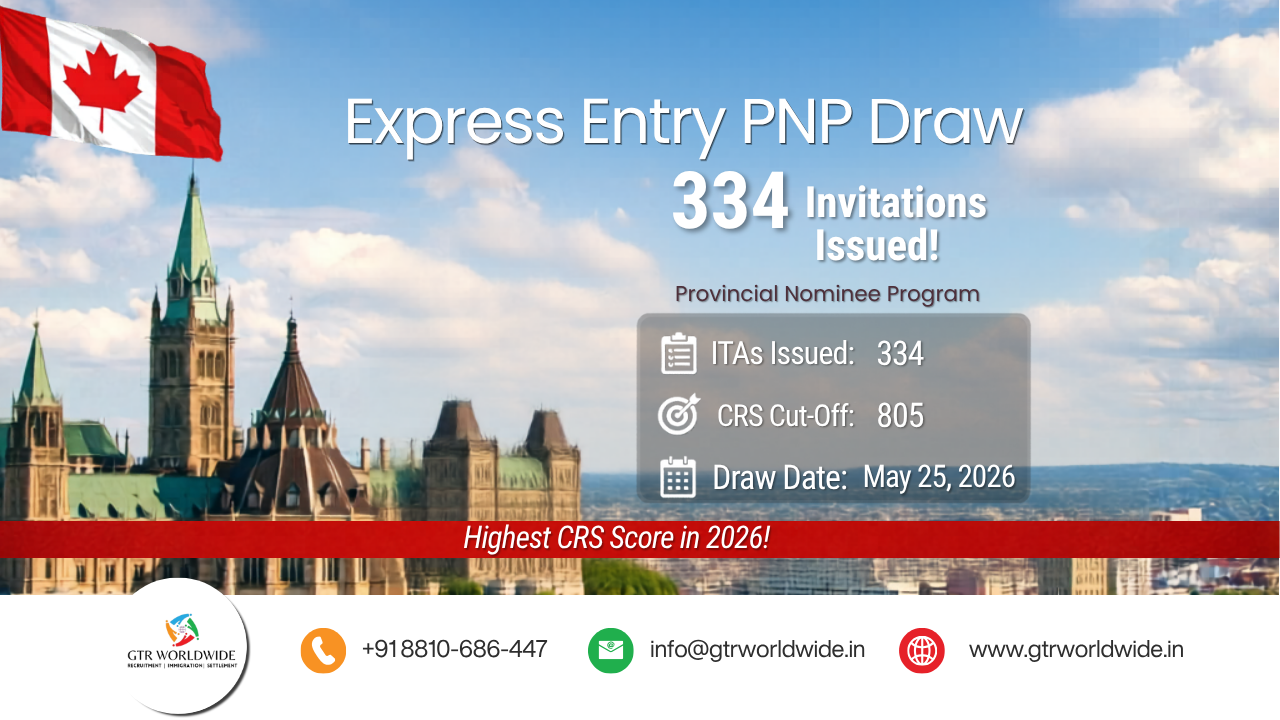
    Canada has issued 334 Invitations to Apply (ITAs) in its latest Express Entry draw targeting Provincial Nominee Program (PNP) candidates. The draw was held on May 25, 2026, with a minimum CRS score requirement of 805 — the highest PNP cut-off recorded in 2026 so far.

    Latest Express Entry Draw Results

    Draw TypeITAs IssuedCRS Cut-OffDraw Date
    Provincial Nominee Program (PNP)334805May 25, 2026

    The draw marks Canada’s second consecutive PNP-focused Express Entry round in May 2026. Immigration experts say this reflects the growing importance of provincial immigration pathways in Canada’s long-term immigration strategy.

    Provincial Immigration Becoming More Important

    Canada continues shifting toward province-led immigration selection. Candidates nominated through a Provincial Nominee Program receive an additional 600 CRS points, significantly increasing their chances of obtaining permanent residency.

    The federal government has already announced increased provincial immigration targets for 2026 and 2027, with provinces receiving larger nomination allocations to address labour shortages across healthcare, construction, skilled trades, and regional communities.

    IRCC Backlog Reaches Lowest Level in Years

    Immigration, Refugees and Citizenship Canada (IRCC) recently reported that the Express Entry application backlog has dropped to one of its lowest levels in recent years. As of March 31, 2026, the immigration backlog declined to approximately 935,000 applications, improving processing efficiency for many economic immigration categories.

    PEI Conducts New PNP Draw

    Prince Edward Island also held a new Labour & Express Entry draw this week, issuing 114 invitations to skilled workers and international graduates under the PEI Provincial Nominee Program.

    Key Canada Immigration Trends in 2026

    Canada’s immigration system in 2026 is increasingly focused on:

    • Provincial Nominee Programs (PNPs)
    • Healthcare professionals
    • Skilled trades workers
    • Regional immigration pathways
    • Employer-driven immigration
    • Faster permanent residency pathways for workers already in Canada

    Recent Express Entry draws also show continued emphasis on category-based selection and targeted invitations aligned with labour market needs.

    Conclusion

    Today’s immigration updates confirm that Canada is continuing its transition toward a more targeted and province-focused immigration system in 2026. With new PNP draws, rising CRS scores, and increased provincial allocations, skilled workers with provincial nominations remain among the strongest candidates for Canadian permanent residency.

    As provinces take on a larger role in immigration selection, candidates in high-demand occupations such as healthcare, construction, trades, and education are expected to benefit the most from Canada’s evolving immigration policies.

  • Canada Increasing Provincial Immigration Targets for 2026 and 2027

    Canada Increasing Provincial Immigration Targets for 2026 and 2027

    Canada is significantly expanding its Provincial Nominee Program (PNP) targets for 2026 and 2027, reinforcing the growing role provinces and territories play in selecting skilled immigrants to meet regional labour market demands.

    Under Canada’s latest Immigration Levels Plan, the federal government has increased the Provincial Nominee Program admissions target to 91,500 permanent residents in 2026, compared to 55,000 admissions targeted previously. This marks one of the largest increases ever announced for provincial immigration programs.

    Provincial Immigration Targets Rising Sharply

    The federal government’s new immigration strategy places greater emphasis on economic immigration through provincial pathways rather than relying solely on federal Express Entry programs.

    Provincial Nominee Program Targets

    YearPNP Admissions Target
    202555,000
    202691,500
    202792,500

    The increase represents approximately a 66% rise in provincial immigration admissions for 2026 compared to previous targets.

    Why Canada Is Expanding Provincial Immigration

    The expansion reflects Canada’s efforts to address:

    • Labour shortages across provinces
    • Regional economic development
    • Healthcare staffing gaps
    • Skilled trades shortages
    • Population growth outside major cities
    • Rural and northern workforce demands

    Provincial governments are considered better positioned to identify local labour market needs and nominate immigrants with skills that match regional economic priorities.

    The federal government has stated that provinces will continue to play a critical role in supporting nation-building projects and economic growth through targeted immigration selection.

    Provinces Receiving Higher Allocations

    Several provinces have already announced increased nomination allocations for 2026.

    Province2026 AllocationIncrease Compared to 2025
    Ontario14,11931.3%
    Alberta6,40331.3%
    Manitoba6,23931.3%
    British Columbia5,25431.3%
    Saskatchewan4,76131.3%

    Additional provinces and territories are also expected to receive expanded allocations as Canada shifts more immigration authority toward provincial programs.

    Greater Focus on Targeted Immigration

    The expanded PNP targets indicate Canada is increasingly prioritizing:

    • Healthcare professionals
    • Construction workers
    • Early childhood educators
    • Engineers and tech workers
    • Skilled tradespeople
    • Rural and regional immigrants
    • Workers already living in Canada

    Many provinces are now conducting sector-specific draws targeting occupations experiencing severe labour shortages.

    Impact on Express Entry Candidates

    The increased provincial allocations are expected to make Provincial Nominee Programs one of the strongest pathways to Canadian permanent residency in 2026 and 2027.

    Candidates nominated through a provincial program receive an additional 600 CRS points under Express Entry, significantly improving their chances of receiving an Invitation to Apply for permanent residence. Recent PNP-only Express Entry draws have continued throughout 2026 with high CRS cut-offs due to strong demand.

    Immigration experts believe the growing emphasis on provincial immigration shows Canada is moving toward a more targeted and region-driven immigration system.

    Conclusion

    Canada’s decision to significantly increase Provincial Nominee Program targets for 2026 and 2027 highlights the rising importance of provincial immigration pathways in the country’s long-term economic strategy. With admissions targets increasing to more than 91,000 annually, provinces will gain greater ability to attract skilled workers tailored to their labour market needs.

    For immigration candidates, the expanded allocations create stronger opportunities through provincial streams, particularly for workers in healthcare, skilled trades, construction, education, and other high-demand sectors. As Canada continues shifting toward targeted and regional immigration selection, Provincial Nominee Programs are expected to remain one of the most important pathways to Canadian permanent residency in the coming years.